

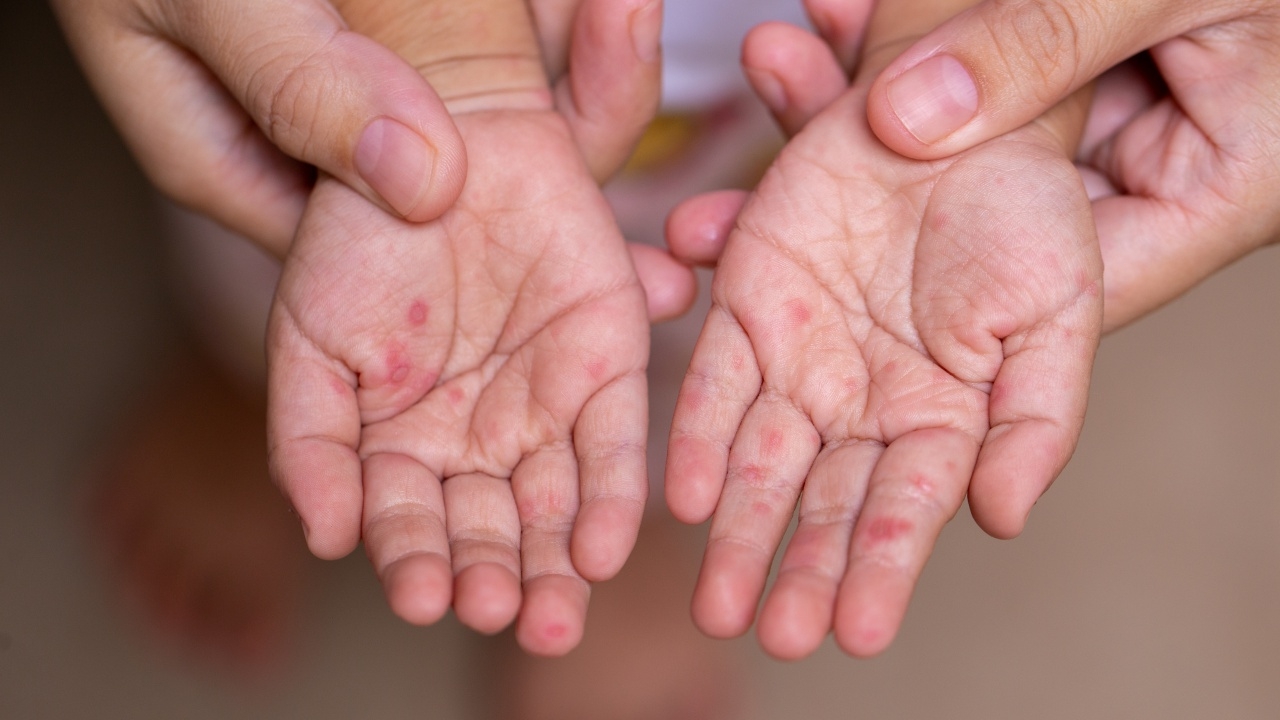
The Department of Disease Control warns "Hand, Foot, and Mouth Disease" is beginning to spread with the start of the rainy season school term. Check for risk symptoms and advise parents and schools to increase surveillance in young children.
On 29 June 2026, Dr. Montien Kanasawat, Director-General of the Department of Disease Control, stated that data from the Digital Disease Surveillance System (DDS) of the Epidemiology Division showed that from 1 January to 25 June 2026, there have been a cumulative total of 16,332 hand, foot, and mouth disease cases with no reported deaths. The number of cases this year remains lower than the same period last year.
Children aged 0–4 years represent the largest group of patients, followed by those aged 5–9 years and 10–14 years, respectively. The northern region currently has the highest incidence rate. Surveillance in cooperation with partner agencies through random laboratory testing in 2026 found Coxsackievirus A16 (36.36%) as the predominant strain, while the more severe Enterovirus 71 (EV71) strain, though less common, cannot be overlooked.
"Based on statistics from the past 10 years (2015–2025), hand, foot, and mouth disease cases tend to rise during the rainy season, especially from June to August annually. We are now entering the increasing phase of this seasonal outbreak cycle. Therefore, teachers, parents, and caregivers are urged to closely monitor children’s symptoms.
If a child has a fever along with mouth ulcers or red spots in the mouth, such as on the tongue, palate, or cheeks, and has rashes or clear blisters on the palms, soles, torso, or buttocks, and if the child is irritable, refuses to eat or drink milk, drools, or complains of mouth pain, hand, foot, and mouth disease should be suspected. In severe cases with high fever, very little food or water intake, lethargy, seizures, vomiting, or difficulty breathing, immediate medical attention is necessary as these could be warning signs of encephalitis or myocarditis, which can be life-threatening," said the Director-General.
Dr. Direk Khampan, Deputy Director-General of the Department of Disease Control, provided prevention advice for schools and childcare centers as follows:
1) Educational staff should strictly screen children every morning. If a child is found to be sick, such as having a fever, blisters on hands or feet, or mouth ulcers, they should be immediately separated from other children, and parents should be notified to take the child home and keep them out of school until fully recovered.
2) If two or more children in the same classroom fall ill within one week, that classroom must be closed for at least one day for cleaning, and intensified monitoring of sick children should continue for an additional week.
3) Clean children's toys, utensils, and classroom surfaces regularly using appropriate cleaning agents such as detergent, dish soap, soap, disinfectants, or chlorine solutions like bleach diluted according to recommended ratios.
. (This part is a fragment and repeats 'appropriate' — no additional content.)
4) Promote proper hygiene behaviors among children and caregivers, emphasizing regular and correct handwashing with soap and clean water, especially before eating, after using the toilet, and after contact with nasal mucus, saliva, or bodily fluids. The virus spreads through contact with nasal mucus, saliva, fluid from blisters, stool of infected persons, as well as contaminated toys, utensils, or surfaces. For more information, contact the Department of Disease Control hotline at 1422.