

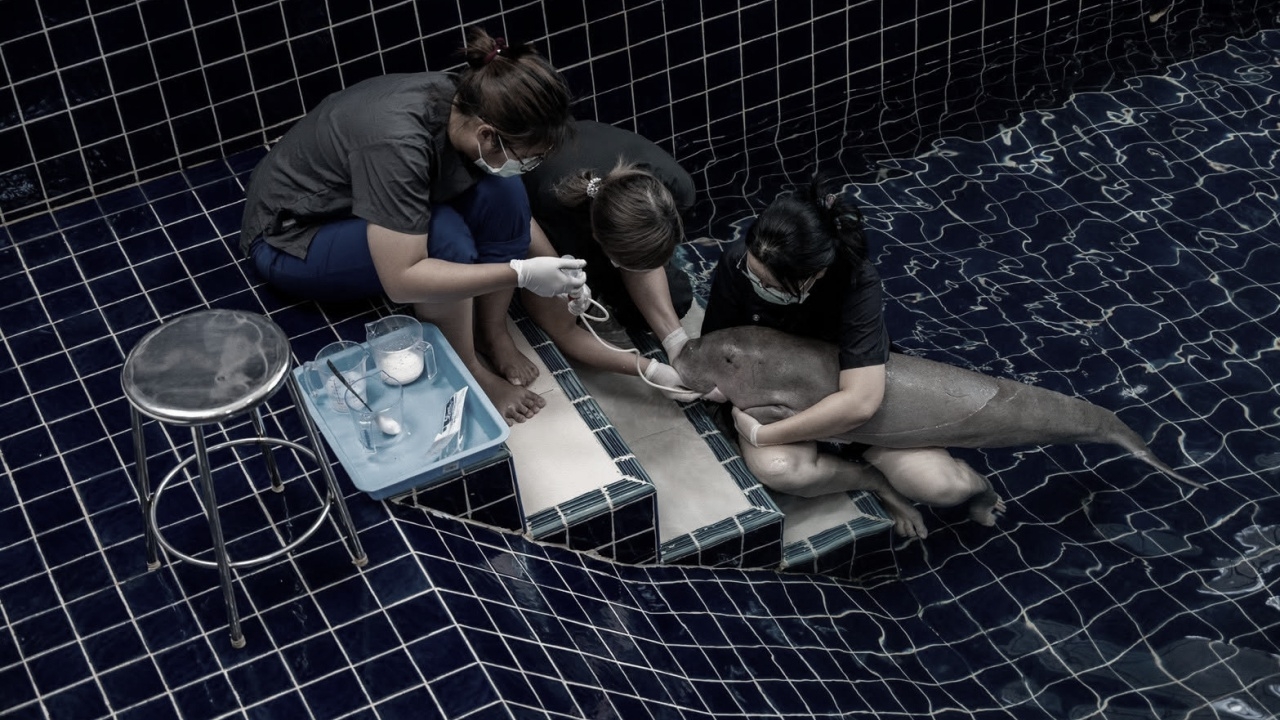
A young dugong that was separated from its group and stranded on Laem Son Beach in Ranong Province has died. The Minister of Natural Resources and Environment has ordered an urgent autopsy to determine the cause of death and called for enhanced efforts to rescue rare marine animals.
On 7 July 2026, the Facebook pageof the Department of Marine and Coastal Resourcesposted a statement saying that Mr. Suchat Chomklin, Minister of Natural Resources and Environment, expressed his condolences over the loss of the male young dugong that became separated from its group and died during treatment. Although officials and veterinary teams from the Department of Marine and Coastal Resources provided full assistance, he instructed an expedited autopsy to determine the cause of death to use the information to improve conservation and rescue efforts for rare marine animals in the future.
Dr. Pinsak Suraswadi, Director-General of the Department of Marine and Coastal Resources, revealed that on 5 July 2026, they received a report of a male young dugong measuring 112 cm long and weighing 25 kg stranded at Laem Son Beach, Ranong Province. Local villagers helped rescue the animal and handed it over to Laem Son National Park officials. Initial examination showed small wounds on its body and head, presumed caused by separation and being swept ashore by currents. Officials provided first aid and transferred it to the Siritharn Rare Marine Animal Rescue Center of the Department of Marine and Coastal Resources in Phuket for further care.

Throughout the treatment period, staff from the Siritharn Rare Marine Animal Rescue Center, part of the Upper Andaman Marine and Coastal Resources Research Center, along with volunteers, took turns monitoring and caring for the young dugong around the clock. Health checks showed the body condition was normal but somewhat thin (Body condition score 2.5/5). Externally, bruises were visible on one side of its body.
These bruises were likely caused by stranding. The heart rate averaged 80–100 beats per minute, varying with dugong behavior. Resting respiratory rate averaged 1–3 breaths per 5 minutes, increasing to 4–5 breaths per 5 minutes when swimming. Tests found low blood sugar and moderate to severe dehydration. Digestive function showed bloating with significant gas accumulation, due to the dugong not eating for a prolonged period.

Despite the veterinary team’s full efforts to treat it, the young dugong went into shock. The team performed emergency CPR and administered stimulants to save its life but were unable to revive it, and it died shortly afterward.
An in-depth autopsy to determine the exact cause of death is underway. The results will be used to develop knowledge and guidelines for rescuing rare marine animals to improve their survival chances in future incidents. The ministry also continues to advance conservation and restoration measures for Thailand’s dugong population.
Information from the Facebook page of the Department of Marine and Coastal Resources