

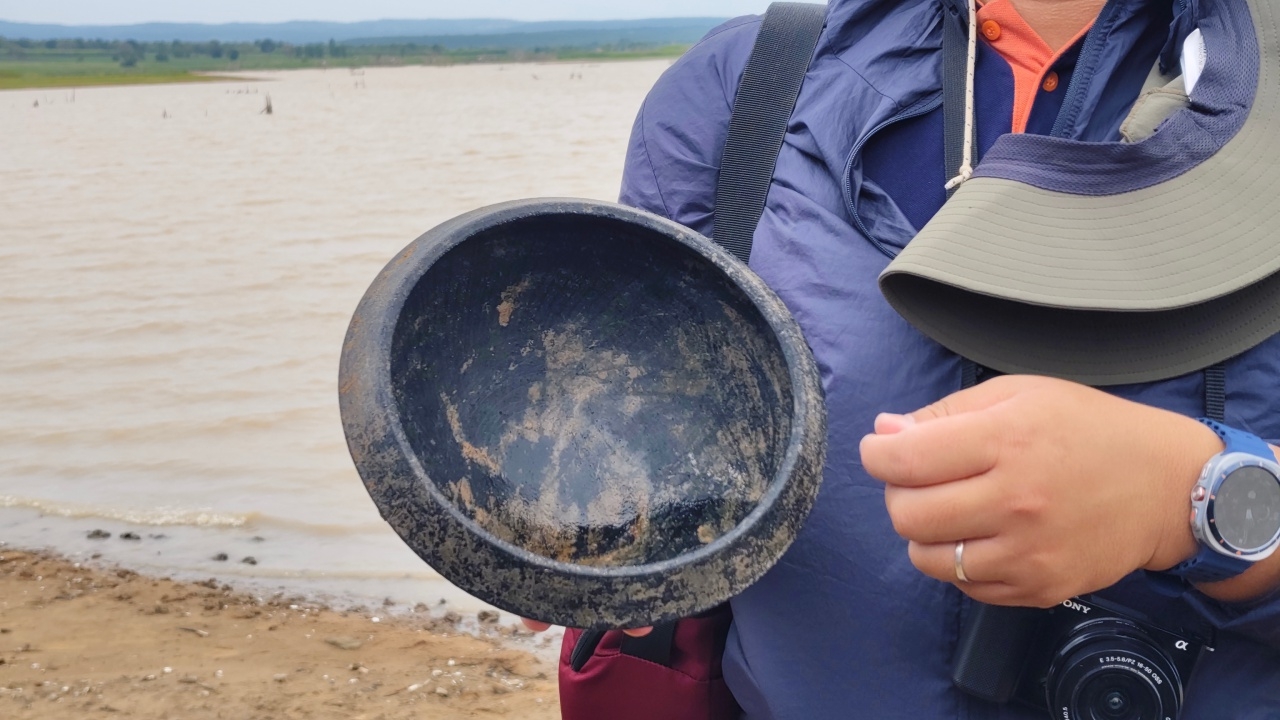
The Department of Fine Arts has discovered an intact Phimai black pottery vessel approximately 2,500 years old in the middle of the Mun Bon Dam in Nakhon Ratchasima, along with human skeletons and numerous ancient artifacts.
At 10:30 a.m. on 9 July 2026, officials from the 10th Fine Arts Office in Nakhon Ratchasima, led by Ms. Patra Chaopratchayakul, head of the Mahaweerawong National Museum, and Mr. Wannapong Palakawong Na Ayudhya, an experienced archaeologist from the same office, along with their team, traveled to inspect a site where villagers had found human skeletons and numerous pottery fragments. The location is in the middle of the Mun Bon Dam area, at Ban Taling Chan, Village No. 9, Chorakhe Hin Subdistrict, Khonburi District, Nakhon Ratchasima Province. This archaeological site was later named Mun Bon Dam 1 after water levels in the dam had steadily decreased.
Upon arrival, officials initially found intact Phimai black pottery vessels resembling bowls or basins, dating from about 1,500 to 2,500 years ago, with a diameter of approximately 15 cm, alongside numerous human bone fragments.

In addition, they discovered contemporaneous archaeological evidence including several scattered orange glass beads, iron tools, pottery shards, polished stone axes, and pottery vessels buried as offerings with the human skeletons.

Officials preliminarily believe this site to be an ancient burial mound from the Late Prehistoric cultural period, characterized as a raised earth mound near the river. This represents the closest ancient civilization site ever found near the Mun River’s source.

Mr. Wannapong Palakawong Na Ayudhya explained that this site shows traces of an earth mound burial from the Late Prehistoric period. The special aspect of Mun Bon Dam 1 is the discovery of fully intact Phimai black pottery vessels, which is rare since usually only fragments are found. This allows for a reasonably precise dating to the Late Prehistoric Iron Age, approximately 2,500 to 1,500 years ago.

He added that this type of pottery is distributed throughout the upper Mun River basin, but it was unexpected to find such a large site so close to the river’s source. The mound is large and shows clear burial traces. Future academic studies could provide valuable insights into human history in Khonburi, as previous surveys found smaller points at locations like Sa Wan Phraya and Lam Phiek Subdistricts.
However, it is believed there are likely more such sites. Combining all data suggests these points share a contemporaneous timeline, corresponding to the Late Prehistoric period.