

New coordinates: "Gray Chinese capital" expands base, seizing "Port City" as new hub for call center gangs.
An in-depth mission by SEE TRUE, through Thairath News Show's team, tracks the global cybercrime and call center scam network known as "gray Chinese capital." After exposing the King's Roman empire in the Special Economic Zone of the Golden Triangle in northern Laos, new insights reveal this network has fractured and expanded southward, establishing a base in "Port City," Kham Muang Province, Laos, opposite Nakhon Phanom Province, Thailand.
Investigations show these criminals continue deceiving victims via online platforms, using attractive profiles to recruit them for backend stock account system jobs with salaries of 20,000–30,000 baht, requiring computer use. Ultimately, recruits are forced into scammer gangs operating in neighboring countries.
Mekong riverside strategy as scammer gangs splinter.
Professor Songrit Phonngern, an expert on the Mekong region, noted this network is large and has previously caused violence in Kham Muang Province. Heavy crackdowns along the Thai-Cambodia and Thai-Myanmar borders, such as areas around KK Park and Shwe Kok Ko, have forced the gray Chinese capital group to seek new locations to continue cybercrime businesses. Port City has thus become the new strategic Mekong riverside base.
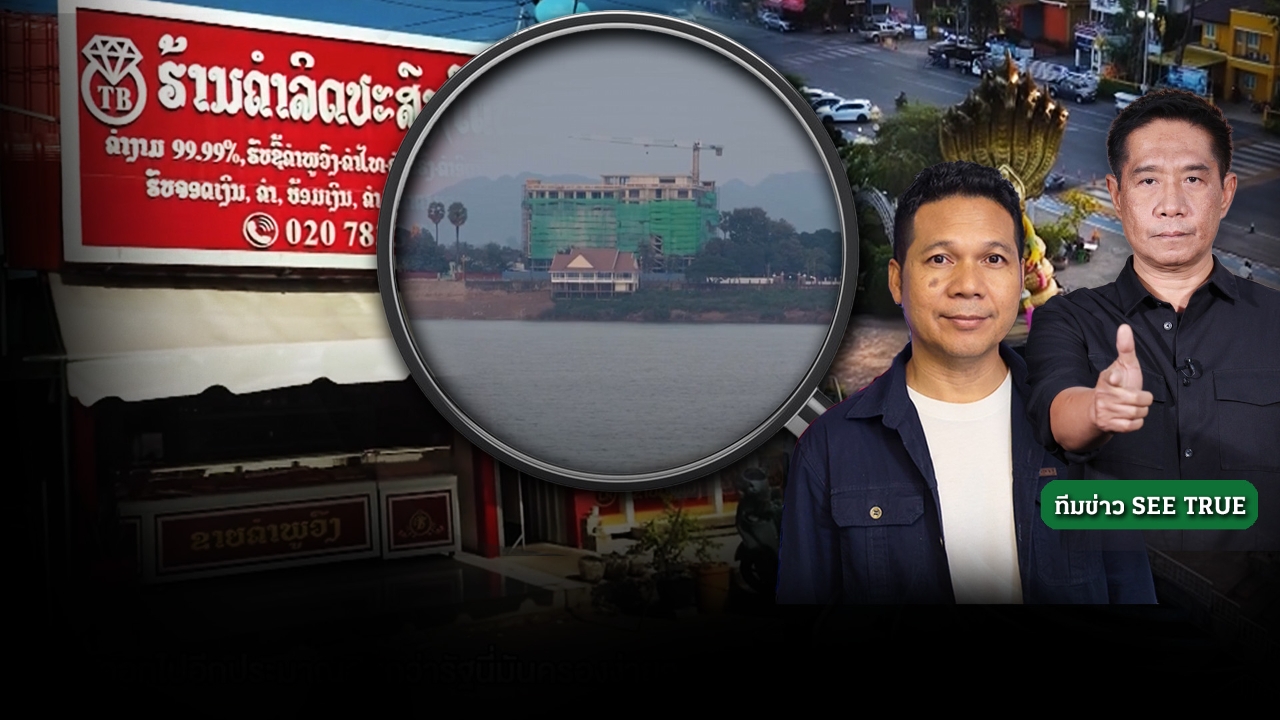
From the Thai side, large buildings about 10 stories high wrapped in green mesh are visible. Local sources explain this area is near Lao government offices and Chinese restaurants. It is a concession area controlled by Zhao Wei, the King's Roman boss, to build a comprehensive entertainment complex including entertainment venues, shopping centers, and casinos catering to Chinese visitors. An old prison has been demolished to accelerate ongoing infrastructure construction.
Industrial capital, potash mining, and shifting culture.
The news team surveyed deeper into Ban Dong Tai, an industrial area where Chinese capital holds a potash mining concession in Laos. Physical changes are clear: roads lined with Chinese signs and KTV entertainment venues. Factory layouts are systematic, with buildings and employee housing. Security and most staff are Chinese, with only a small number of Lao workers.
Additionally, Chinese capital is rapidly expanding into the local economy. A Lao taxi driver reported that Chinese individuals are engaging in business activities, money laundering, and marrying local women to use them as nominees to hold property.
The influence of these groups is transforming the traditional cultural context along the Mekong riverside. As a neighboring country, Thailand inevitably faces impacts from cybercrime networks and related security threats.
Related news series: "Thai Graves Under the Shadow of Chinese Capital"