

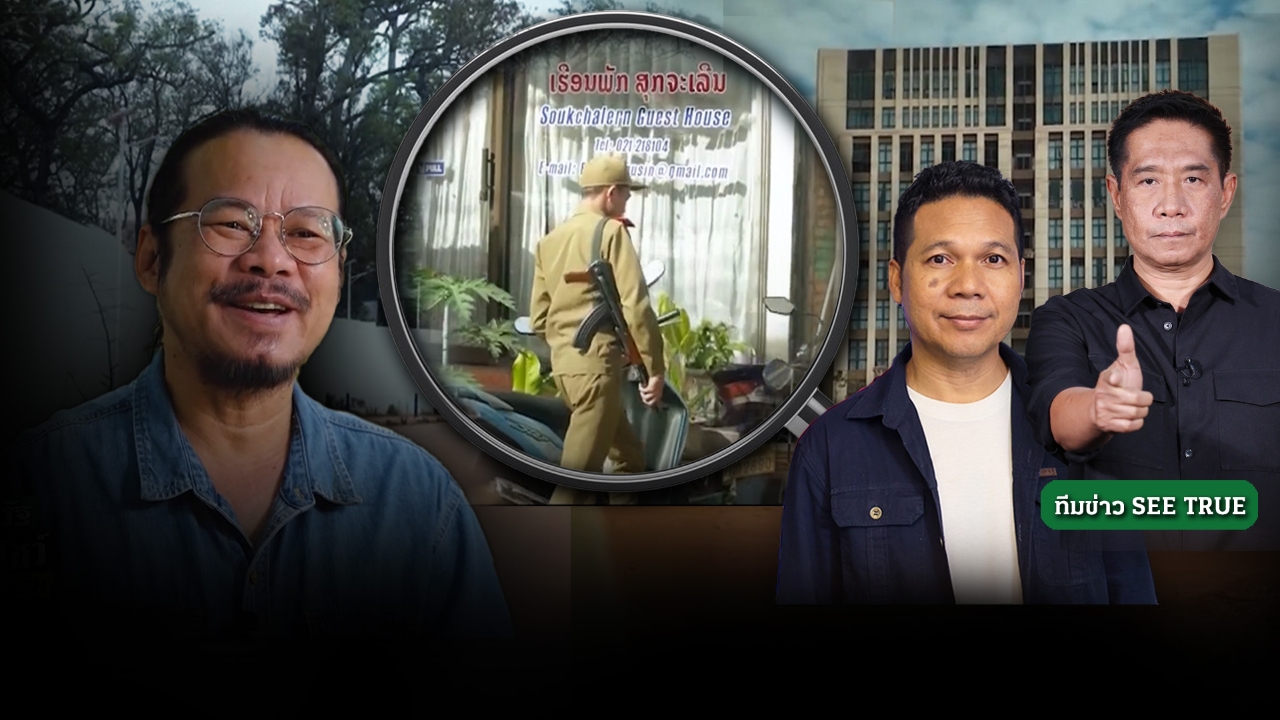
Tracing the "Gray Chinese Capital" as it relocates its base to "Vientiane".
The SEE TRUE news team of Thairath News Show continues its intensive investigation into the global scam call center network linked to "Gray Chinese Capital." After uncovering their presence in the border town of Thakhek, sources have now pointed to a new stronghold where cybercriminal groups have fled crackdown efforts in Cambodia and Myanmar — the capital city of Laos, Vientiane.
A key lead emerged early this year when the Nong Khai immigration investigation team discovered the illegal installation of three "Simbox" devices comprising over 96 SIM cards hidden in the ceiling of a dormitory in Nong Khai province. These devices relay phone signals over the internet to deceive victims, ultimately connecting to scammer operations across the border in Laos.
Revealing the location: "Kilometer 16" — a full-service scammer hub.
The SEE TRUE news team crossed the First Thai-Lao Friendship Bridge to investigate a suspicious site near Kilometer 16, close to the Laos National Stadium — a facility previously built by China for Laos. On-site inspection found a roughly 10-story building with closed curtains, signal antennas installed on the rooftop, and tight security monitoring every outside movement. Chinese nationals were observed living and working inside, treating it as a private compound.
This aligns with information from Joseph Akarawong, a Laotian political refugee, and Dr. Songrit Phon-ngern, an expert on Mekong region countries. They confirmed that the area around the stadium and Sangjiang international commercial district in Sisaket province has transformed into a large Chinatown, where Chinese language is dominant, money laundering occurs, and marriages to local women are used to create nominees. These buildings are linked to gray Chinese capital groups leasing space to run cyber businesses.
Behind the scenes of the personal data trafficking gang leaking 10 million names, sorted and sold to call center gangs.
The scammers’ key weapon is "Thai personal data." Recently, the Anti-Corruption and Misconduct Prevention Division (ACMPD) expanded its crackdown by arresting suspects in a major data trafficking network in Aranyaprathet district, Sa Kaeo province. They discovered a database of Thai citizens’ names for sale stored on computers totaling 9.6 million records.
Pol. Lt. Gen. Jiraphop Phuridej and the investigation team reported these names are "premium quality" data, with detailed information including age and job positions. For example, if the victim is a teacher, the data specifies which school and subject they teach. This allows call center gangs to craft believable stories tailored to victims. Prices range from 3 to 10 baht per name, depending on financial capacity. Since 2022, over 1,050 victims have been reported, with total losses reaching 354 million baht.
The threat from gray Chinese capital near the Thai border and the trafficking of personal data is a hidden wave eroding citizens’ security. Government agencies are urgently developing applications and web platforms for the public to check leaked data groups and proactively protect themselves.
Related news series: "Thai Graves Under the Shadow of Chinese Capital"