

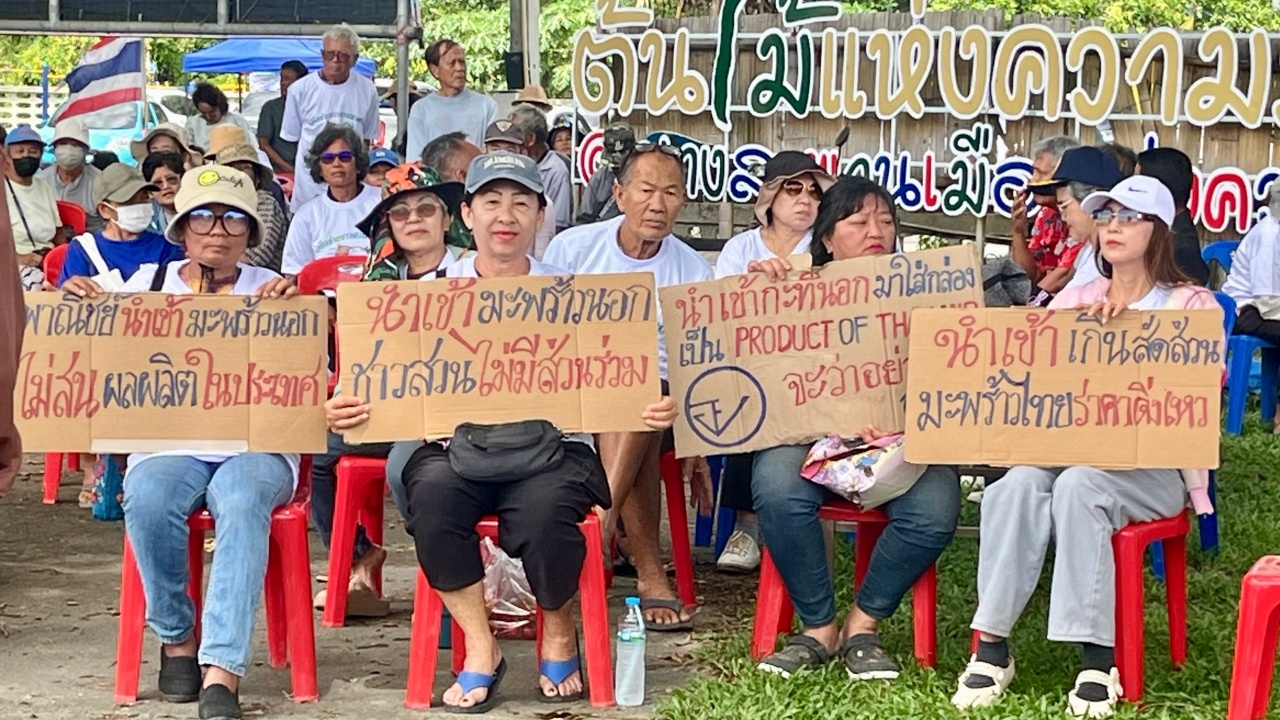
In Prachuap Khiri Khan, the Bang Saphan coconut farmers' protest demanded answers from three agencies amidst the absence of Commerce Minister Supajee and the Agriculture Ministry. The FDA sent its deputy secretary to clarify issues after being linked to the allocation of import quotas for coconut milk and products, affirming no involvement whatsoever.
On 15 July 2026, reporters reported that at around 11:30 a.m. on 14 July 2026, at the rain tree plaza near Bang Saphan District Office in Prachuap Khiri Khan, Mr. Pongsak Butrak, leader of the Prachuap Khiri Khan coconut farmers network, gathered over 400 coconut farmers to demand answers from three agencies: the Ministry of Commerce, Ministry of Agriculture, and the Food and Drug Administration (FDA). This followed a letter submitted on 7 July requesting these agencies to explain the ongoing domestic coconut price decline persisting for over four months to the farmers at 2 p.m. that day. However, no representatives from the Commerce or Agriculture Ministries appeared.

At around 12:00 p.m., Mr. Nimit Wongjinda, Bang Saphan District Chief, met with the protest leaders and participants, informing them that the FDA deputy secretary would come at about 2:00 p.m. to talk with the group. The protesters then moved to the Bang Saphan District auditorium to await the agency's response. While waiting for the FDA representative, a panel discussion was held to address the issues and seek ways to promote a National Coconut Committee to oversee the entire coconut system. The panel included representatives of coconut farmers from Thap Sakae and Bang Saphan districts, a former agricultural officer from Bang Saphan Noi, Democratic Party representatives, Mr. Sitthipol Viboonthanakul, a party-list MP and commerce working group member from the People's Party, and Dr. Decharat Sukkamned, opposition leader spokesperson from the People's Party.

The panel concluded unanimously that to ensure coconut prices are sufficient for farmers' livelihood, a National Coconut Act is necessary to promote coconut as an economic crop. Additionally, a National Coconut Committee must be established, including true farmer representatives, coconut traders, and representatives from coconut product factories, to oversee the entire coconut supply chain—from farmers at the origin to processed products leaving factories.
At 2:00 p.m., Dr. Pichet Phuedkhuntod, deputy secretary-general of the FDA, arrived with his team and responded to the letter submitted by the coconut farmers to the FDA secretary last week.

Dr. Pichet stated that the FDA's role regarding coconut imports is to inspect the quality of imported coconut milk and frozen coconut milk from abroad to ensure they meet FDA standards for maximum consumer safety. Importers can apply under the Food and Drug Act, Section 15, and the FDA inspects the quality of imports to ensure compliance and absence of contamination. However, the FDA has no involvement whatsoever in import quantities or quota allocations. He urged farmers to understand this clearly.
Mr. Pongsak Butrak, leader of the Prachuap Khiri Khan coconut farmers network, said that the farmers had gathered to hear responses from the three agencies addressed in their letter last week. He thanked the FDA for sending its deputy secretary to explain the facts about imported coconut milk and frozen coconut milk. Previously, when he asked about control or import quantity information, the Ministry of Commerce directed him to the FDA regarding regulations and import volumes, which created the impression that the FDA managed import quotas.
On that day, the FDA deputy secretary clarified to the farmers that the FDA has no role or responsibility in setting import quotas for coconut milk and frozen coconut milk.
Another observation today, reviewing import volumes of coconut milk and frozen coconut milk shows that in 2025, 44,208.955 tons of ready-to-use coconut milk were imported, equivalent to 117.15 million coconuts, and 17,257.805 tons of frozen coconut milk, equivalent to 39.90 million coconuts—exceeding factory demand. Consequently, in the past year, 111.42 million coconuts remained unsold. In 2026, rainfall was good, similar to 2024, which caused prices to drop in 2025. Coconut product industries bought coconuts cheaply, raising concerns that without government controls on all coconut imports, prices next year may fall even lower than this year.

Regarding efforts to urge the government to resolve coconut price problems, the leaders plan to meet soon to set the farmers' next movement strategy. Ultimately, they aim to promote coconut as an economic crop and seek government price controls by designating coconut as a controlled commodity. They also want to push for a National Coconut Act and a National Coconut Committee comprising representatives from all sectors and all coconut-producing provinces to oversee and manage the entire coconut system, Mr. Pongsak said.
Reporters added that the protest atmosphere was peaceful, with over 400 coconut farmers participating—more than twice last week's number. After Dr. Pichet Phuedkhuntod, FDA deputy secretary-general, and Mr. Pongsak Butrak, network leader, finished the explanation, a memorandum of understanding (MOU) was signed between the FDA and the coconut farmers' network. The agreement commits to jointly oversee and disclose information accessible to the network within their authority. The FDA will also promote regulations requiring producers to specify raw material origins so consumers can know the country source of the product's ingredients.