

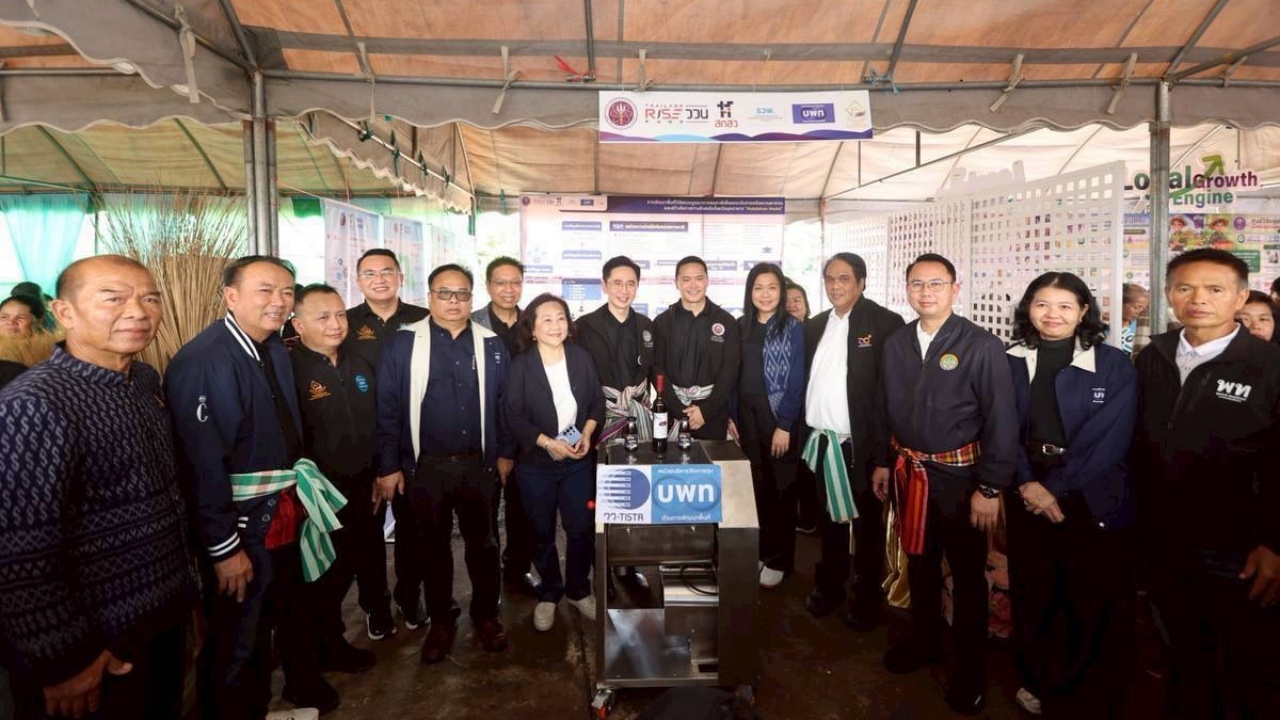
Prof. Dr. Yoschanan moves forward in Yasothon province, launching a comprehensive poverty alleviation initiative. He promotes an AI platform to extensively identify overlooked poor individuals, integrating them into processes that enhance skills and generate income. The plan aims for nationwide expansion and includes strategies to eliminate poverty and improve livelihood capital across five key areas.
On 19 July 2026, Prof. Dr. Yoschanan Wongsawat, Deputy Prime Minister and Minister of Higher Education, Science, Research and Innovation (MHESI), addressed a meeting of the development partners network in Kut Chum district, Yasothon province. The gathering took place near Wat Pa Phutthikhun, Nong Nae subdistrict, Kut Chum district, and included Yasothon Governor Chanchai Sorsrichai, Community College Council President Sirikorn Maneerin, Yasothon Community College Director Chuchart Kaewnok, provincial executives, MHESI officials, as well as representatives from the Ministry of Social Development and Human Security, Ministry of Agriculture and Cooperatives, and local residents. He expressed confidence in committing full support to eradicate poverty among the people, using knowledge from research, science, and innovation as key tools.
“I will prioritize solving poverty comprehensively by addressing five types of livelihood capital: human, physical, natural, economic, and social capital. This will rely on the knowledge from a research project aimed at precise and comprehensive poverty alleviation, which the Area-based Capital Management Unit (ACMU) has been conducting jointly with several universities continuously for over seven years, covering 20 pilot provinces across all regions of the country.”
The Deputy Prime Minister and MHESI Minister added that the poverty alleviation research, led by ACMU in collaboration with multiple universities in 20 pilot provinces, operates through a process starting with detailed identification and verification of poor people’s data. This information is then used to design poverty reduction models tailored to the social and geographic context of each area, based on the participation of the poor themselves and local partner networks. The approach has proven successful in helping poor people gain stable occupations, increase income, and improve living conditions. The model is planned to be promoted as a standard for poverty reduction across all provinces nationwide.
“The successes and effective poverty alleviation models from the 20 pilot provinces will be carefully analyzed to extract the best practices. These will be shared and expanded to other provinces nationwide, ensuring that all citizens benefit quickly within one year without delays. Where any model shows good progress, we will hand it over to the respective provincial governors and the Ministry of Interior to continue implementation, enabling sustainable budgeting and development.”
Prof. Dr. Yoschanan also emphasized empirical evidence he personally observed during field visits at two key locations. First, visiting the household of Mrs. Buaphan Upphan, 72, living in a deteriorated and unsafe house prone to flooding during the rainy season. The poverty alleviation research project by ACMU, Yasothon Community College, and partner networks coordinated with the Community Organization Council and the Community Development Office of the Ministry of Social Development and Human Security to assist in repairing and upgrading the home with new concrete flooring, roof, doors, and windows to meet sanitary and safety standards, ensuring secure living conditions.
Second, he visited the “Organic Agriculture Cooperative Learning Center” at Ban Nong Nae, Nong Nae subdistrict, Kut Chum district. The center utilizes a 30-rai communal plot owned by Mr. Prinya Meechai as shared farmland for the community. Thirty poor households benefit from this cooperative plot, focusing on linking “people, knowledge, resources, and markets” through field developers (ADM) who closely coach participants. This is supported by production inputs and technology from academic institutions such as Yasothon Community College and the Thailand Institute of Scientific and Technological Research (TISTR), which introduced innovations like bio-products and organic fertilizers to reduce constraints, thereby enhancing supplemental income and self-reliance skills for poor households.
Prof. Dr. Yoschanan stated that the poverty alleviation research conducted by ACMU in partnership with university networks and local stakeholders has transformed assistance from temporary relief to a participatory research process. It integrates intelligent information systems and AI technology to extensively identify overlooked poor individuals. Since 2020, this approach has enabled more than 7,663 poor people with livelihood capital deficiencies to enter skill upgrading processes, generating over 2.17 million baht in additional income. It has also coordinated networks to reduce debt and provide targeted scholarships to beneficiaries.
“I have visited many provinces, including Udon Thani, Kalasin, Nakhon Ratchasima, Nakhon Phanom, Roi Et, and now Yasothon. My sincere intention is to use knowledge from research, science, and innovation to solve poverty and to accelerate the implementation of welfare systems so that people can improve their quality of life, access education, secure employment, and have safe housing. As the official responsible for human capital, I will do my utmost to integrate efforts across the system to develop human capital comprehensively and to eradicate intergenerational poverty thoroughly.”
The Deputy Prime Minister and MHESI Minister explained that they use a database to analyze the causes of poverty through a cooperation mechanism via the PPAP platform, an extension of TPMAP. When individuals who have ‘fallen through the cracks’ in the system are identified, immediate assistance is provided. This assistance is divided into two parts: promoting occupations through poverty alleviation models and connecting people to state welfare systems. If any data are incomplete, local community colleges and Rajabhat universities take the lead in collecting full information from the field.
Additionally, poverty analysis based on five livelihood capitals, especially human capital, reveals that many vulnerable groups and elderly people lack income-generating occupational skills. Therefore, technology and localized research are applied to enhance skills tailored to each household’s needs. This enables citizens, particularly the elderly, to work with less effort and lower costs but maintain or increase income. Regarding physical capital such as lack of farmland, he expressed appreciation for areas that allocate communal land for the community to farm together, marking a good start and a practical solution.

Dr. Kitti Satchawatan, Director of the Area-based Capital Management Unit (ACMU) under the Office of Research and Innovation Promotion for Competitiveness and Area Development (ORIPCAD), Ministry of Higher Education, Science, Research and Innovation (MHESI), said it is very encouraging that Deputy Prime Minister Prof. Dr. Yoschanan has taken responsibility to extend and expand the benefits of the poverty alleviation research project. This involves linking with related ministries responsible for human capital under his oversight, including MHESI, Ministry of Social Development and Human Security, Ministry of Labor, Ministry of Education, and Ministry of Agriculture and Cooperatives. This will facilitate easier and more flexible access for the poor to state welfare services.
“Expanding the poverty alleviation research results and models from 20 pilot provinces nationwide, as intended by the Deputy Prime Minister and MHESI Minister, will greatly benefit the quality of life of the poor and the nation. However, this requires cooperation from all sectors and sustained, serious efforts. Most importantly, mechanisms at community and local levels must be strong and collaborative. Ultimately, poverty is not just a structural problem; people must be given opportunities in education and income enhancement to enable them to stand on their own and feel socially valued.”
Going forward, the Area-based Capital Management Unit (ACMU) will collaborate with the National Higher Education, Science, Research and Innovation Policy Council (NXPO) under MHESI, and with support from the Science, Research and Innovation Promotion Fund, to work with the Ministry of Social Development and Human Security (MSDHS), university networks, and all partners. This aims to enhance assistance coverage for targeted poor populations in the 20 pilot provinces and to expand adoption of the poverty alleviation platform and models to other interested provinces, creating sustainable security and reducing social inequality nationwide in a concrete manner.