

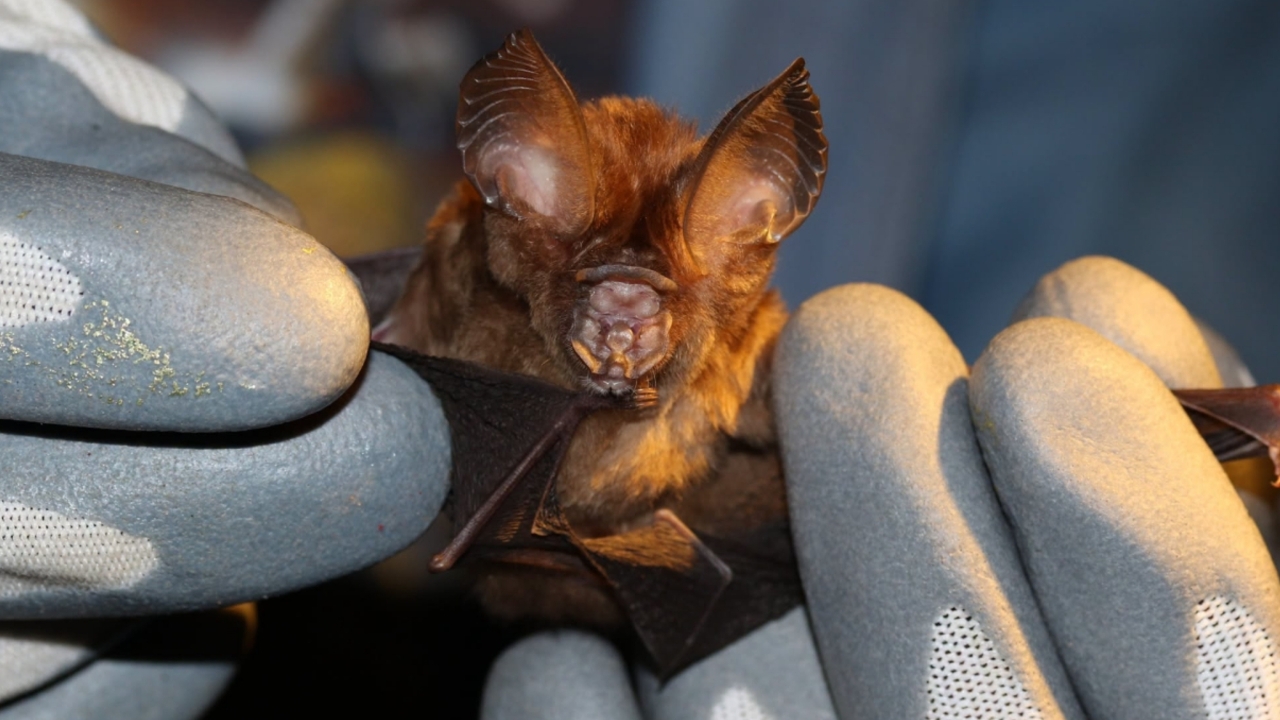
A Forest Department research team discovered the Hipposideros rotalis bat for the first time in Thailand at Hin Sam Wan in Bueng Kan Province.
On 25 Jul 2026, it was reported that the fan pageof the Forest Biodiversity Research Divisionpublished information about the first discovery of the Hipposideros rotalis bat in Thailand at Hin Sam Wan.
It stated that through surveying the recreational forest area, the Laotian Leaf-nosed Bat (Hipposideros rotalis) was found for the first time in Thailand.

In early 2025, a research team conducted a wildlife survey in Hin Sam Wan Recreational Forest, Bueng Kan Province, under the responsibility of the Forest Department. This area is an important natural site in northeastern Thailand, noted for its unique terrain and outstanding biodiversity. The team discovered bats with distinct and interesting features.
After examining the characteristics and consulting academic data with experts, they identified the species as the Laotian Leaf-nosed Bat or Hipposideros rotalis. Importantly, this represents the first record of this species in Thailand (New Record of Thailand).

This discovery is very significant because previously, H. rotalis was known to be endemic only to Laos, with a distribution area covering more than 20,000 square kilometers. Although data on this bat species remain limited, it is estimated to have a fairly large population. Its presence in Thailand expands understanding of the species’ distribution and highlights ecological and forest connectivity across borders.
Generally, H. rotalis is quite small, weighing about 11 grams, with an arm length of approximately 45-49 millimeters. Key identifying features include broad ears and a distinctive noseleaf structure: the front noseleaf is wide with a rounded front edge and only one side noseleaf plate. The rear noseleaf has three vertical partitions creating four distinct chambers. The back fur is brown, while the belly fur is lighter, with hair color transitioning from white at the base, brown in the middle, to lighter tips.

Reports indicate this species inhabits natural forest areas and uses limestone caves as roosting sites. It primarily feeds on insects and typically roosts in small groups. Its echolocation calls used for navigation range from about 69 to 71 kilohertz (kHz) in the F segment.
Information on its reproduction and other biological aspects remains limited. Currently, Hipposideros rotalis is classified as Least Concern (LC) on the IUCN Red List, assessed as having a relatively large population and wide distribution.

This discovery underscores the value of forest ecosystems and the importance of biodiversity surveys and studies, which continue to hold potential for finding new species and scientific information beneficial for Thailand’s conservation and natural resource management.
The results of the second-year (2025) study on vertebrate wildlife diversity in Hin Sam Wan Recreational Forest, Bueng Kan Province, received support from the Office of the Science Promotion Commission, Research and Innovation.

The research team included the Forest Biodiversity Research Division, Forest Research and Development Office, Forest Department, working alongside staff from Hin Sam Wan Recreational Forest, Bueng Kan Province.
Species identification was confirmed by experts: Associate Professor Dr. Ronglap Sukmasuang, Faculty of Forestry, Kasetsart University (project advisor); Dr. Pipat Soisuk, Head of Curator Group and Network Coordination Center, Office of Natural Resources and Environmental Policy and Planning, Prince of Songkla University; and Mr. Uten Phumrin, biodiversity expert (wildlife).