

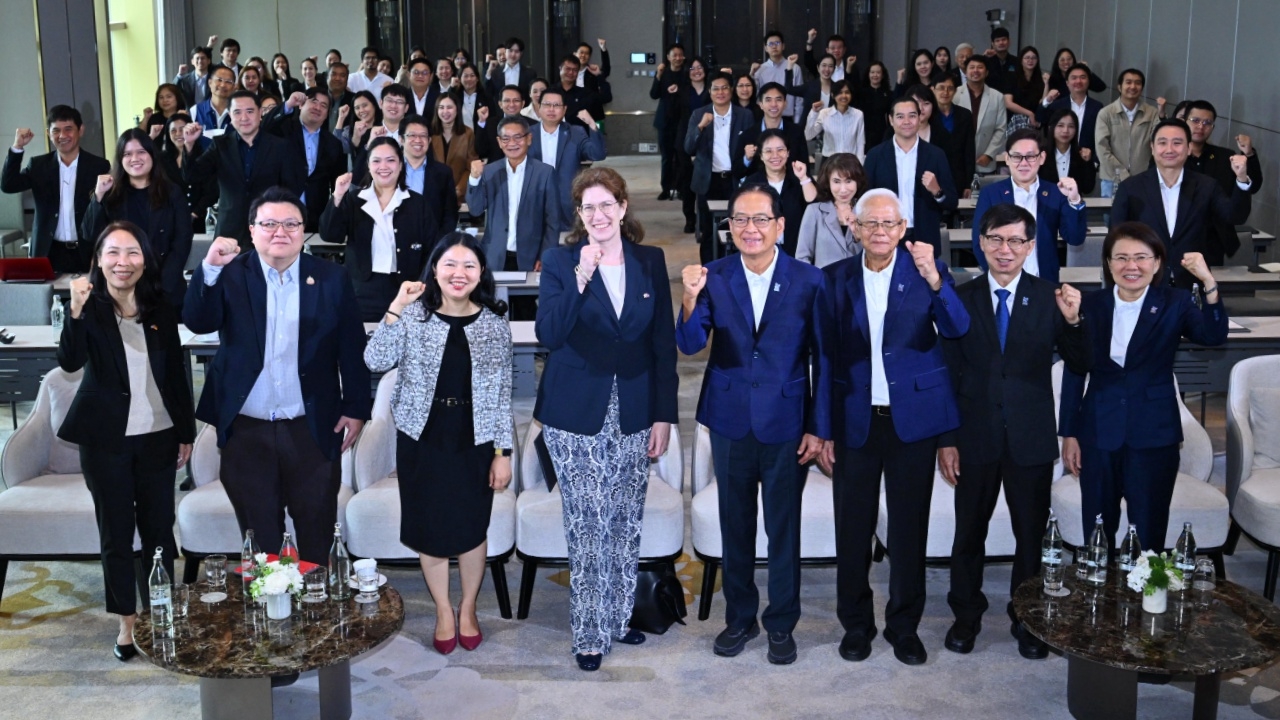
TCMA has enhanced its partnership with GIZ to accelerate the low-carbon industry aiming for the Net Zero 2050 target, showcased at the TCMA x GIZ session during the TCMA Technical Conference 2026, underscoring a clear direction toward concrete action rather than just intentions and declarations.
On 30 July 2026 GMT+7, Mr. Naphadon Romyarup, Vice President of the Thai Cement Manufacturers Association (TCMA), said the Thai cement industry has moved beyond mere declarations and entered a phase of earnest implementation. TCMA's cement producer members have collectively advanced the Thailand 2050 Net Zero Cement and Concrete Roadmap, encompassing the development and promotion of low-carbon cement, enhancing energy efficiency, adopting alternative fuels and raw materials (AFR), and utilizing renewable energy.
At the same time, TCMA plays a key role in the “Saraburi Sandbox” a model low-carbon city, in collaboration with the German Agency for International Cooperation (GIZ) under the Thai-German Cooperation on Energy, Mobility and Climate (TGC EMC) project, to prepare policy, technology, and research and development readiness.
“Today we not only have goals but also clear outcomes and direction. The challenge is to rapidly scale up results widely while maintaining the competitiveness of Thailand’s industry on the global stage,” Mr. Naphadon said.
Ms. Ebba Scholl, Deputy Chargé d’Affaires of the Federal Republic of Germany to Thailand, stated that Germany prioritizes reducing greenhouse gas emissions in heavy industries, especially the cement sector, which requires innovation, policy, and international cooperation.
“For Germany, MadeInGermany does not only signify the place of production but reflects standards of innovation, quality, and sustainable development. This collaboration will help transfer proven knowledge and technology, adapting them appropriately for Thailand’s context.”
The cooperation includes technology transfer, knowledge development, access to green financing, and enhancing industry readiness. “Transitioning to a low-carbon economy is not a cost but an investment in future competitiveness.”
Dr. Kittisak Prukkanon, Director of the Strategy and International Cooperation Division, Department of Climate Change and Environment, said this partnership reflects the combined strength of government, industry, and international allies to reduce greenhouse gases while fostering economic development.
The government is accelerating development of climate change legal frameworks, green investment promotion measures, and financial instruments to support investments in greenhouse gas reduction technologies, including Carbon Capture, Utilization, and Storage (CCUS), a key mechanism for the country's long-term shift to a low-carbon economy.
“This collaboration will advance technology development, create new investment models, and accelerate the transition to a low-carbon industry, which not only cuts greenhouse gas emissions but also presents a critical opportunity to enhance Thailand’s economic competitiveness,” he added.
Dr. Kittisak also emphasized that the private sector should prepare by investing in technologies, data management, and adapting business processes to align with forthcoming laws and policies.
“This transition is not a burden but an opportunity to strengthen competitiveness and long-term sustainability. The government is ready to support through measures and financial mechanisms to ensure all sectors grow alongside greenhouse gas reduction.”
The conference focused on three key technologies central to carbon reduction in the cement industry:
However, Mr. Naphadon stressed that achieving Net Zero cannot happen in isolation but requires cooperation among all sectors—government, industry, and international partners.
The partnership between TCMA and GIZ is not merely a knowledge exchange platform but a vital mechanism linking concepts to practice and scaling results industry-wide. Ultimately, success will be measured not by declared goals but by the ability to continuously act, elevate Thailand’s global competitiveness, and become a model low-carbon industry in ASEAN.