

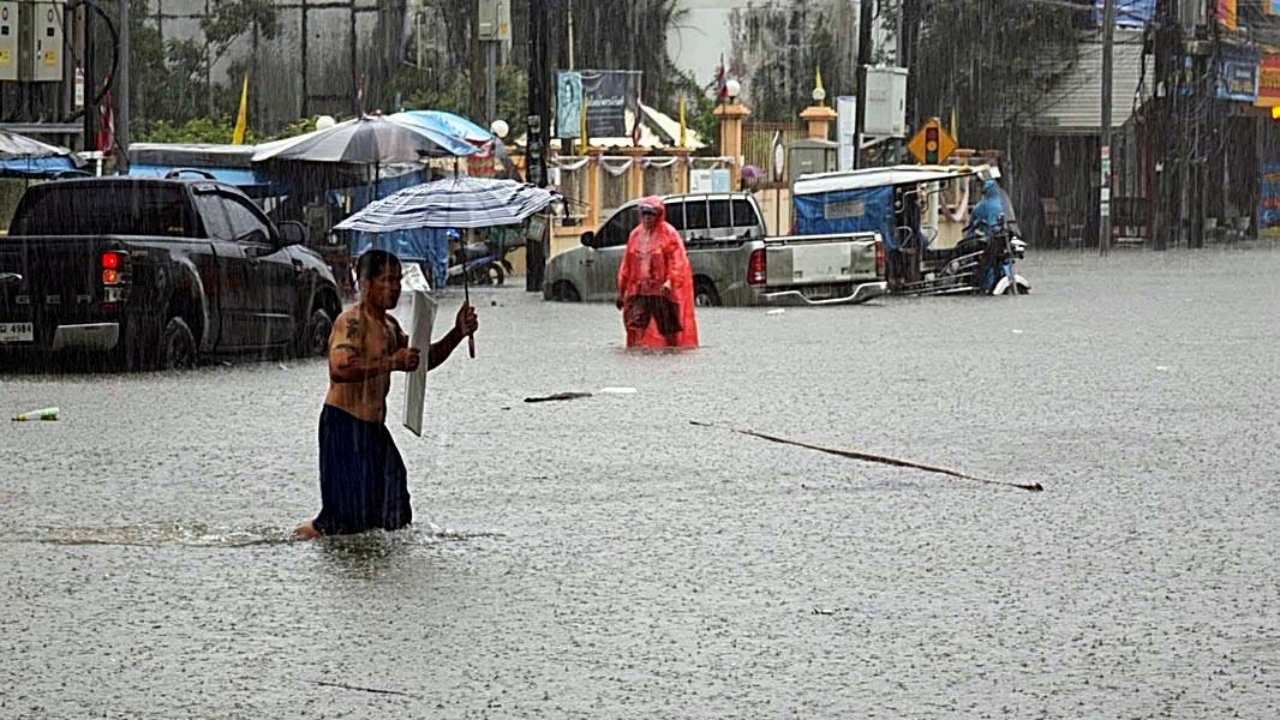
Heavy rain battered Nakhon Phanom, the heaviest in 30 years, causing massive floodwaters to inundate the municipal area. The economic district along Apibanbancha Road was submerged, waiting for drainage, making travel difficult. The governor ordered urgent installation of water pumps to discharge the water into the Mekong River.
On 9 August 2026, reporters noted that continuous heavy rain throughout the night in Nakhon Phanom caused floodwaters in the municipal area to overflow into the Mekong River too slowly, flooding communities within the municipality. Several municipal roads were submerged about 30-40 cm deep. Additionally, some main roads were flooded in spots, disrupting traffic as cars and motorcycles could not pass.

The Nakhon Phanom Meteorological Station recorded 107.9 mm of rainfall, while other districts saw a maximum of 61 mm. Within the municipality, water pooled and awaited drainage on streets, alleys, and lanes. Even the meteorological station on Apibanbancha Road became flooded, with water reaching the station’s office steps.
At around 05:00, weather radar detected light to moderate rain moving from north to south continuously. By 06:30, dense cloud clusters suggested heavy to very heavy rain over Mueang Nakhon Phanom District, especially the municipal area. This was the heaviest rain in 30 years, causing flooding and delayed drainage into the Mekong in many areas. Rain stopped around 09:00, allowing residents to assess the damage.

Tevich Tohmad, 20, a southern chili curry paste vendor at Nakhon Phanom municipal fresh market, said it was his first time experiencing such heavy rain. He began setting up at 3 a.m., but it was already raining and he couldn’t sell anything. Market vendors had to rush to protect their goods from the heavy rain.
Meanwhile, 75-year-old Veerapol Tantipanyawong, owner of a clothing, shoes, and school uniform shop in front of the municipal fresh market, recounted that as floodwaters rushed into his house and he moved belongings to higher ground, passing cars speeding by created waves that worsened the flooding. Despite people signaling drivers to slow down, it was ineffective.
Supattra Sonpasit, 73, was driving to the market when she tried to cross floodwaters but her car stalled mid-way and water entered the vehicle. She was trapped inside, waiting for rescue by officials.

Later, Lieutenant Colonel Adisak Noisuwan, governor of Nakhon Phanom, inspected the flood situation in the municipality along with Deputy Mayor Wathanasak Jiawiriyaboonya on Apibanbancha Road, the province’s largest commercial area. He explained that this road is a low-lying area with delayed drainage, but the Mekong River level remains about 2 meters below the critical point. Sixteen water pumps are being used to push water out efficiently.
Additionally, on Highway 22 from Nakhon Phanom to Sakon Nakhon, floodwaters overflowed onto the road surface. Authorities placed warning signs to prevent accidents.

The cause was a monsoon trough passing over northern Thailand and upper Laos, bringing thunderstorms and heavy rain to upper northeastern provinces including Nong Khai, Bueng Kan, Udon Thani, Sakon Nakhon, and Nakhon Phanom. Mueang Nakhon Phanom recorded the highest rainfall in the region at 107.9 mm, with water depths of 50-75 cm flooding many roads. Fortunately, it was Sunday; if it had been a weekday with school attendance, chaos would have been much worse.