

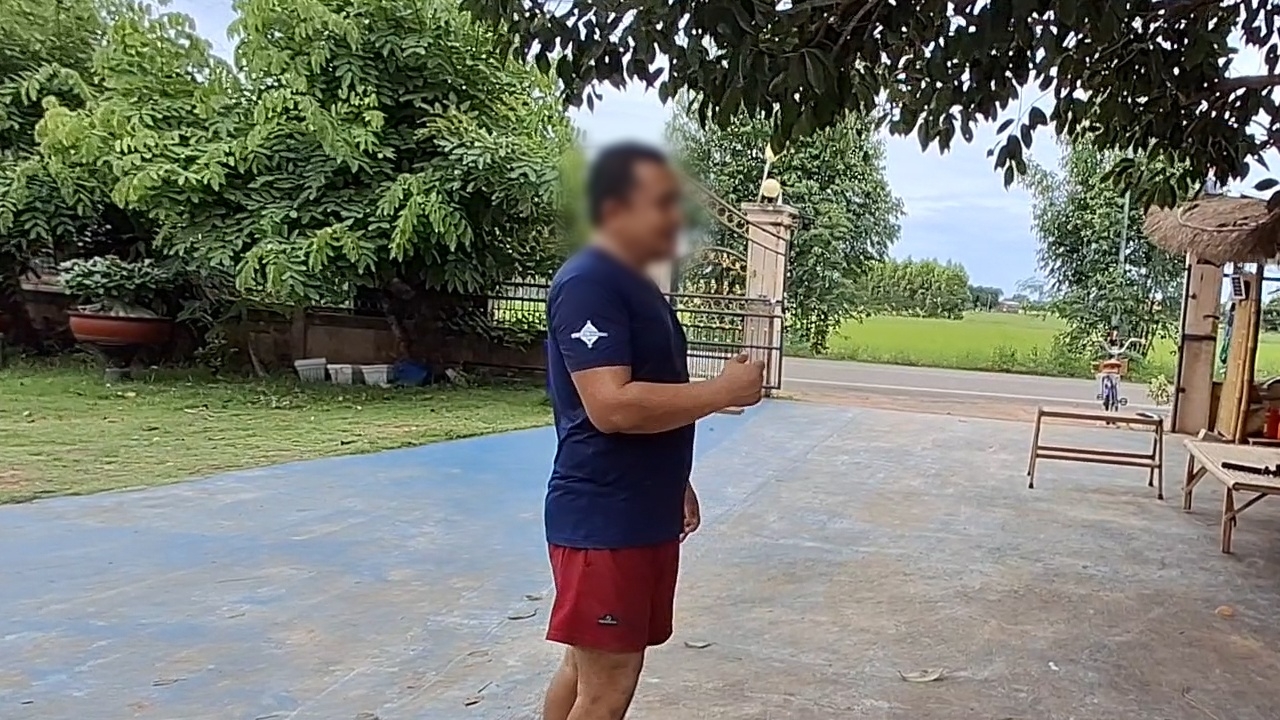
Opening statement "Deputy Superintendent" He insists he did not choke or assault the reporter, claiming he was challenged to a fight first. He admits to hugging and throwing the other man down, causing his head to hit the ground, and vows to contest the case based on evidence.
Regarding the case where a local Khon Kaen reporter claimed he was choked and assaulted by the "Deputy Superintendent," suffering a cut on his right eyebrow requiring 12 stitches, along with bruises and marks on his neck, the Khon Kaen Provincial Police ordered an immediate transfer of Deputy Superintendent Warawit to assist the provincial command center, removing him from his previous position and forming a committee to investigate the facts, as previously reported. (Khon Kaen Provincial Police clarifies the case of "Deputy Superintendent" choking and assaulting reporter; latest order to transfer him)
At 1:00 p.m. on 9 August 2026, reporters met with Deputy Superintendent Warawit, nicknamed "Deputy Ko," deputy head of investigations at Ban Phai Police Station, who is involved in the incident with the local reporter, while he was watching over a shop in Dong Keng village, Manjakhiri district, Khon Kaen province. Warawit shared his side of the story, explaining that on the day of the incident he and his investigation team were conducting routine work, and in the afternoon after finishing, they sat down to eat and discuss work.
Around 6:00 to 7:00 p.m., as it was getting dark, a man named Treethap, or "Mo," came and sat beside them uninvited. There had been no prior conversation. Treethap stayed about 20 minutes while the police group did not speak with him. Warawit then asked only one question: “Hey Mo, why have you lost so much weight? What have you been doing?” This upset Treethap, who responded loudly that if Warawit doubted him, he could do a urine test—but Warawit would have to be tested too.
Seeing the situation deteriorate, Police Major Wut, who was present, told Treethap to go back. Warawit thought the matter was over as Treethap walked about 40 meters to his car opposite the investigation office. Shortly after, Treethap returned, challenging Warawit to a one-on-one fight, using phrases like “Is it one-on-one or not?” though Warawit could not recall the exact words.
Warawit was still seated on a marble bench outside the investigation office when Treethap approached and uttered those words. Warawit stood and ran toward him but was unsure if Treethap threw a punch first. He insists he did not punch but instead hugged Treethap and threw him off. After throwing him, Warawit looked away and sat down again. He later learned from his subordinates that Treethap hit his head on the ground, requiring emergency aid and 12 stitches on his eyebrow. Warawit also stated he did not carry a firearm, did not punch or hit, and that he threw Treethap because he was bigger and stronger; if he intended to harm him, it would have been worse. That is the full extent of the facts as he sees them.
To establish the truth, Warawit believes both parties and all witnesses should be questioned together, especially regarding why Treethap came to Ban Phai Police Station that day. While there was an official event for village chiefs that day, it should be confirmed whether Treethap actually met with those officials, whom he called before approaching the investigation team, and his purpose in coming.
He stressed that the accounts should not be given separately but together. He denied choking Treethap. When Treethap sat beside the group, they neither spoke nor touched him except for Warawit's question about his weight loss, which was not an accusation or inquiry about drug use but simply an observation.
Moving forward, Warawit said he will stand firm and fight based on facts and evidence. He believes that conceding would only lead to further concessions and that being a police officer does not mean accepting everything. He accepts that disciplinary action may be necessary to maintain trust in the investigation but trusts that his superiors will be fair. The evidence will prove how Treethap’s injuries occurred—whether from assault or other circumstances—and all evidence must be considered.
Regarding his state of mind, Warawit said he is not discouraged despite ongoing stress. His superiors and Khon Kaen police have offered support, emphasizing that the police chief listens to both sides impartially. He views his transfer to the provincial command center as positive, ensuring a transparent investigation and showing that police do not cover for one another. Staying in the original area could have raised concerns about interference. He believes the transfer was the right decision to allow an independent inquiry.
After speaking with reporters, Warawit appeared in better spirits and expressed relief at the chance to share his side. Previously, he hesitated, worried that speaking out might harm the agency, as 'police' represent the entire organization, and he did not want his personal issue to reflect poorly on all officers, many of whom perform their duties well.
When asked about the possibility of talking with Treethap, Warawit said he is unsure what type of conversation is meant. If it is to reconcile, he is open, but if it means accepting all blame, he will not, as he maintains that Treethap challenged him first. He wants the process to be fair on this point and is willing to continue a brotherly relationship.
Regarding future talks, Warawit said that is uncertain. He denied holding grudges or intending to harm Treethap secretly. From a humanitarian perspective, he acknowledged Treethap’s injuries resulted from being thrown, which he accepts, but he rejects bearing full blame.
Meanwhile, Treethap, the local reporter, remains hospitalized at Ban Phai Hospital awaiting medical clearance and has confirmed he will file a police complaint after discharge to pursue legal action.
The facts of the case remain under investigation by a committee appointed by Khon Kaen Provincial Police, which is gathering statements from both parties, witnesses, and related evidence to reach a conclusion through proper procedures.