

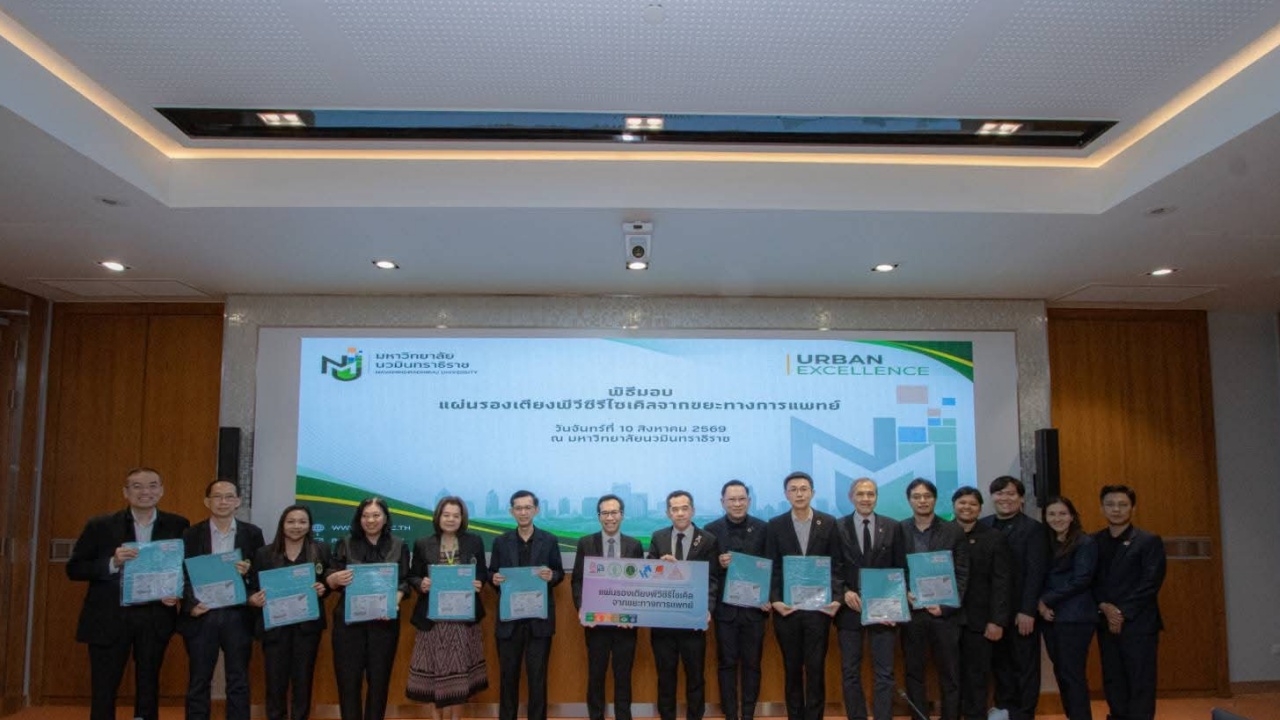
The KHUN Foundation joined forces with Chulalongkorn University's Petroleum and Petrochemical College and several other sectors to create a model environmental community through the Dusit Nawamin Integrated Project, including the donation of PVC bed sheets made from recycled materials from medical waste.
On 10 Aug 2026, reporters reported that the KHUN Foundation collaborated with Navamindradhiraj University, Chulalongkorn University's Petroleum and Petrochemical College, RICOH (Thailand) Ltd., and government and private agencies to launch the Dusit Nawamin Integrated Project. This initiative serves as a model for urban community management covering public health care, environmental protection, safety, and disaster response—including fire, flood, and earthquake preparedness—in the Soda Alley community, Dusit district, Bangkok.
Ms. Prangtip Anantawipat, Chairperson of the KHUN Foundation, and Lieutenant Thanarat Klaimanee, Foundation Advisor, stated that the activities promote environmental awareness under the campaign "This Afternoon, Happiness: United to Protect the Earth." Organized jointly by the KHUN Foundation and Chulalongkorn University's Petroleum and Petrochemical College, the campaign has been held twice and will continue, including teaching waste separation and engaging participants with games.Games.They also distribute gifts and conduct real waste surveys and collection activities using the PIRIKA application developed by Japan's JICA, along with donating bed sheets for bedridden patients made from recycled hospital materials.Recycle.Lieutenant Thanarat and Ms. Prangtip have worked with various organizations for over eight years. Their main goal is to raise awareness about environmental care, especially starting with waste reduction and repurposing waste through proper segregation and recycling. These methods reduce reliance on new resources and sustainably lessen environmental impact.

Assoc. Prof. Dr. Pongsak Noipayak, President of Navamindradhiraj University, said the four-year Dusit Nawamin Integrated Project results from collaboration with partner organizations to advance the vision of a leader in urban science for city development and quality of urban life. The project under the URBAN EXCELLENCE strategic plan applies digital and urban science concepts to solve city issues, using the Dusit Nawamin Integrated Project as a model toward becoming the top City University in the ASEAN region.Integration.This project integrates the university's comprehensive knowledge and expertise in urban science and urban quality of life enhancement, considering benefits to the model community alongside partners from government agencies such as Dusit District Office, Chulalongkorn University's Petroleum and Petrochemical College, Thammasat University's Puey Ungphakorn College of Development Studies, private organizations including the KHUN Foundation, RICOH (Thailand) Ltd., and Sky ICT Public Company Limited. The KHUN Foundation and its partners aim to educate community members on waste management and cleanliness through the Environmental Guardians project, empowering the community to care for the planet using environmental knowledge and approaches focused on reducing greenhouse gases and promoting a circular economy.
The project is integrative.Integration.It brings together the university's expertise in urban science and urban quality of life promotion comprehensively, emphasizing benefits to the model community with partners from government sectors such as Dusit District Office, Chulalongkorn University's Petroleum and Petrochemical College, Thammasat University's Puey Ungphakorn College of Development Studies, and private organizations including the KHUN Foundation, RICOH (Thailand) Ltd., and Sky ICT Public Company Limited. The KHUN Foundation and partners intend to raise community awareness about waste management and cleanliness through the Environmental Guardians project, building community strength to protect the planet with environmental knowledge alongside efforts to reduce greenhouse gases and promote circular economy principles.

On Monday, 10 Aug 2026, a ceremony was held to donate PVC bed sheets made from recycled materials. Professor Dr. Pramote Rangsarnwijit, Dean of Chulalongkorn University's Petroleum and Petrochemical College, presented them to Associate Professor Dr. Pongsak for use in patient care and to support social and environmental activities.
Assoc. Prof. Dr. Pongsak added that this project pilots the development of a model community that can be adapted to other communities in Bangkok and local administrative organizations. The development process began by surveying community problems and needs, engaging residents in all stages, conducting systematic evaluations, and summarizing the model approach to apply or expand toward genuine sustainability.

Assistant Professor Dr. Manit said the project is a collaboration among the ASEAN Vinyl Council (AVC), the KHUN Foundation, Nakornluang Plastic Industry Co., Ltd., and Chulalongkorn University's Petroleum and Petrochemical College. Vejkarunrasm Hospital serves as the model hospital for sorting and collecting non-infectious medical PVC waste under the project for managing medical waste materials (non-infectious) from PVC post-use and recycling as an alternative resource for sustainable environmental benefit following the circular economy concept. Since 2023, the project promotes proper segregation and management of non-infectious medical PVC waste according to scientific principles, resulting in collecting over 1,000 kilograms of PVC waste and transforming it into more than 4,500 PVC bed sheets circulated back into the healthcare system, creating value from what was once waste.
Recycling medical PVC waste and transforming it into PVC bed sheets exemplify turning waste into valuable resources aligned with the circular economy concept. This reduces landfill waste, conserves natural resources, lowers greenhouse gas emissions, and maximizes resource efficiency. This collaboration demonstrates the power of integrating education, industry, and healthcare sectors to develop sustainable medical waste management models, drive circular economy development, and affirm that non-infectious medical waste can truly create new value for healthcare, society, and the environment.