

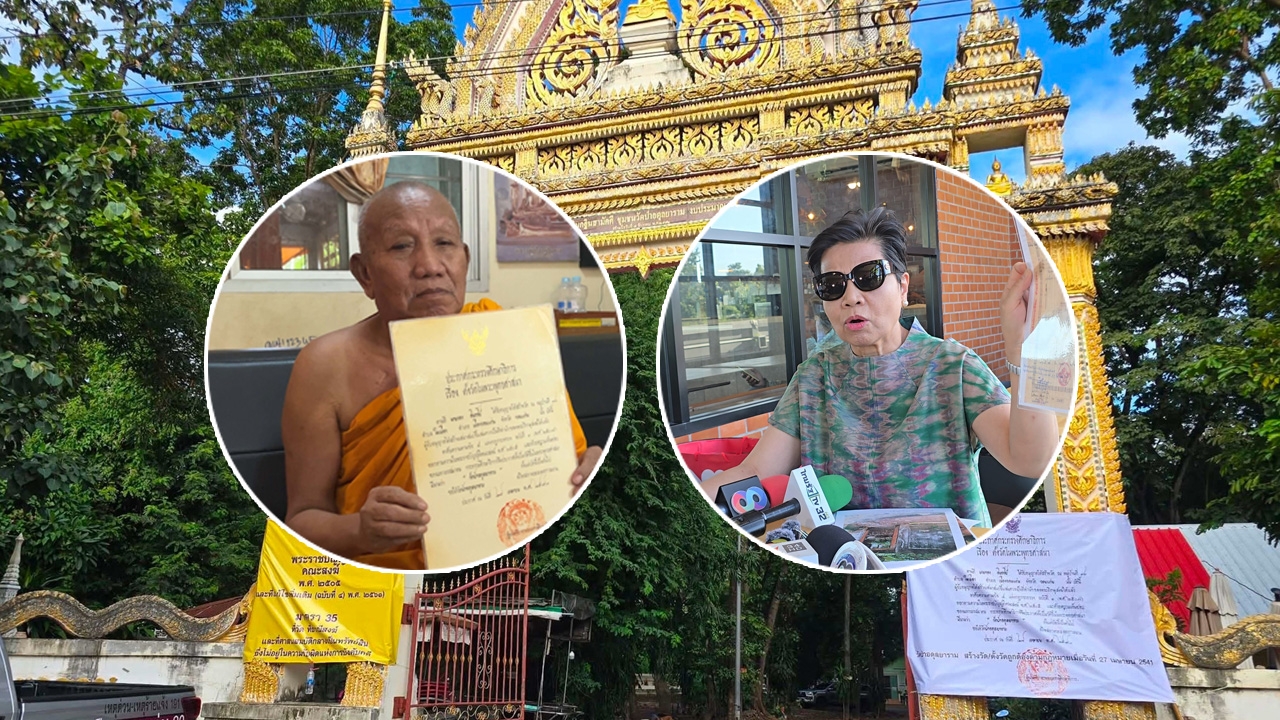
The land dispute at Wat Pa Adunyaram in Khon Kaen Province involves the estate manager confident in ownership rights, who led people to block the temple's entrances and exits. Meanwhile, Mr. Hiang's daughter insists her father did not transfer the land to any individual. The abbot remains unconcerned and intends to fight the case legally.
On the afternoon of 10 August, a group of men accompanied by one woman brought concrete pipes to the entrance and exit of Wat Pa Adunyaram, pouring concrete into the pipes to block access and posted notices demanding the removal of structures within 15 days.
Later, Phra Kru Adun Saranithet, the 72-year-old abbot of Wat Pa Adunyaram, revealed that the temple’s 26-rai land was donated by Mr. Hiang Pimsri to establish the temple. The temple has been sued by Mr. Hiang's heirs seeking to reclaim the land since 2004, but the litigation has passed through three courts and the case is now concluded.
Phra Kru Adun Saranithet also presented copies of the land title deed and photographs from the event when Mr. Hiang donated the deed during a donation ceremony on 4 September 1990. He also showed the Ministry of Education’s official announcement establishing the temple, the abbot's registered household book listing the temple’s address, the construction permit, the abbot's appointment document, and emphasized that the temple holds all necessary documentation to confirm ownership in every legal challenge.

Phra Kru Adun Saranithet further explained that the temple applied for permission to build in 1992 and was officially declared a temple in 1998. Mr. Hiang, the landowner who donated the land, passed away in 1991. Before becoming a temple, the site was a monastic retreat. When he began residing there, he saw the land title deed donated by the landowner to Luang Pho Pheuy, the monk who founded the retreat. Luang Pho Pheuy then entrusted Mr. Ken, a close associate, to obtain permission to establish the temple.
During the process of applying for temple establishment, Mr. Ken passed away. Subsequently, Luang Pho Pheuy assigned his close friend, Mr. Nong, to continue the application and oversee construction until completion in 1998. The temple then received official recognition from the Ministry of Education.
I, Luang Pho Adun, was appointed head of the monastic retreat in 1992. Regarding adverse possession, the temple has occupied the land since 1990. Until 2001, the relatives never filed complaints or took action, and the temple had been established for over ten years.
In 2004, the heirs filed a lawsuit. The lower court ruled in favor of the temple, as did the appellate court. The Supreme Court declined to hear the case. The plaintiffs then filed in civil court claiming to be estate managers, referencing the original deed which had been donated to the temple and consented to in front of the district chief and land office, necessary for temple construction. The plaintiffs claim to be estate managers acting independently and first filed in administrative court, which transferred the case to civil court. The civil court named the Khon Kaen Land Office as defendant, Khon Kaen Municipality as first defendant, and Wat Pa Adunyaram as second defendant.

Mrs. Nattanan Liewsakunmachai, a senior religious scholar from the Khon Kaen Provincial Office of Buddhism, stated that according to the National Office of Buddhism's records, Wat Pa Adunyaram is a local temple under the Dhammayutika Nikaya order, located in Nai Mueang Subdistrict, Mueang District, Khon Kaen Province. The temple was legally established with registration and temple code, recognized by the National Office of Buddhism, and was officially authorized on 27 April 1998. At that time, the Ministry of Education, through the Department of Religious Affairs, oversaw temple establishment, confirming that Wat Pa Adunyaram was lawfully established and holds legal entity status.
A former director of the Khon Kaen Provincial Office of Buddhism, now retired, informed the media about temple establishment procedures. For Wat Pa Adunyaram in Nai Mueang Subdistrict, Khon Kaen, Ministry Regulation No. 1/2004 was applied as the foundational law for legal registration. The process began by submitting the temple land to land officials for verification of legal status before forwarding to the district chief, who also verifies the land's legality. Only after confirming legality does the temple prepare a site plan detailing structures like monks' quarters and pavilions, ensuring they fall within the permitted land boundaries; discrepancies lead to immediate termination of the process.
After completing these steps, reports are sent to the district ecclesiastical chief for inspection. Simultaneously, the district chief reports to the provincial governor, who conducts inspections. Following completion, reports proceed to the provincial ecclesiastical chief, then to the Office of Buddhism (formerly the Department of Religious Affairs), which re-verifies land legality, site plan accuracy, and coordinates of listed structures. Upon approval, a temple construction permit is issued.
Upon receiving the construction permit, the temple builds the designated structures according to the site plan coordinates. After completion, reports are submitted to the subdistrict, district, and provincial ecclesiastical chiefs, as well as the provincial governor. The case is then forwarded to the Ministry of Education for ministerial approval.
The authorization to establish a temple includes appointing the abbot to reside in the constructed buildings, conferring legal entity status under the Sangha Act of 1962 on 27 April 1998. Once legally established, the temple appoints the abbot as authorized. The abbot then registers the temple as his residence with address No. 350, Village 16, Nai Mueang Subdistrict, Mueang District, Khon Kaen. The abbot updates his ID card to match the temple’s address. Based on my experience in this area, I confirm Wat Pa Adunyaram was legally established and holds legal entity status from 27 April 1998.

The lower court’s ruling on 17 August 1990 stated that Mr. Hiang made a written agreement to donate land for temple construction. This shows his intention to dedicate the disputed land for the temple's use. The disputed land therefore belongs to the state for temple construction immediately, without needing further documentation or registration. After dedication, neither Mr. Hiang, his wife, nor heirs retain ownership rights. Even if the temple was not yet built or under construction at the time, the land remains state property for the temple until completion and official establishment on 27 April 1998. From that date, ownership fully belongs to Wat Pa Adunyaram. Thus, the estate manager has no rights over the land.
The appellate court upheld this ruling.
Additionally, the civil court’s 2023 judgment stated that the plaintiff, both personally and as estate manager of Mr. Hiang, has no ownership rights over the land. The land belongs to Wat Pa Adunyaram, so no further ownership transfer is necessary since the temple already owns it.

On 12 August, Aunt Da, a grandchild and heir of Mr. Hiang, arrived with a group presenting evidence asserting that the legal transaction ended upon Mr. Hiang’s death. Ownership has belonged to the heirs since 1991 because Mr. Hiang handwritten a condition stating the land would only be transferred once the temple was completed. Since the land was donated in 1990 and Mr. Hiang died in 1991 before the temple was finished — which was officially declared a temple on 27 April 1998 under the Sangha Act — this supports her claim.
Aunt Da also claims her legal right as an heir, noting that the land title was updated at the Land Office on 13 July 2026 and still bears Mr. Hiang’s name. She asserts that the handwritten condition in the donation agreement states that if the temple is not completed, the land would not be transferred, rendering the transaction void. The agreement was signed by officials including the district chief and land officers, with two witnesses, before Mr. Hiang’s death in 1991.
Upon examining the document, it states the donation agreement was written at house number 45, Village 14, Mueang District, Khon Kaen, dated 17 August 1990. It says, “I, Mr. Hiang Pimsri, age 80, residing at house 45, Village 14, Mittraphap Road, Nai Mueang Subdistrict, Mueang District, Khon Kaen Province, agree to donate land to build a temple to the Khon Kaen district chief and land officers with the following terms.”
“I promise to donate land at Village 14, Ban Nong Waeng, Nai Mueang Subdistrict, Mueang District, Khon Kaen Province, totaling 21 rai, 3 ngan, 461 square wah. I own the land by title deed No. 61945, book 620, page 45, Mueang District, Khon Kaen, attached herewith, with clearly defined boundaries, for temple construction. Mr. Ken has already sought government permission to establish the temple. I will arrange to transfer the land to the temple within the timeframe specified by the district chief.” The phrase about arranging the transfer is underlined for emphasis.
The agreement further states that if I fail to transfer the land as promised, I consent that the Khon Kaen district chief and land officers may take legal action against me. Signed by Mr. Hiang.

Regarding blocking the temple’s entrances with concrete pipes, Aunt Da insists there was no intent to harass the monks or damage the temple. The dispute concerns land ownership rights fought over for more than 20 years by rightful heirs. She added that she has applied for a new land title deed, currently awaiting the 30-day period ending on 27 August 2026. If granted, she will proceed to dismantle the structures if the temple does not remove them within 15 days.
When asked if the land’s rising value motivated the dispute, Aunt Da affirmed she has been fighting for over 20 years and that the land price is irrelevant. The case is about rightful ownership as reflected on the title deed. Ownership passes to heirs upon the holder’s death as normal. What the family does with the land thereafter is their right.
Mrs. Buarun Pimsri, the third daughter of Mr. Hiang and Mrs. Nang, explained that her father was a village headman and land seller. The disputed land totals 42 rai; 10 rai were given to Khon Kaen University, about 21 rai to the temple, and 5–6 rai of marginal farmland. This area was mostly forested, where a nun built a monk’s dwelling and monks built a firewood stove. Her father bought a dwelling out of compassion and gradually developed faith, intending to establish a temple there. However, he did not transfer the land to any individual. He managed to convert the land from a local land certificate (Sor Kor 1) to a title deed and donated temple offerings.
The former abbot, then head of the retreat, displayed the land title deed to villagers to show Mr. Hiang’s intention to establish a temple on the land, though the land was not formally given. The temple posted the deed publicly as an announcement that a temple would be built. Later, parties interested in acquiring the land attempted to seize it, leading to the ongoing dispute.
As a member of the next generation, I gave up due to financial constraints. We are simple villagers. Later, my niece Da, the daughter of my sister and a real estate agent knowledgeable about the matter, volunteered to continue the fight. I lacked the resources and entrusted her fully, as all relatives trust her to carry on this matter.

Police Colonel Yosawat Kaewsuebnanich, superintendent of Khon Kaen City Police Station, stated that summonses have been issued to Aunt Da, owner of three vans. The concrete truck's registration is under investigation; the vans are registered in Bangkok, and the concrete truck is believed to be in Khon Kaen. Charges depend on evidence collected and detailed questioning of temple representatives before summoning both parties for interrogation. No charges have yet been filed.
Phra Kru Adun Saranithet, abbot of Wat Pa Adunyaram, after returning from Bangkok last night, is resting in the abbot’s residence. He said he lives simply and is untroubled. As a monk, suing laypeople is inappropriate. He has been abbot for 36 years without concern or feeling burdened, though age brings occasional fatigue.
Regarding the dispute, many devotees have offered moral support, urging not to worry or stress because the matter has passed legal procedures. The courts have ruled the land belongs to the temple.

Mr. Khajornkiat Rakpanichmanichot, governor of Khon Kaen Province, said that lawyers for the temple have submitted requests, but the process is incomplete. When someone requests land document changes, there is a public notice period for objections. If objections arise, land officials assess the legitimacy. If no objections, the process continues according to procedure.
This dispute dates back to 1990 when a donor gifted land to the temple but the registration was incomplete and litigation ensued. The lower and appellate courts have ruled, leaving only the Supreme Court pending. The governor urges all parties—temple and heirs—to await the Supreme Court's final decision, warning that personal interventions may violate the law.
The governor added that to prevent conflict, especially after reports of blocked temple entrances causing damage and disputed facts, the province has deployed police to maintain order and volunteers to engage with villagers to avoid confrontations. Legally, the case is resolved except for registration steps.
He gave an analogy that wills remain enforceable after the testator's death, indicating this is a legal matter requiring proof. He urged all officials not to make assumptions and invited both temple representatives and Aunt Da to meet with him if they have concerns.