

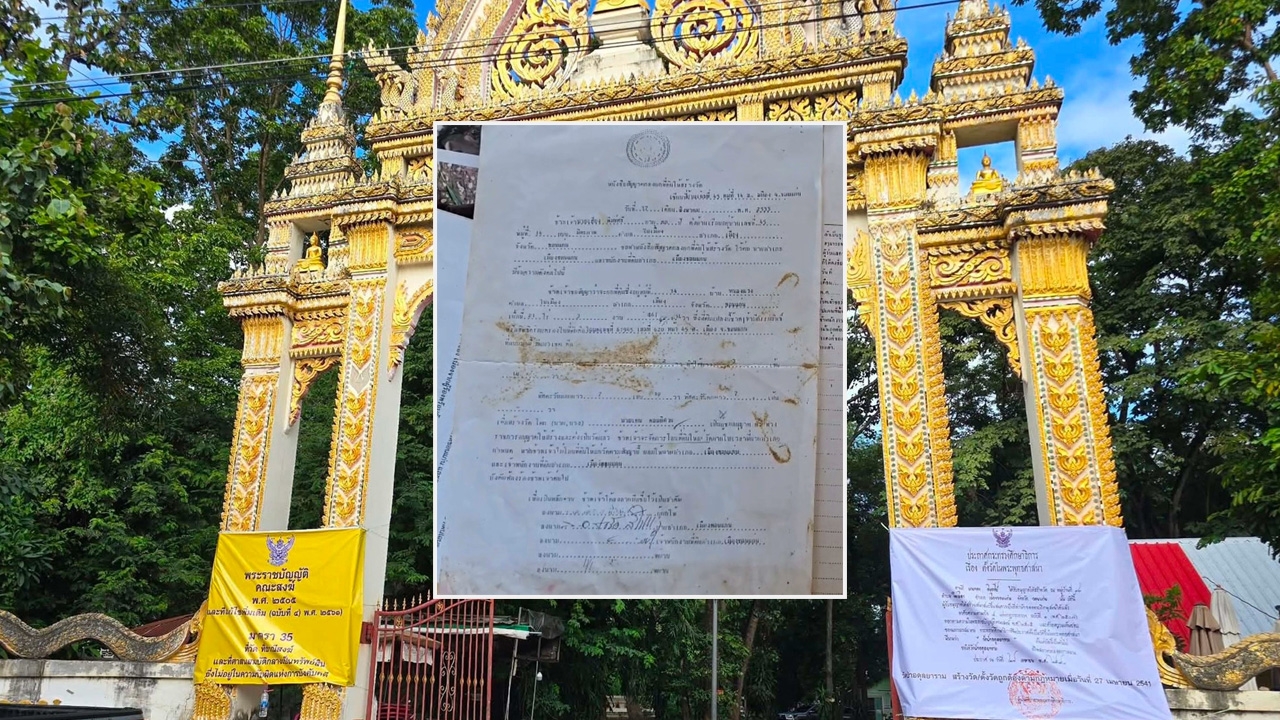
The former director of Khon Kaen’s Buddhist Office pointed out that "temple land" is not subject to legal enforcement actions. He viewed the contract document as similar to a will, protecting the deceased’s intentions, and stressed that those involved must urgently complete the related procedures.
On 14 Aug 2026 at Wat Pa Adulyaram on Kanlapaphruek Road, Mueang District, Khon Kaen Province, reporters visiting the site met the former director of Khon Kaen’s Buddhist Office, who had come to see the abbot. He said the contract document cited by the heirs resembles a will because the property owner expressed the intention to donate the land for temple construction. Since the owner died suddenly, those involved must expedite completion according to the stated intentions.
The former director explained that the contract bears the signatures of the district chief and land officer as legal witnesses. Even after the landowner’s death, the process must continue according to the deceased’s intentions. The contract is prepared in advance to prevent issues such as the owner dying during proper temple construction, which could cause harm due to ongoing processes, and to prevent heirs from reclaiming the land later. Thus, the contract serves as protection.
Before drafting the contract, multiple verification steps must be completed. The district land officer checks the land ownership to confirm legal validity and that the owner acquired it lawfully. Only if the land is lawfully owned can it be dedicated for temple construction. If the land is involved in court cases or mortgaged, it cannot be used for temple building.
The former director stated that upon receiving this contract, the land donation is considered complete. Even if the owner died just one day after signing, temple construction must proceed according to the deceased’s intentions. This principle follows the 1964 Ministerial Regulation, Section 2, stating that a land title deed constitutes ownership; if not a title deed, such as a Nor Sor 3 certificate, it is only possession rights. The owner must sign a land donation contract to prevent later disputes. Once legally established as a temple, the temple becomes a juristic person.
Regarding heirs’ claims that a handwritten condition by Mr. Hiang stating the land would not be donated if the temple was unfinished, thus voiding the donation after his death, the former director said such claims cannot be accepted. Accepting them would harm the temple and the devotees who contributed donations for construction. Therefore, the land donation contract acts like a will to prevent reversals or heirs reclaiming the land after the owner’s death. This reflects the clear provisions in the Ministerial Regulation, Chapter 1, Section 2, requiring careful procedure.
The former director added that current events show that the law was created to prevent heirs from reclaiming ownership after the owner’s death and to stop temple land from being taken back. Drawing from his extensive legal experience with the Sangha laws, he called on Buddhists to unite in protecting Buddhism under Section 67 of the 2017 Constitution of the Kingdom of Thailand. The key protection measure today is for all parties to expedite issuing land deeds to temples, as deeds are vital legal evidence securing temple land. Furthermore, the 2018 Sangha Act, Section 35, states that "temple land" is exempt from legal enforcement. Thus, even if a court rules against a temple, its land cannot be seized. Wat Rom Pho Tham is an example. He emphasized that temple land is not subject to enforcement and urged Buddhists to collectively protect Buddhism.