

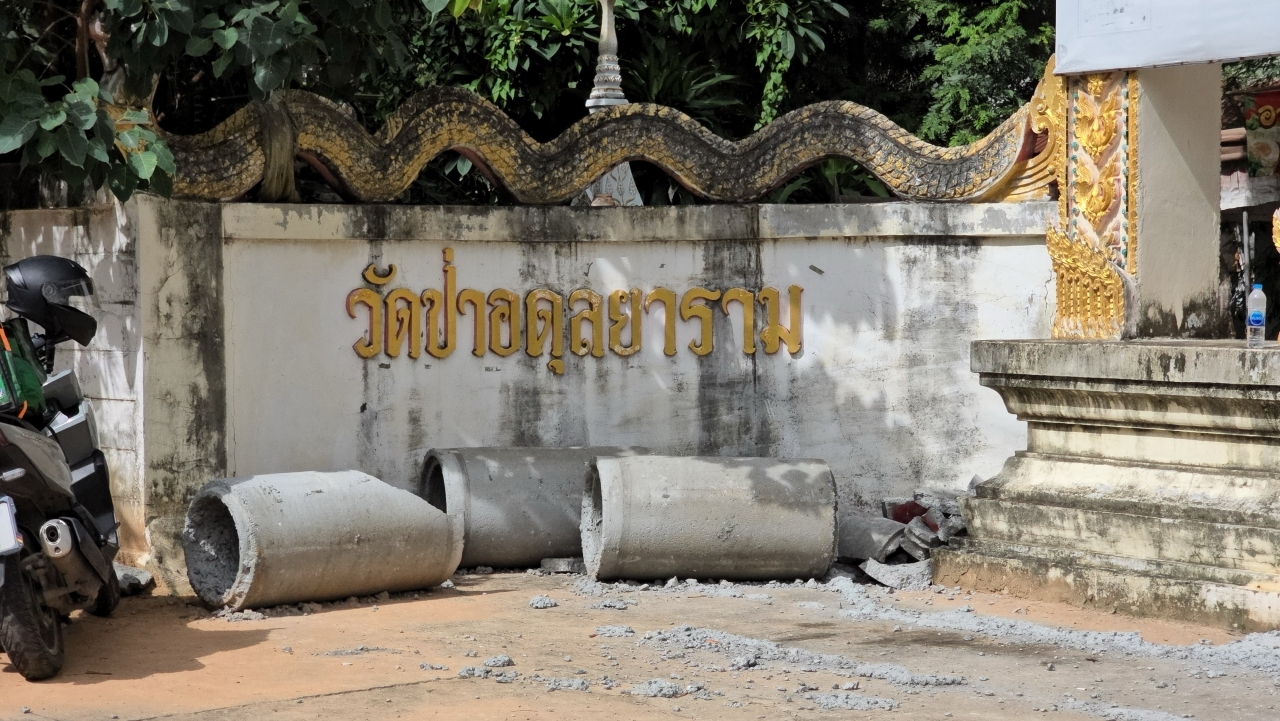
The land dispute at Wat Pa Adunyararam arises as the abbot of Wat Trachuwanaram states someone wants 6 rai of cemetery land, but the abbot cannot grant it due to legal prohibitions, which has led to a lawsuit filing.
On 25 Aug 2026 GMT+7, at Wat Trachuwanaram, Mittraphap Road, Nai Mueang Subdistrict, Mueang District, Khon Kaen Province, reporters met with Phra Kru Adunsilaporn, abbot of Wat Trachuwanaram on Mittraphap Road within Khon Kaen municipality, to inquire about the history, land use, buildings, and the process of applying for land title deeds to support the permit application for constructing Wat Pa Adunyararam, which is currently under dispute.
Phra Kru Adunsilaporn, abbot of Wat Trachuwanaram, said the root of the dispute is one issue: someone wants 6 rai of land and may have requested it from the abbot, but the abbot could not give it. This led to the lawsuit. By law, an abbot cannot give temple land to anyone. Even if someone suggests the temple should kindly allocate land for descendants to farm, this cannot be done because temple land is legally restricted. If a monk gives temple land away, it could be a crime punishable by imprisonment. He urged society to understand the law clearly and not hold prejudice against monks or the temple.

Regarding leasing temple land, the abbot explained that such decisions require approval from the National Office of Buddhism and related agencies to assess appropriate rental rates. All steps must comply with legal regulations. Even if the abbot and all temple committee members agree, they cannot simply decide to lease temple land among themselves. It is not as simple as outsiders might think and cannot be decided solely by internal votes or desires.
He also raised questions about boundary lines dividing some areas, asking why such divisions exist. If the title deed shows 21 rai of temple land, the subdivided parts should not appear on the deed. Earlier surveys seem to have covered about 26 rai, including the 5–6 rai now disputed. Later, boundary lines appeared, so it is necessary to check who drew them, when, and why. He believes this issue is part of the cause of the lawsuit.

The abbot further stated that historically, the land did not originate as inheritance from Father Hiang but was vacant land used by villagers for gathering wild vegetables, mushrooms, and forest products. Later, it became a burial site used by villagers from Sam Liam village, especially when many leprosy patients died. The area was used for burial and later for cremation. At one time, bodies were cremated at Wat Trachuwanaram itself, while burials occurred on the 5–6 rai now in dispute. This land has been commonly used by villagers from the start. Calling it public land requires legal certification or management by an agency like the municipality, but originally it was vacant land used collectively by villagers.
During the land title process, the abbot was nearby and aware of discussions and events because he was assisting Luang Pu. The sole purpose of applying for the title deed was to provide documentation to support the permit to build the temple. For this reason, Father Hiang quickly transferred the land to the temple. If the land was to be kept as inheritance, the temple could not use the title deed to apply for the construction permit. The process was not intended to preserve land as inheritance for descendants, as Father Hiang already had several rai divided among 8–9 children.

Regarding the day the land was transferred, the abbot admitted he was not present but heard from others that Father Hiang brought his descendants to the temple in a traditional ‘Thod Pha Pa’ ceremony, with a formal transfer event including donations typical of such occasions. He confirmed the title deed was not simply deposited with the temple as collateral. Claims that the deed was held as security are untrue; it was intended solely to support the temple construction permit. Father Hiang, his wife Nang Nang, and descendants were well aware of this. Many descendants who have grown up and moved away have never opposed or prevented Father Hiang from transferring the land to the temple.
Phra Kru Adunsilaporn described the buildings on the land: the current crematorium was renovated with a 1 million baht Kathin donation from Khon Kaen University, upgrading it from charcoal to electric cremation. The original crematorium dates to the era of Luang Por Sim. The current mortuary pavilion likely replaces an older building. The gate's age is uncertain but may date to around 1986, while the bell tower was definitely built during Luang Por Sim’s time. This period saw many temple developments under Luang Por Sim, who likely arrived around 1981–1982 and stayed until about 1986, though exact dates are approximate. Later, Mahanil took over, known for his eloquence, attracting many devotees.
The land survey occurred during Mahanil’s time, witnessed by many devotees. When traveling to Bangkok, villagers collectively raised funds for Mahanil and Phor Pu Sirithammanet to proceed with the survey, as the temple lacked funds and relied on community support. There were witnesses present on that day.
