

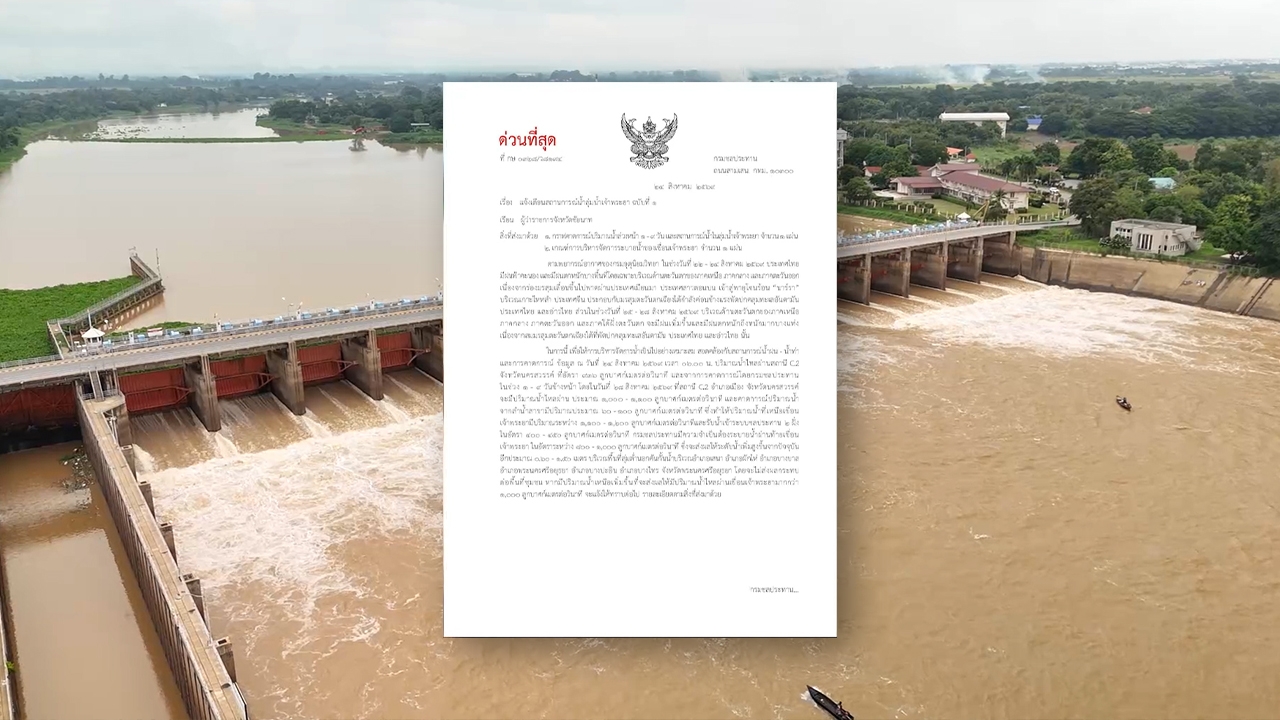
The Royal Irrigation Department issued an urgent notification for 11 provinces in the Chao Phraya basin to prepare for a northern water surge behind the dam, expected to rise approximately 0.60 to 1.50 meters behind the dam.
On 25 August 2026, reporters reported that Mr. Det Lekwichai, Deputy Director-General acting on behalf of the Director-General of the Royal Irrigation Department, issued Water Situation Alert No. 1 to the governors of 11 provinces in the Chao Phraya basin: Uthai Thani, Chainat, Sing Buri, Ang Thong, Phra Nakhon Si Ayutthaya, Suphan Buri, Lopburi, Pathum Thani, Nonthaburi, Samut Prakan, and Bangkok.
According to the Meteorological Department's forecast, from 22 to 24 August 2026, Thailand experienced thunderstorms and heavy rain in some areas, especially in the western parts of the North, Central, and Eastern regions. This was due to a monsoon trough shifting over Myanmar and northern Laos into Tropical Storm Nangka near Hainan Island, China, combined with a fairly strong southwest monsoon covering the Andaman Sea, Thailand, and the Gulf of Thailand. From 25 to 28 August 2026, increased rain and heavy to very heavy rainfall are expected in the western North, Central, Eastern, and western Southern regions due to the southwest monsoon winds covering the Andaman Sea, Thailand, and the Gulf of Thailand.
At water measurement station C.2 in Mueang District, Nakhon Sawan Province, the water flow was recorded at 1,024 cubic meters per second flowing into the Chao Phraya Dam, causing the water level upstream of the dam to rise to 15.59 meters above mean sea level. The water flow through the dam was 570 cubic meters per second, with the downstream water level at 9.03 meters above mean sea level, 7.31 meters from the riverbank.
To manage water appropriately in line with rainfall and runoff forecasts, the Royal Irrigation Department predicts that from 1 to 9 days ahead, on 28 August 2026, station C.2 in Mueang District, Nakhon Sawan will record water flow of approximately 1,000 cubic meters per second. Tributary inflows are forecast at 60–100 cubic meters per second, resulting in total upstream dam flow of about 1,100–1,200 cubic meters per second. The irrigation system on both sides of the Chao Phraya basin is expected to receive 400–450 cubic meters per second.
Therefore, the Royal Irrigation Department must release water downstream of the Chao Phraya Dam at rates between 700 and 1,000 cubic meters per second, which will raise water levels by approximately 0.60 to 1.50 meters from current levels in low-lying areas outside the embankments in Sena, Phak Hai, Bang Ban, Phra Nakhon Si Ayutthaya, Bang Pa-in, and Bang Sai districts in Phra Nakhon Si Ayutthaya Province. This will not affect community areas. If upstream water volume increases causing flow through the dam to exceed 1,000 cubic meters per second, further notifications will be provided.
However, to prepare for this water situation, the Royal Irrigation Department urges residents in the 11 Chao Phraya basin provinces, relevant agencies, and people living along both banks of the Chao Phraya and Noi rivers to closely monitor the water situation.