

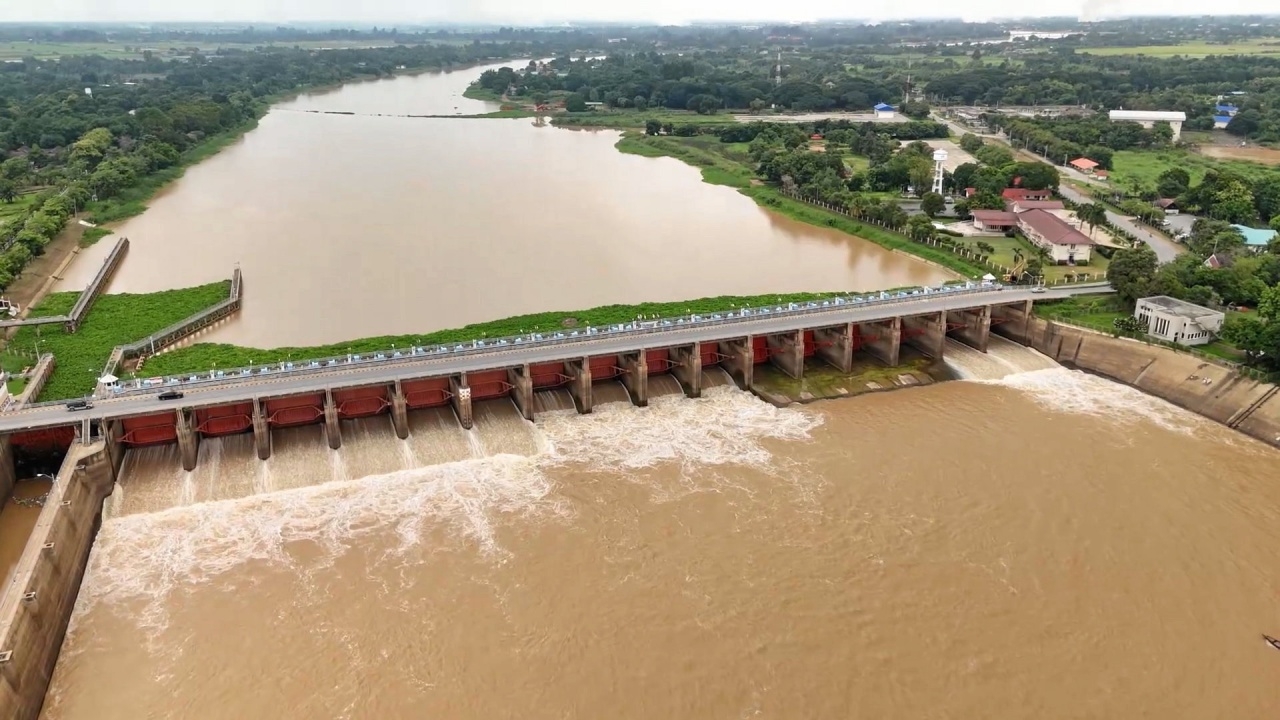
The Royal Irrigation Department is monitoring increased rainfall from 29 August to 2 September 2026, revealing that the Chao Phraya basin reservoirs have over 9.6 billion cubic meters of capacity available and will manage water releases in accordance with the situation.
On 27 August 2026, Mr. Witthaya Kaewmee, Director-General of the Royal Irrigation Department, stated that the department’s Smart Water Operations Center (SWOC) is closely monitoring water and weather conditions. According to the Meteorological Department’s announcement No. 2 (169/2569), from 29 August to 2 September 2026, Thailand is expected to experience increased rainfall, with heavy to very heavy rain in some areas, especially the upper northern region, upper northeastern region, eastern region, and areas exposed to the southwest monsoon. Accordingly, the Royal Irrigation Department has instructed all its units nationwide to prepare for the situation.
Currently, large and medium reservoirs nationwide hold approximately 49,524 million cubic meters of water, representing 65% of total capacity, and still have over 27,142 million cubic meters of available storage. Meanwhile, the four main dams in the Chao Phraya basin — Bhumibol, Sirikit, Kwae Noi Bamrung Dan, and Pasak Chonlasit — collectively contain 15,095 million cubic meters, or 61% of total capacity, with more than 9,688 million cubic meters of additional capacity available.
Therefore, the Royal Irrigation Department has instructed irrigation projects to manage reservoir water levels appropriately, balancing the need to store water during the rainy season while reserving supplies for the dry season, in line with rainfall and inflow volumes.

Regarding the Chao Phraya basin situation at 06:00, the C.2 station in Nakhon Sawan province recorded a flow of 1,042 cubic meters per second, while the Chao Phraya Dam discharge was 620 cubic meters per second. The Royal Irrigation Department manages upstream water by controlling irrigation system intake on both the east and west sides and gradually adjusts water releases through the dam to align with conditions, aiming to minimize impacts downstream as much as possible.
If water volumes increase and additional discharge through the Chao Phraya Dam becomes necessary, the Royal Irrigation Department will inform the public regularly and urges residents in affected areas to closely follow updates and water situation information.
Mr. Witthaya added that the Royal Irrigation Department has prepared to handle the situation by readying machinery, equipment, and personnel for operations, inspecting and maintaining irrigation infrastructure to ensure readiness, and accelerating removal of waterway obstructions to improve drainage efficiency and cope with potential increased rainfall in the coming period.
The Royal Irrigation Department will continue to closely monitor water and weather conditions, managing water resources in line with the situation and the needs of all sectors to ensure efficient allocation and minimize impacts on the public as much as possible.