

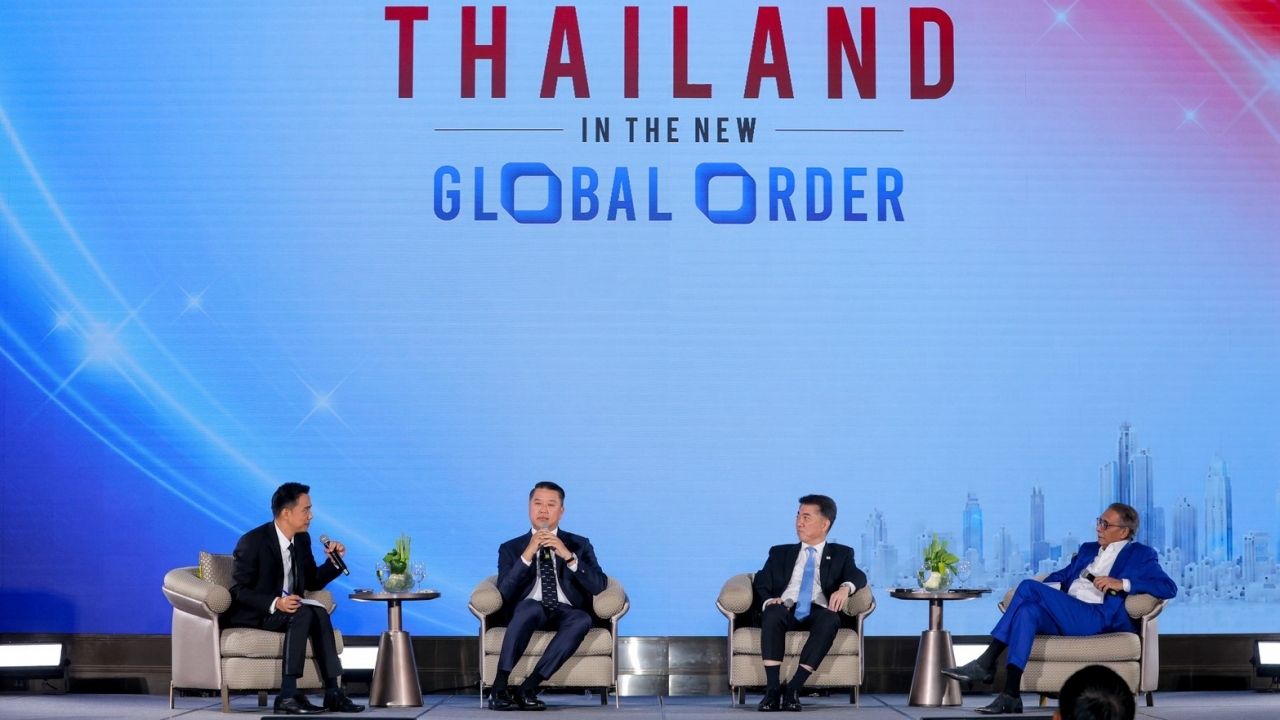
Amid geopolitical volatility, global economic shifts, and technological changes, leaders of three major Thai private organizations—Indorama Ventures Public Company Limited, Charoen Pokphand Foods Public Company Limited, and SCB X Public Company Limited—discussed strategies to handle uncertainty at a national forum. They emphasized the core importance of risk diversification, building resilience, and collaboration for sustainable growth of Thailand's economy, and connected value chains from upstream to downstream.
Thairath Group organized Thairath Forum 2026 under the theme "THAILAND IN THE NEW GLOBAL ORDER," exploring how Thailand should strategize to "survive" and "grow" amid new global economic challenges and changing rules.

Professor Emeritus Dr. Surakiart Sathirathai, Chairman of Chulalongkorn University Council and former Deputy Prime Minister, delivered the keynote speech, pointing out eight major global disruptions Thailand faces. These span technology, demographics, pandemics, environment, education, energy, economic geopolitics, and changes in the world order led by the US and other great powers. Crucially, these eight issues are happening simultaneously and interact with each other continuously.
Dr. Surakiart noted that the failure of the multilateral system is undeniable, with the UN Secretary-General having little role in peace mediation, and the Security Council being dominated by great powers......using veto power,resulting in no resolutions being passed, while General Assembly resolutions are merely recommendations without binding force. Meanwhile, the multilateral trade system under the World Trade Organization has been undermined by reciprocal tariff measures.
These crises have shifted global leaders’ mindset on risk from an "Efficiency First" approach—producing at the lowest cost—to "Security First," accepting higher costs to ensure availability. The strategy has shifted from "Just in Time" to "Just in Case," because in an uncertain world, the cost of shortages outweighs expensive goods. The world is moving from fragmented globalization to diversifying raw material sources, ultimately leading to a globalization that emphasizes adaptability.
Regarding Thailand’s stance, Dr. Surakiart proposed that the country must become a "Resilient Regional Hub" that is stable yet open—"Resilient but Connected." Thailand should be a country with acceptable costs, a workforce with market-relevant skills, and strong connections with all parties, making it indispensable to the world.
Dr. Surakiart concluded that the new world offers Thailand more opportunities, including in the aging economy where Thailand excels in care services; the transition to clean energy; high-tech manufacturing; and rethinking tourism to emphasize safety from crime, disasters, and cybercrime. He also stressed education reform, which should be viewed as an industrial and economic policy, not merely a social policy that often faces budget cuts first.
Following the keynote, a panel discussion featured top executives from three large private companies with production bases and revenue diversified across multiple regions: Aloke Lohia, Group CEO of Indorama Ventures Public Company Limited; Prasit Boondoungprasert, CEO of Charoen Pokphand Foods Public Company Limited; and Arthit Nanthawithaya, CEO of SCB X Public Company Limited.

Aloke Lohia recounted that he arrived in Thailand in 1988 with $10 million in capital, surviving the 1997 Asian financial crisis and the 2008 global financial crisis. Today, the company has expanded to over 100 factories worldwide.
He shared that the key lesson from 1997 was not to put all eggs in one basket, leading to the company’s first foreign investment in the US in 2002 and integrating the entire value chain from upstream to downstream. He noted that the recent Hormuz Strait crisis barely affected the company, despite Thailand’s heavy reliance on energy imports, and no factory had to halt operations. The more severe crisis was in 2022, which has since passed. He emphasized that Thailand is home and a vital supportive base for the company.

Prasit Boondoungprasert described CPF as a well-diversified and resilient portfolio, with factories and farms spread across about 17 countries and exports to 40-50 countries worldwide. The company focuses investment primarily in Asia due to deeper cultural understanding and work methods, while Europe shows slower growth. CPF is also exploring opportunities in Africa. He pointed out that food security and self-reliance are growing concerns in many countries, citing Saudi Arabia as an example of a nation that once heavily depended on imports but now produces some products domestically and even exports.

Arthit Nanthawithaya, from the financial sector perspective, observed a significant increase in foreign direct investment into Thailand over the past 7-8 months, driven by major waves in technology investments such as AI and data centers, which are directly linked to energy demand. However, he cautioned that Thailand’s economy overall remains "K-shaped," with the lower segment still vulnerable. He questioned the extent to which Thailand’s economic structure has changed over the past decade and whether it still relies on old frameworks. He suggested that the current investment wave will truly benefit Thailand only if localization, local content creation, and technology transfer are realized.
All three agreed that growth by large corporations alone is insufficient. Prasit noted that CPF has over 5,000 business partners in Thailand, including about 3,600 SMEs, and if these partners cannot survive, the company cannot either. This led to initiatives supporting partners starting during the COVID-19 pandemic.
Meanwhile, Arthit emphasized that all companies start fragile, so giving opportunities to new businesses is effectively supporting the Thai economic system. Aloke proposed leveraging Thailand’s capital markets and improving the efficiency of state enterprises and infrastructure investments to act as shock absorbers, similar to their role in supporting the economy after the 1997 crisis.