

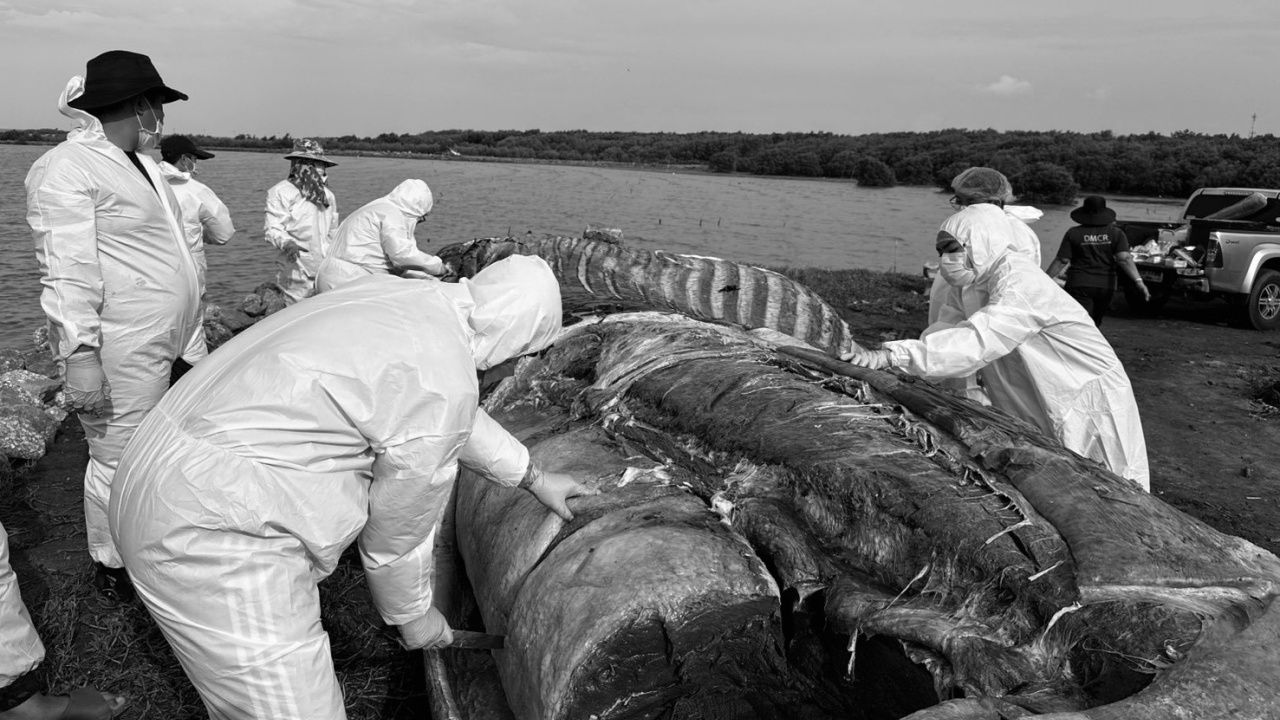
Autopsy results revealed "Chao Malee" the Bryde's whale stranded dead at Bang Pu suffered severe blunt force trauma causing shock from serious injuries combined with blood loss.
On 31 August 2026, a Bryde’s whale was found stranded near the rock embankment at Khlong Sao Thong community, Bang Pu Subdistrict, Mueang Samut Prakan District, Samut Prakan Province. Mr. Suchat Chomklin, Minister of Natural Resources and Environment, recognizing the importance of conserving and protecting Bryde’s whales, assigned Dr. Pinsak Suraswadi, Director-General of the Department of Marine and Coastal Resources, to urgently find ways to prevent and resolve the issue of Bryde’s whale deaths caused by vessel collisions.
Officials were deployed to monitor, inspect, and track vessel movements in areas where Bryde’s whales live and travel. They also coordinated with related agencies and boat operators to establish concrete measures to reduce boat speeds and minimize collision risks.
The autopsy of the reported whale carcass identified it as a male Bryde’s whale (Balaenoptera edeni), sub-adult stage, measuring 10.70 meters long (excluding the missing tail portion). The carcass was decomposed with peeling skin. The upper jaw bones (maxilla and premaxilla), left lower jaw (mandible), nasal bones, and tail section were missing.
The whale was in generally good physical condition, with 2.8–4.0 cm thickness of subcutaneous blubber. No external wounds were visible. The muscular and skeletal systems showed bruising and hemorrhaging around the head, with fragments of upper jawbone embedded in tissue. The right lower jaw showed abnormal protrusion (mandibular prognathism). The cardiovascular system showed no abnormalities.
The respiratory system was decomposed. The digestive system was abnormally positioned, with the stomach and intestines displaced from the abdominal cavity to beneath the skin on the left side of the body (traumatic lumbar hernia). No intestinal necrosis was found, but bruising and hemorrhaging were present around the abdominal wall, indicating severe blunt force trauma from a blunt object, causing tearing of muscles and fascia on the side of the body. Food residue was found in the lower digestive tract. The liver, kidneys, and pancreas were decomposed.
In summary, the autopsy concluded the whale died from severe blunt force trauma to the head and upper jaw, resulting in fractured upper jaw bones, herniation beside the body, and shock from severe injury combined with blood loss.
Additionally, based on physical characteristics and initial sighting data, the whale is believed to be "Chao Malee," the sixth calf of mother Kan-ya, first recorded by Mr. Jirayu Ekkul on 16 May 2021.
To prevent and reduce future incidents, the Department of Marine and Coastal Resources will intensify surveillance and vessel tracking in Bryde’s whale habitats and travel routes. They will consider deploying staff to patrol and coordinate with boat operators and relevant agencies to jointly establish appropriate measures to reduce vessel speeds and prevent recurrence.
Meanwhile, the public and boat operators navigating the upper Gulf of Thailand are urged to reduce speeds when spotting Bryde’s whales, maintain safe distances, and avoid approaching or crossing whales’ travel paths. This will help prevent disturbance and reduce the risk of vessel-whale collisions, contributing to the conservation and protection of Bryde’s whales in the upper Gulf of Thailand for their safe and sustainable survival.