

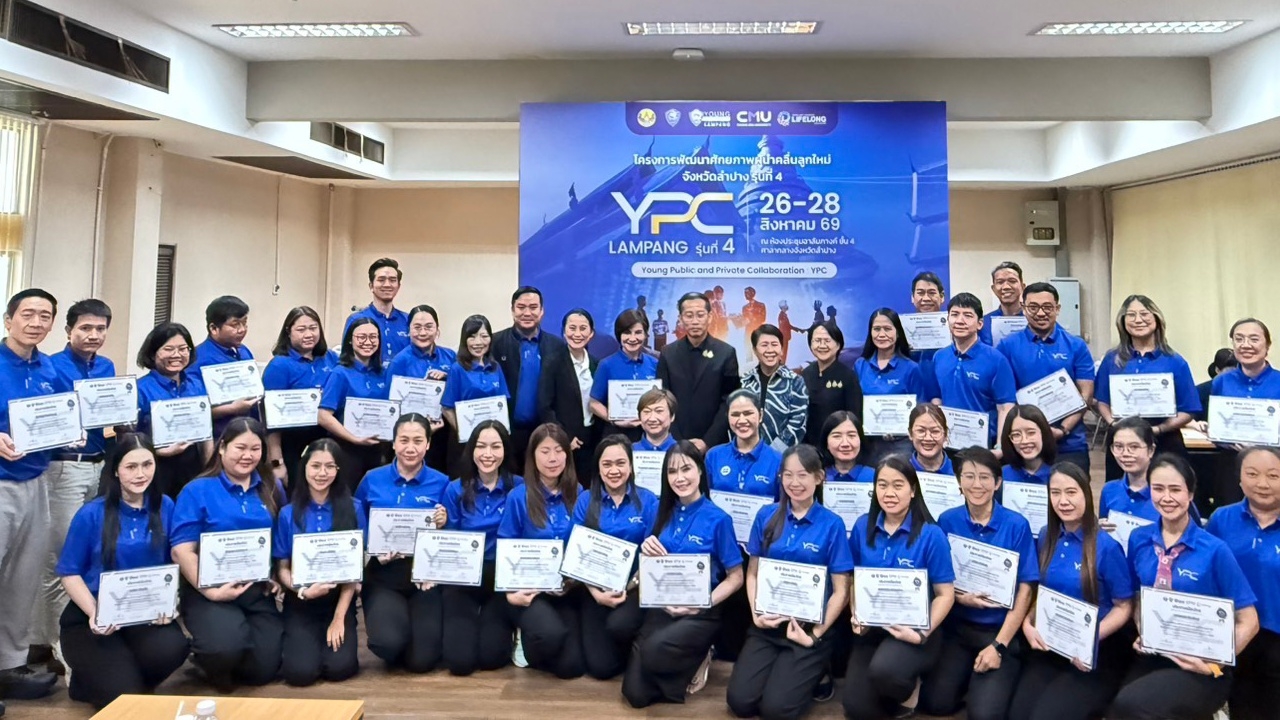
YPC LAMPANG The 4th cohort shapes new wave leaders by linking government, private sector, and academia to collaborate and apply knowledge in designing Lampang province's development strategies.
Lampang province is advancing by building new leaders and networks through the Young Public and Private Collaboration program: YPC LAMPANG 4th cohort, the 138th YPC nationwide, aiming to develop personnel from government, private, and various sectors to work together, understand development challenges, and apply modern knowledge to concretely design the province’s development paths.
YPC LAMPANG 4th cohort is a collaboration between Lampang province, the Lampang Chamber of Commerce, CMU Lifelong Education, and partner networks. The curriculum uses an Active Learning Lab process where participants engage with real provincial issues—from understanding problems, data analysis, strategic thinking, cross-sector collaboration, to designing projects ready for implementation.
A key concept this year is shifting the mindset from “Activity-based” to “Impact-based,” encouraging participants to look beyond holding events or spending budgets, and instead ask how projects create outcomes and changes for citizens, the economy, society, and the city.
Participants, new leaders from government, private sector, civil society, and academia, practice analyzing current phenomena and situations, identifying real problems and causes, stakeholders, and relevant data before linking these to setting goals, solutions, activities, and desired outcomes. This ensures project designs are well-founded and measurable.
The curriculum also emphasizes Strategic Thinking, Data, and AI to prepare new leaders for change, especially using demographic, economic, social, and spatial data to uncover problems and new opportunities, as well as applying AI to analyze data and support urban development decision-making.
Another core idea is the Four Helix Collaboration concept, recognizing that provincial development cannot be driven by a single entity but requires linking the power of government, private sector, academia, and civil society to pool knowledge, resources, networks, and expertise to solve local challenges.
Throughout the process, participants envision Lampang’s future amid economic and social changes—including the green economy, digital economy, logistics and rail transport, aging society, creative industries, tourism, and quality-of-life-focused urban development—to explore how Lampang can build on existing strengths and create new opportunities.
All knowledge culminated in group work, with participants divided into eight teams developing project concepts based on real provincial challenges, covering social, tourism, agriculture, handicrafts, and environmental sectors. Each project underwent problem and cause analysis, data use, and systematic solution design before presenting for expert feedback.
Mr. Peerarak Pichyakul, chairman of the Lampang Chamber of Commerce, stated that YPC’s key goal is to create thinking processes and networks that participants can carry forward into their work and provincial development, becoming the area’s future.
“We want to develop people who start by understanding what the real problems are, what the data tells us, who is involved, and how we can link powers from multiple sectors to solve issues together. Ultimately, what matters is the change that happens for people and the city,” he said.
The YPC LAMPANG 4th cohort is the starting point for a new wave leadership network that better understands multi-sector collaboration and is ready to apply knowledge, relationships, and developed projects to connect with real operational mechanisms locally.
From developing individuals to linking networks, and from learning to action, YPC aims to be a mechanism that fosters new generations ready to participate in designing and driving Lampang province’s future together.