

For the past three decades, global businesses have been trained to answer one question: how to produce goods at the lowest possible cost. This led to relocating production to the cheapest locations, minimizing inventory, and relying on a single supplier offering the best price.
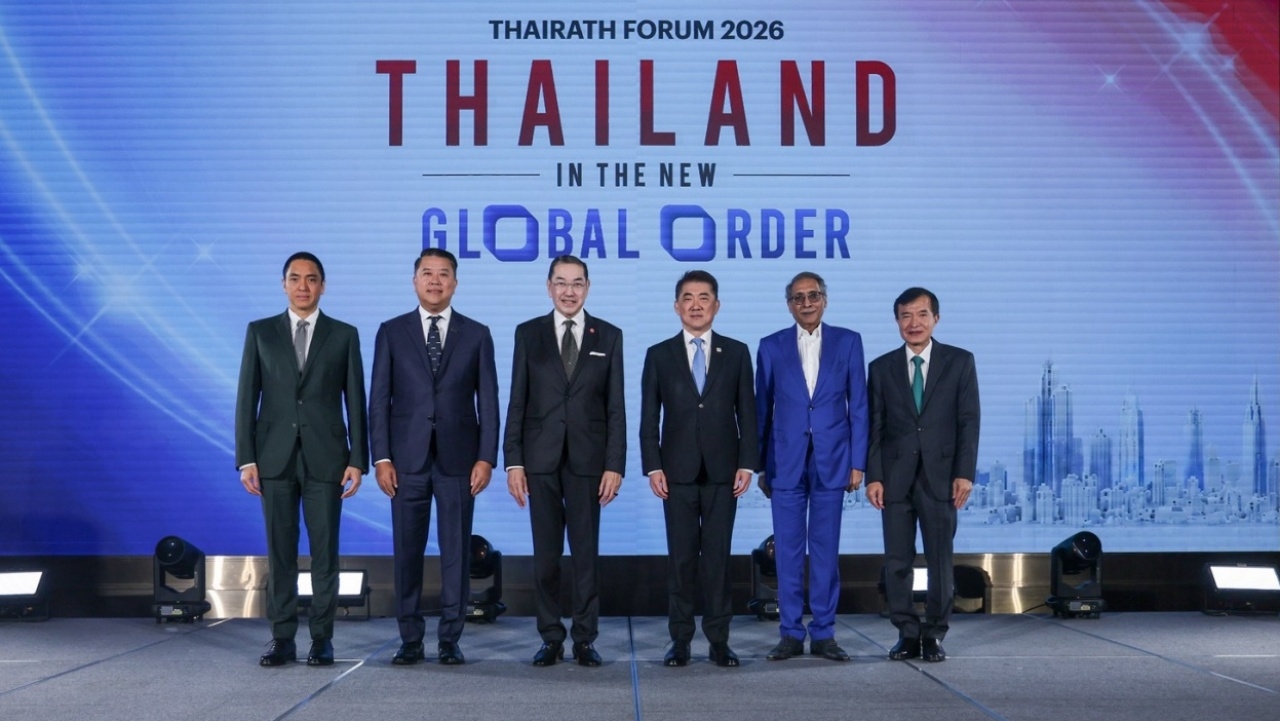
However, the THAIRATH FORUM 2026: THAILAND IN THE NEW GLOBAL ORDER stage highlighted that this question is undergoing significant change.

Special Professor Dr. Surakiart Sathirathai, Chairman of Chulalongkorn University Council and former Deputy Prime Minister, stated that global organizational leaders are shifting focus from Efficiency First to Security First, changing the question from"How to produce at the lowest cost?"to"What happens if that item is unavailable?"In practice, this means abandoning Just in Time inventory management and adopting Just in Case stockpiling for essentials like energy, fertilizer, food, medicine, and technology.
Dr. Surakiart summarized this new equation simply: expensive oil is better than no oil, and costly fertilizer is better than none. In an uncertain world, the cost of shortages outweighs the cost of high prices.
The first clear cost is tariff barriers. Dr. Surakiart, who wrote his doctoral thesis on customs duties, noted that it took about 50 years to negotiate tariffs down to an average of 3.6-3.8 percent globally. However, Reciprocal Tariff measures have pushed this up to 10-15 percent within just a few years.

People wonder if tariffs will fall again after leaders like Trump leave office. Dr. Surakiart’s answer is "No." The reason is not political but structural: when tariffs rise, many businesses invest heavily in the U.S. to bypass the barriers. The billions invested create powerful lobbying groups that resist tariff reductions because lowering tariffs reopens competition from abroad.
The result is a permanently higher global trade cost, not a temporary spike. Thai businesses must incorporate this into long-term plans rather than expect it to pass.
On finance, Dr. Surakiart pointed out that efforts to reduce dollar dependency are underway. Several trading partners now conduct transactions in their own currencies, such as India with the UAE, and China with Saudi Arabia trading energy in yuan. Meanwhile, gold has shifted from a store-of-value asset to a trading commodity, followed by silver and platinum, raising questions about stablecoins potentially replacing the dollar.
All these developments signal that international payment rules are no longer static.

Aloke Lohia, CEO of Indorama Ventures Public Company Limited, came to Thailand in 1988 with $10 million in capital. He survived multiple crises, including the 1997 Asian financial crisis and the 2008 global financial crisis. Starting from a single factory in Lopburi, the company now operates over 100 factories worldwide. Lessons from 1997 taught him not to put all eggs in one basket, leading to the first overseas investment in the U.S. in 2002 and integrating the entire value chain from upstream to downstream to build scale.
Interestingly, the recent Hormuz Strait crisis was not a crisis for his company, even though Thailand imports over 90% of its crude oil. No factory stopped production, and according to Aloke, no chemical company in Thailand halted operations. Their real crisis began in 2022 with the Russia-Ukraine war, coupled with the rise of electric vehicles, causing major oil companies to delay refinery investments and tighten raw material supply.

Prasit Boondoungprasert, CEO of Charoen Pokphand Foods Public Company Limited, shared a similar view from a different industry. The company has factories and farms in about 17 countries and exports from its main base in Thailand to 40-50 countries worldwide, following a strategy of producing where products are sold, since relying solely on exports is unsustainable in food business.
Prasit emphasized that food security and self-sufficiency are becoming major concerns globally. He cited Saudi Arabia as a case study: once heavily reliant on imports, it now produces some items domestically and even exports them. This indicates that countries once customers can quickly become competitors, a challenge relevant to Thailand as a major food exporter.
From a financial institution perspective, Arthit Nanthawithaya, CEO of SCB X Public Company Limited, noted a significant increase in foreign direct investment into Thailand over the past 7-8 months, driven by large technology investments in AI and data centers, which are directly linked to energy demand. However, Arthit emphasized that Thailand’s economy remains K-shaped, with the lower segment still weak and fragile.
Arthit candidly described banks’ situation: while appearing protected externally, banks face challenges because they cannot fully control their own fate. If customers struggle, banks struggle. Currently, their client portfolios are a mix of those doing well and those under stress.
This aligns with Dr. Surakiart’s early forum prediction that the future world will have higher prices, reduced incomes for many organizations, and small and medium businesses suffering from rising costs, declining purchasing power, reduced bargaining power, and harder access to capital.
In economic terms, Security First is a strategy requiring capital and scale. Businesses with both can diversify production across more than ten countries to reduce risk. Those without must bear higher costs fully. Thus, the gap between the upper and lower legs of the K-shaped economy tends to widen rather than narrow in this crisis.

Prasit illustrated this connection by noting CPF has over 5,000 Thai suppliers, about 3,600 of which are SMEs. He frankly stated that if these suppliers fail, CPF will fail too, as no single company can replace 3,600 partners. This explains why CPF supported suppliers since COVID-19 by accelerating payments and sending engineers to improve efficiency at no cost.
The sharpest point from Thairath Forum 2026 wasn’t external problems but the question Arthit posed: looking back over a decade, how much has Thailand’s economic structure changed? Do we still rely on the old structure? Do we have too few options?
All three speakers represent organizations that have restructured multiple times: IVL evolved from a single factory to a global network; CPF spread production across more than ten countries; SCBX restructured its financial group entirely. Yet at the national level, Dr. Surakiart observed that ministries and government departments remain largely untouched, while private companies have undertaken many changes.
Prasit pointed to the same root issue but from another angle: many problems persist because public administration focuses on short-term views. Government leaders serve only 1-3 years, too brief to understand businesses and implement long-term plans, unlike the private sector, which appoints leaders for longer terms to manage operations.
Arthit added that the problem isn’t lack of ideas or plans but unclear rules, causing societal disagreements and preventing progress.

In the new economic order, Dr. Surakiart proposed that Thailand stop marketing itself as the cheapest production base. Instead, it should become a country that produces at an Acceptable Cost, with reliability and the ability to connect with all power blocs as economic assets. Thailand can engage simultaneously with the U.S., China, Europe, Japan, Russia, Australia, and New Zealand—an uncommon trait. But to command such prices, it must deliver value and reasonableness. The biggest limitation, he said, is people. Foreign investors like Thailand almost entirely, but once familiar, they always add a "but"."But"always follows. The question he poses is whether Thailand produces people aligned with labor market needs. The answer is yes, it does not.
His proposal is to treat education as an industrial and economic policy, not merely a social one. If seen as social policy, education budgets are the first to be cut. The correct approach starts with asking what kind of people the country needs, then determining the budget accordingly.
On opportunities, he noted the new world opens more options for Thailand, including a longevity economy that requires distinguishing between "Health and care." He explained that while many compete with Thailand in health services, Thai care services are number one, attracting people from China, Japan, Singapore, and Europe.
Additionally, the clean energy transition requires financial mechanisms, and sectors like high-tech manufacturing and tourism must rethink strategies, emphasizing safety from crime, disasters, and cybercrime—factors modern tourists consider before deciding.
The private sector offered tangible mechanisms: Arthit said the current wave of tech investment will benefit Thailand only if localization, creation of local content, and technology transfer occur—not just inflow of investment money.
Aloke suggested leveraging Thailand’s capital market, second only to Singapore in ASEAN, and improving state enterprises and infrastructure investment to absorb shocks, similar to how infrastructure investment supported Thailand’s economy after 1997.

Ultimately, as global trade moves beyond competing on the label"cheapest,"Thailand can no longer remain stuck in its old economic structure.Establishing an"Acceptable Cost"requires continuous government vision to reform rules and upgrade human resources, alongside private sector flexibility to grow grassroots businesses together. In a new world full of uncertainty,are the new currencies of highest value, and that is the only way Thailand can remain an indispensable puzzle piece for the world.