

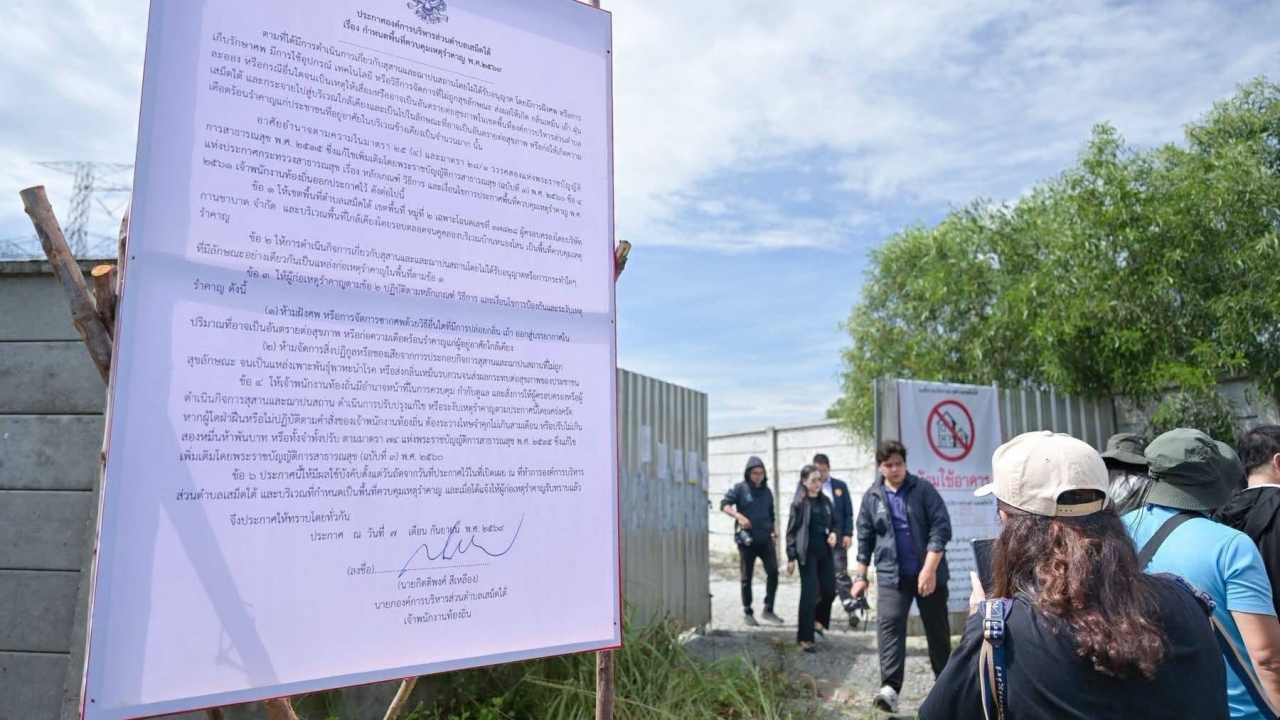
The Department of Provincial Administration clarified facts about the Jewish cemetery case. Representatives of the company that previously obtained a cemetery establishment license are prepared to relocate four bodies from Bang Khla to a licensed cemetery in Chonburi by 16 September 2026.
On 15 September 2026, reporters reported on the Jewish Cemetery Thailand in Chachoengsao province. The Department of Provincial Administration explained the facts regarding the non-renewal of the cemetery establishment license, details of the deceased, and measures to relocate the bodies. The Ministry of Interior, led by Deputy Minister Polpee Suwannachawi, the Governor of Chachoengsao, local administrative authorities, and related agencies conducted a field inspection on 11 September 2026 and now provide this explanation to clarify the situation.
Regarding the license acquisition in 2021 and the non-renewal in 2024, Kan Shabad Company Limited received its initial cemetery establishment license on 19 April 2021, using land deed number 1515, covering 15-2-86 rai. At that time, the location was about 15 kilometers from Highway 304, and the front road, San Chang–Nong Sono Road, was not registered as a local highway. The Semet Tai Subdistrict Administrative Organization certified that the land was not adjacent to any public canal, meeting the criteria under the 2000 ministerial regulation.
The license renewal request submitted on 21 December 2023 was denied by the Bang Khla screening committee in 2024. They found that changes in legal and physical conditions violated ministerial regulation clause 4(4) concerning waterway proximity. Specifically, the cemetery wall was only 187 meters from "Khlong Mai," which local leaders confirmed is a public canal used for drainage and agriculture. This violates the rule requiring a minimum 400-meter distance from waterways used for public navigation, unless odor and waste leakage prevention measures are in place, in which case the minimum is 100 meters.
The Ministry of Interior has instructed Chachoengsao province to establish a committee to investigate the individuals and agencies involved in issuing the initial license and denying the renewal, to ensure accurate and comprehensive information is obtained. The findings must be reported to the Ministry within 30 days.
Regarding the four bodies buried in the cemetery, site inspections found four burial pits: three concrete pits with permanent markers and one un-concreted pit with a temporary handwritten Hebrew marker. Related agencies have reviewed death certificates, death notifications, and passports of the deceased, gathering the following information.
Pit 1: Male, Israeli nationality, buried under a valid cemetery license, died on 14 November 2023. Pit 2: Male, Israeli nationality, buried while the cemetery was unlicensed, died on 26 November 2025. Pit 3: Male, Israeli nationality, buried during unlicensed period, died on 26 April 2026. Pit 4: Female, British nationality, buried during unlicensed period, died on 18 July 2026.
This verification involved examining the site and information on the grave markers alongside death certificates, death notifications, and passports. It does not constitute forensic proof conclusively identifying the individuals.
An order for demolition, issued by Chachoengsao province as order no. 2037/2569 dated 7 September 2026, was followed by a notice on 8 September 2026 from Bang Khla district to Kan Shabad Company Limited. The company was instructed to dismantle structures and relocate bodies within seven days of receiving the order.
Regarding the demolition and body relocation, company representative Joseph Hem Canter sent a letter dated 14 September 2026 to the Bang Khla district chief stating that Kan Shabad Company Limited acknowledges the order and will expedite dismantling and relocating the bodies to a licensed cemetery in Ban Bueng district, Chonburi province, by 16 September 2026. This cemetery is legally authorized for operation.
Deputy Minister Polpee Suwannachawi has directed the Governor of Chachoengsao to communicate with local residents about the body relocation. This includes allowing all stakeholders to prepare appropriately while ensuring compliance with legal, public health, and environmental standards. The province is also tasked with regularly reporting progress to the public until the company completes the process.