

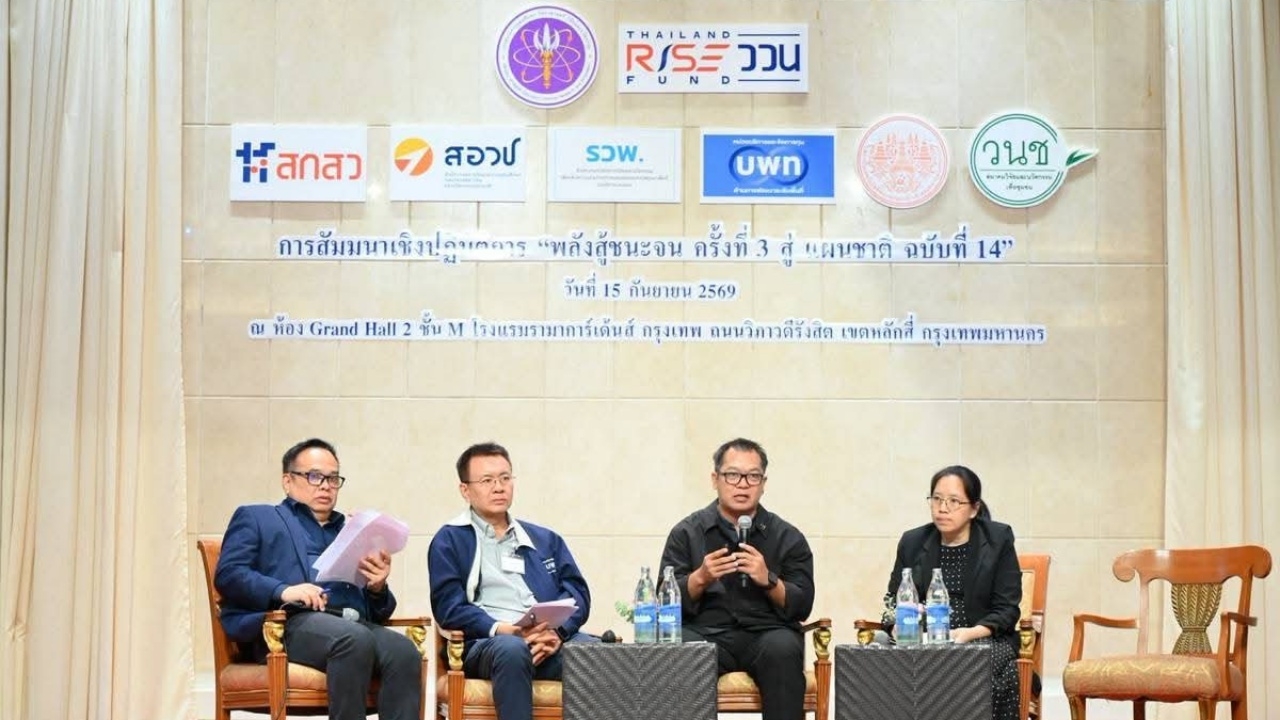
A multisectoral network joins forces with the BOPT to brainstorm and develop a sustainable poverty alleviation plan, reinforcing the 14th National Development Plan created by the people, for the people.
On 15 Sep 2026 GMT+7, Mr. Kitti Sajjawattana, Director of the Area Development Fund Management Unit at the Office of Research and Innovation Promotion for Competitiveness and Area Development (public organization), Ministry of Higher Education, Science, Research and Innovation,said,faculty members, researchers, and partners from government agencies, civil society, and private businesses gathered to share ideas and experiences to develop a comprehensive and sustainable poverty reduction plan. This plan will be submitted to the National Economic and Social Development Council (NESDC) for inclusion in the 14th National Economic and Social Development Plan, elevating it to a people-centered economic and social development strategy. The plan is based on knowledge derived from research conducted jointly by BOPT and academic institutions.
The third workshop titled “Power to Overcome Poverty” was held on 15 Sep 2026 GMT+7 at the Rama Gardens Hotel, Bangkok. Its main goal was to gather feedback from participants representing various sectors: NESDC, researchers from 19 academic institutions across 20 provinces, community organizations, civil society, and business sectors. The objective was to finalize concrete measures to be proposed for the 14th National Economic and Social Development Plan, which will serve as the master plan for Thailand’s socio-economic development from 2027 to 2031. The workshop utilized research data on poverty reduction and inequality alleviation collected by BOPT in collaboration with academics since 2020. The findings identified 303,444 poor households and 1,243,449 poor individuals in the 20 poorest provinces, forming the foundational data for discussion.
,Mr. Kitti explained that the seminar was designed to align with the structure of the 14th NESDC plan, divided into five subgroups: economic structure, public sector reform, human capital enhancement, resource and environmental management, and research, technology, and innovation transfer and investment. These groups extracted knowledge, experiences, and opinions from all participants, synthesizing the data to advance the 14th National Economic and Social Development Plan. The focus is on addressing poverty, reducing inequality, improving quality of life, and ensuring security for people in local areas.."Mr. Kitti added that key questions expected to be clearly addressed in the 14th plan include the status of 9 million registered farming households, tens of millions of informal workers, the poorest 20% of households, and grassroots economies at the community level. The plan must clarify their position and the development mechanisms to support them.
He further outlined three main approaches for sustainable poverty reduction: developing skills for steady income generation; enhancing financial management skills and fostering habits of sufficiency without extravagance; and improving budget management efficiency to quickly and accurately reach poor households.

Mr. Ennu Suwansuwan, a member of the NESDC, said that the integrated data from research, feedback, proposals, and participant experiences from this workshop will be synthesized into the 14th National Development Plan. The 14th plan will officially take effect on 1 Oct 2027 and will be the first to emphasize area-based development, aligning with the context of each locality to strengthen local communities. This differs from previous plans, which focused on issue-based development.Area-baseddevelopment tailored to local contexts aims to empower people in their communities, contrasting with previous issue-based plans.
However, the process for developing the 14th plan differs from past plans by opening participation widely to citizens from multiple sectors and professions to express their views and suggestions fully. The goal is to ensure the 14th plan is truly a development plan of the people, for the benefit and happiness of the people, rather than solely a plan of the NESDC.
The foundational research data on poverty reduction and inequality narrowing covers the 20 poorest provinces nationwide: Pattani, Amnat Charoen, Mae Hong Son, Chai Nat, Surin, Yasothon, Sisaket, Sakon Nakhon, Mukdahan, Kalasin, Buriram, Narathiwat, Ubon Ratchathani, Lampang, Phatthalung, Nakhon Ratchasima, Roi Et, Phitsanulok, Loei, and Yala.