

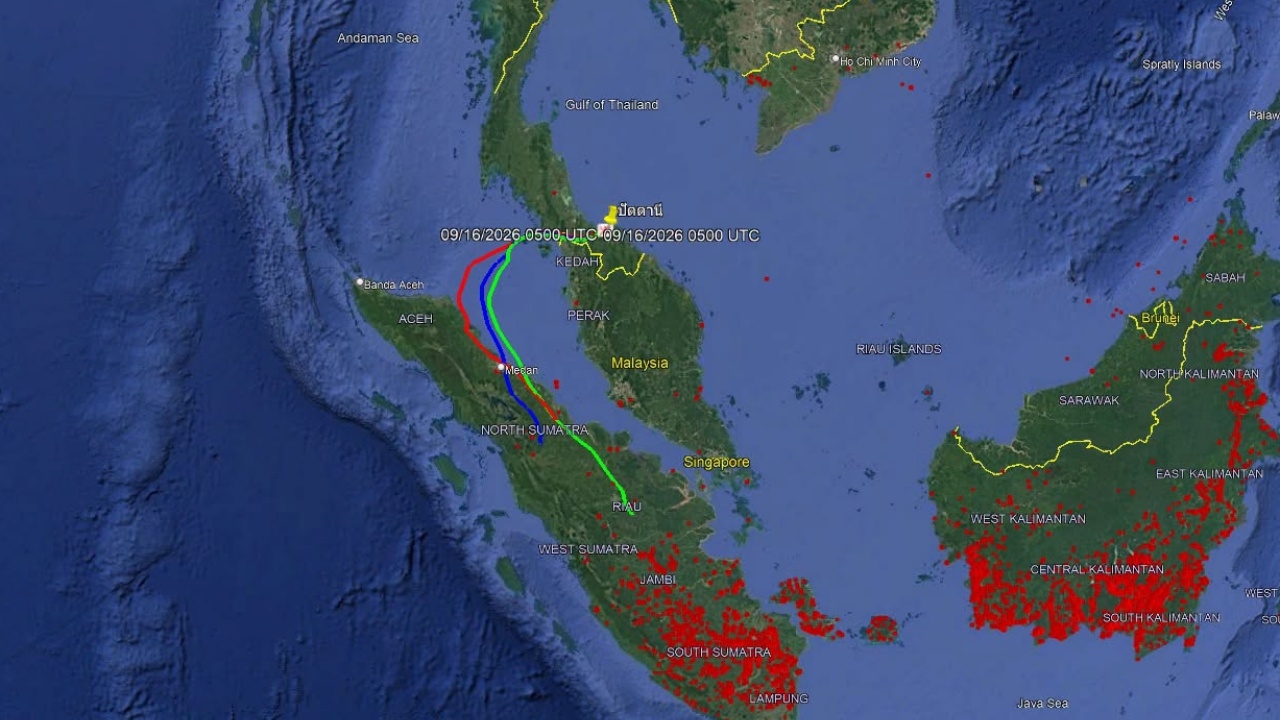
The Pollution Control Department reports that PM 2.5 dust levels in southern Thailand have begun to exceed safety standards and are continuously worsening. Air conditions remain stagnant, and urgent coordination with the ASEAN Secretariat is being prepared to address the problem.
On 17 Sep 2026 GMT+7, the Air Pollution Communication Center of the Pollution Control Department is monitoring the worsening transboundary haze crisis in southern Thailand. Numerous hotspots remain active in Indonesia, and wind patterns are bringing the resulting smoke into southern Thailand, causing PM 2.5 levels in the region to surpass standards.
Air quality in southern Thailand on 17 Sep 2026 GMT+7 shows overall PM 2.5 dust levels ranging from very good to beginning to impact health. Two southernmost provinces, Narathiwat and Yala, recorded 24-hour average PM 2.5 levels exceeding standards, between 14.3 and 39.7 micrograms per cubic meter (µg/m³). Hourly PM 2.5 levels spiked significantly at 14:00 on 16 Sep 2026 GMT+7 as follows:
1. Central Stadium Station, Tha Taphao Subdistrict, Mueang District, Chumphon Province: 14.2 µg/m³.
2. Regional Environmental Office 14, Makham Tia Subdistrict, Mueang District, Surat Thani Province: 26.3 µg/m³.
3. Elderly Health Rehabilitation Center, Khlang Subdistrict, Mueang District, Nakhon Si Thammarat Province: 26.5 µg/m³.
4. Tara Public Park Station, Pak Nam Subdistrict, Mueang District, Krabi Province: 15.5 µg/m³.
5. Phuket Municipal Public Health Service Center, Talat Yai Subdistrict, Mueang District, Phuket Province: 26.1 µg/m³.
6. Phatthalung Central Stadium Station, Khao Chiek Subdistrict, Mueang District, Phatthalung Province: 24.7 µg/m³.
7. Trang Polytechnic College Station, Na Taluang Subdistrict, Mueang District, Trang Province: 25.5 µg/m³.
8. Hat Yai Municipality Station, Hat Yai Subdistrict, Hat Yai District, Songkhla Province: 32.4 µg/m³.
9. Satun Provincial Hall Station, Phiman Subdistrict, Mueang District, Satun Province: 26.7 µg/m³.
10. Pattani Forestry Center Station, Rusamilae Subdistrict, Mueang District, Pattani Province: 38.0 µg/m³.
11. Chang Phueak Ceremony Ground Station, Sateng Subdistrict, Mueang District, Yala Province: 40.2 µg/m³.
12. Betong Municipal Child Development Center Station, Betong Subdistrict, Betong District, Yala Province: 38.2 µg/m³.
13. Narathiwat Provincial Hall Station, Bang Nak Subdistrict, Mueang District, Narathiwat Province: 40.6 µg/m³.
GISTDA data on 16 Sep 2026 GMT+7 recorded four hotspots in Thailand, including one in southern Thailand, while Indonesia had 7,236 hotspots. The southern border area shows low ventilation rates, facilitating dust accumulation. This area requires special monitoring if smoke from Indonesia continues.
In the past 24 hours, rainfall covered most of southern Thailand, and the Meteorological Department forecasts rain in many areas until 21 Sep 2026 GMT+7, which may help ease the situation. However, wind analysis shows air currents blowing from south to north into southern Thailand. Air movement models indicate that air masses and smoke likely originate from southern Sumatra, where many hotspots are active.
The Pollution Control Department will closely monitor the situation. If transboundary haze from neighboring countries affects Thailand, the department will promptly send a letter to the ASEAN Secretary-General seeking cooperation from neighboring countries to reduce hotspots and minimize impacts on the population.
Residents can track air quality and PM 2.5 levels via the Air4Thai app and the Pollution Control Department's Facebook page. Those in risk areas should monitor conditions closely and reduce outdoor activities if dust levels rise, following health guidance from relevant agencies.
Information provided courtesy of the Pollution Control Department's Facebook page.