

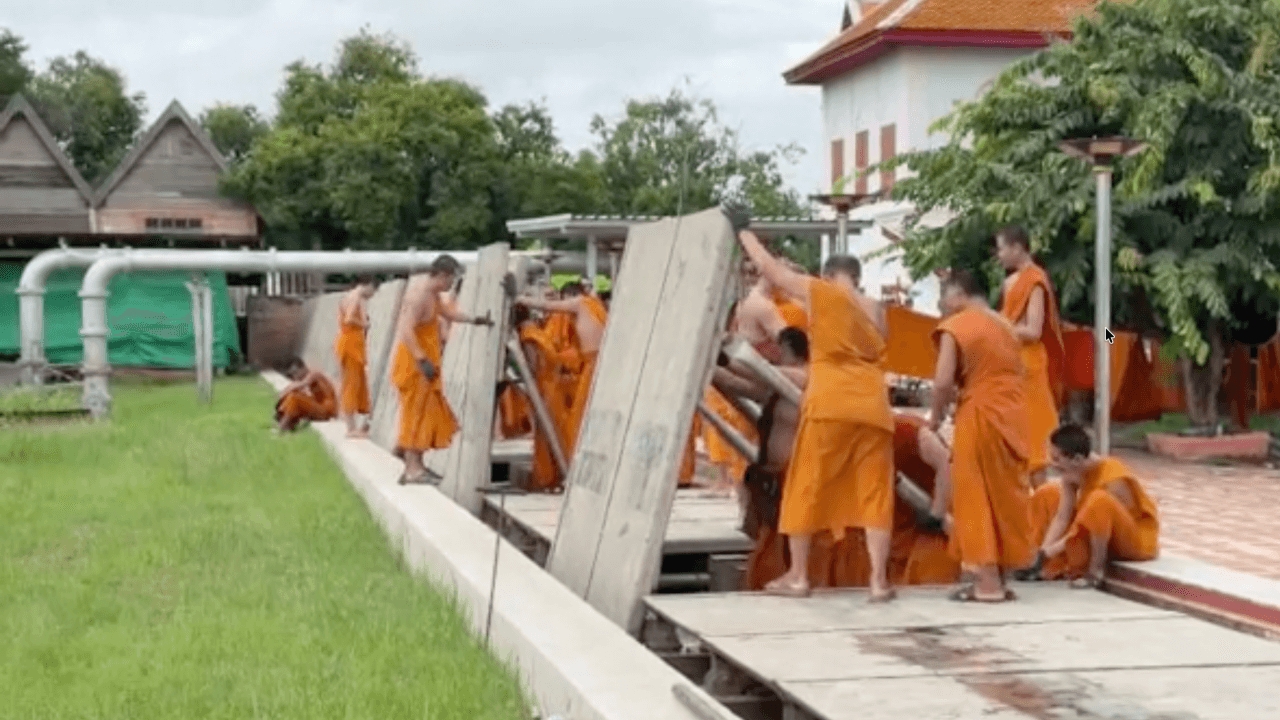
The Chao Phraya River water level continues to rise. In Ayutthaya, authorities are hastening the installation of knockdown-style bunker barriers to prevent flooding in the areas of "Wat Kasattrathirat–Wat Chaiwatthanaram," with only about 30 centimeters left before water reaches the outer riverbanks.
On 24 September 2026, reporters reported on the water situation in Phra Nakhon Si Ayutthaya province. Following increased downstream releases from the Chao Phraya Dam, water levels in the Chao Phraya River, Noi River, and several tributaries have steadily risen. Riverside and areas outside flood embankments are beginning to be affected, while relevant agencies are working to prepare defenses, especially for important riverside historic sites.
At Wat Kasattrathirat Worawihan in Ban Pom Subdistrict, Phra Nakhon Si Ayutthaya District, located on the banks of the Chao Phraya River, water levels have continued rising with strong, fast currents. Currently, about 30 centimeters remain before water reaches the outer embankment level of the temple.

More than 30 monks and novices at Wat Kasattrathirat Worawihan, along with military personnel, are rapidly installing a knockdown flood barrier inside the temple grounds, spanning approximately 120 meters in length and 1.90 meters in height. This aims to prevent Chao Phraya River water from entering important areas within the temple. Two water pumps have been tested and prepared to handle any seepage or leaks.
Phra Thep Watcharachariya, the Provincial Chief Monk of Phra Nakhon Si Ayutthaya and abbot of Wat Kasattrathirat Worawihan, along with Paweena Thongsakulphan, head of the Phra Nakhon Si Ayutthaya Provincial Disaster Prevention and Mitigation Office, and Amornrat Kruengkrai, district chief of Phra Nakhon Si Ayutthaya, closely monitored the water situation and barrier installation on site.
At the historic site of Wat Chaiwatthanaram, officials from the Fine Arts Department have installed prefabricated flood bunker barriers 1.90 meters high along the Chao Phraya riverbank, covering about 165 meters with 138 panels. Tarpaulins and sandbags have been added to reinforce strength and prevent water seepage.
Automatic water pumps have also been installed to immediately remove any water that seeps through the barriers into the historic site. Workers are filling sandbags to have ready for strengthening the defenses if water levels rise further.

Water level checks at Wat Chaiwatthanaram show about 30 centimeters remain before water reaches the outer embankment level of the historic site. The bunker barriers have been used before during higher water events and remain stable and strong.
Meanwhile, tourists, both Thai and foreign, continue to visit Wat Chaiwatthanaram as usual. Roads and main routes into the area remain unflooded, allowing normal access for tourism.
Amornrat Kruengkrai, district chief of Phra Nakhon Si Ayutthaya, revealed that the Chao Phraya Dam continues to release increasing amounts of water, causing residents outside flood embankments to be affected, especially in the municipalities of Phra Nakhon Si Ayutthaya, Ban Mai Subdistrict, Khlong Takian Subdistrict, and Phu Khao Thong Subdistrict. About 50 households have been initially impacted by the water situation.
Regarding historic sites, the Phra Nakhon Si Ayutthaya District has coordinated with the Fine Arts Department, military, and other relevant agencies to install flood defense barriers and prepare to prevent water intrusion into important areas and damage to historic sites.
Additionally, village chiefs, headmen, and community leaders have been notified to stay vigilant and prepare for the water situation. They have been instructed to pay special attention to bedridden patients, elderly people, and other vulnerable groups. The district already has data on these groups to ensure rapid and comprehensive assistance if water levels rise further.