

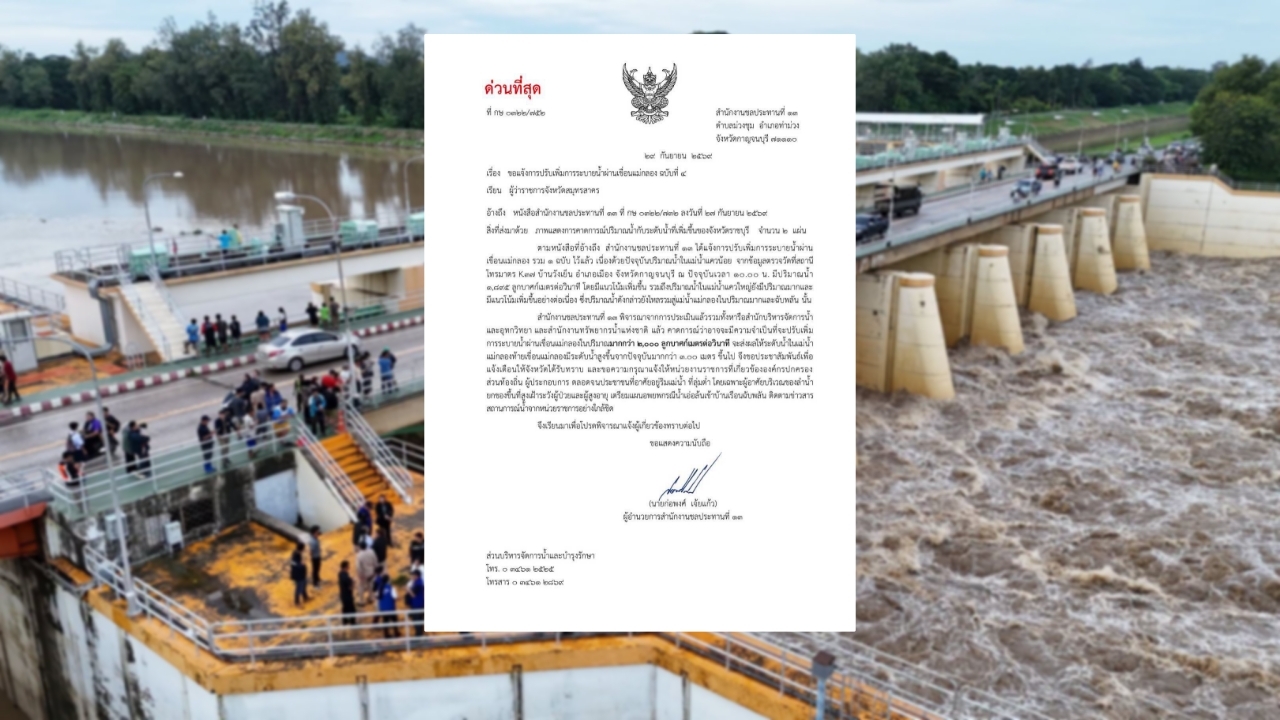
Mae Klong Dam Discharge increased to 2,000 cubic meters per second; four provinces warned to move belongings to higher ground since the afternoon. Water levels downstream of the dam are expected to rise about 3 meters from current levels. Patients and the elderly are being closely monitored, and evacuation plans are being prepared.
On 29 Sep 2026 GMT+7, Mr. Witthaya Kaewmee, Director-General of the Royal Irrigation Department, stated that the department is closely monitoring water conditions in the Mae Klong River basin after water volumes in the Kwae Noi and Kwae Yai rivers have continued to increase, resulting in more water flowing into the Mae Klong River. As of 13:00, the Mae Klong Dam adjusted its discharge to 2,000 cubic meters per second, which is expected to raise water levels downstream by about 3 meters from current levels. Earlier, the 13th Irrigation Office urgently informed the governors of Kanchanaburi, Ratchaburi, Samut Songkhram, and Samut Sakhon provinces. At 10:00, the telemetry station K.37 at Ban Wang Yen, Mueang District, Kanchanaburi, reported Kwae Noi River flow at 1,895 cubic meters per second with an increasing trend. Meanwhile, the Kwae Yai River also has a large and rising water volume, increasing the flow into the Mae Klong River.
The rainfall is moving northward and westward across northern and central regions, especially in Kanchanaburi and Ratchaburi provinces, where heavy and accumulated rainfall must still be closely watched. At Wachiralongkorn Dam in Kanchanaburi, the reservoir held 8,484 million cubic meters of water yesterday, or 96% of its capacity, with inflow continuing to rise. Therefore, increased discharge is necessary to accommodate incoming water.
Today, the Electricity Generating Authority of Thailand (EGAT) increased discharge from Wachiralongkorn Dam from 15 million cubic meters per day to 30 million cubic meters per day, with plans to raise it further to 42 million cubic meters per day from 30 September to 4 October. Water discharged from Wachiralongkorn Dam flows into the Kwae Noi River, then joins the Kwae Yai River in Kanchanaburi before continuing as the Mae Klong River. Thus, the amount of water flowing into Mae Klong Dam requires ongoing assessment.
Mr. Witthaya also urged government agencies, local administrative organizations, businesses, and residents along rivers and low-lying areas, especially near riverbanks, to move belongings to higher ground, monitor patients and the elderly closely, prepare evacuation plans in case of sudden flooding, and keep updated on water conditions through government sources.