

Continuing the End of Buddhist Lent tradition, devotees flocked to the "Tak Bat Devo" merit-making ceremony, bringing a procession of monks down from "Sakae Krang Hill" in Uthai Thani province, with over 30,000 people attending.
On 27 October 2026 at 07:00 at Wat Yai Chai Mongkhon Worawihan, Phra Nakhon Si Ayutthaya district, Phra Kru Sirichai Mongkhon, the district chief monk and abbot of the temple, led 33 monks residing there to walk down from the historic Great Victory Pagoda, built by King Naresuan the Great to celebrate victory over enemies, to receive alms from nuns and Buddhist devotees dressed in Thai silk and white clothing, offering rice, dried food, sticky rice wrapped in banana leaves, and rice balls along a route over 300 meters long.

Along the route, people continuously participated in the Tak Bat Devo ceremony up to the sermon hall, where they jointly made merit by offering food to the monks. Phra Kru Sirichai Mongkhon led the monks in chanting, giving precepts, meditation practice, and delivering sermons.
The Tak Bat Devo Rohana tradition dates back to the Buddha's time after he preached to his mother in the Tavatimsa Heaven throughout the Lent period. Upon his return, devotees awaited him with alms. Wat Yai Chai Mongkhon Worawihan follows the ancient tradition by holding the ceremony one day after the End of Lent, with monks descending from the sacred Great Victory Pagoda, creating a beautiful and auspicious sight.
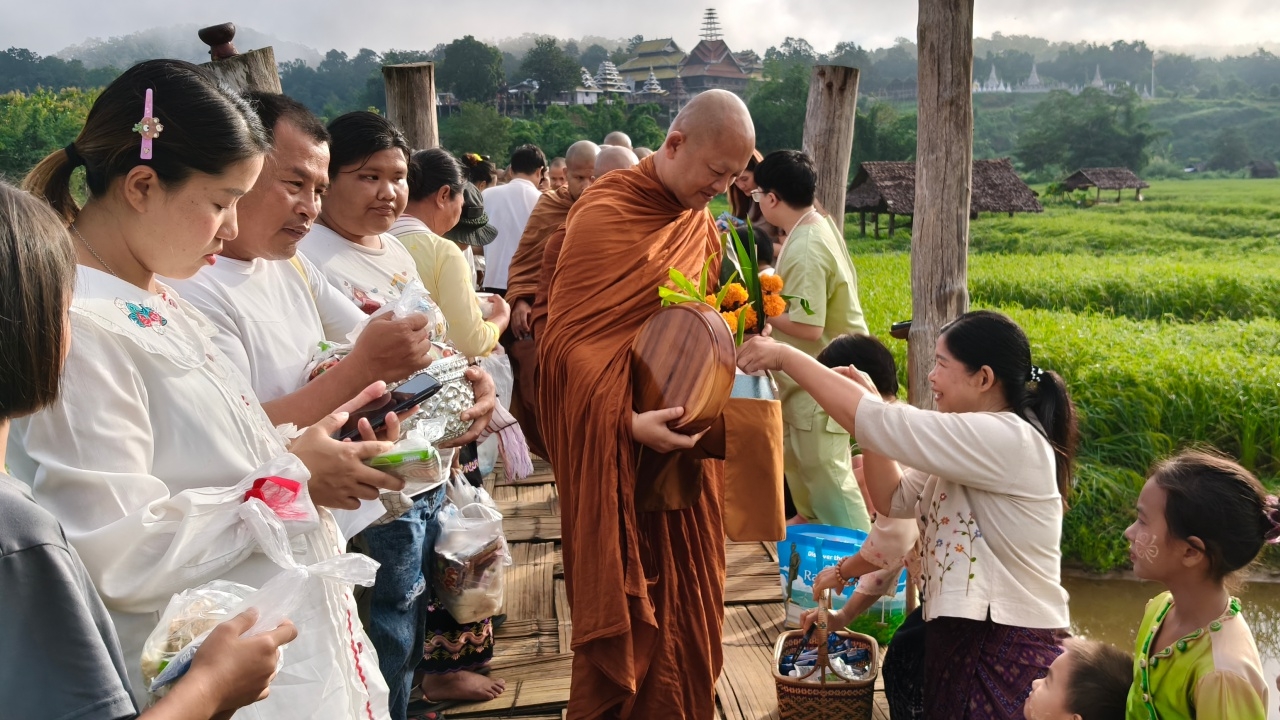
At Wat Phu Somnaram in Ban Kung Mai Sak, Pang Mu Subdistrict, Mueang District, Mae Hong Son, the Tak Bat Devo Rohana ceremony was held for the End of Buddhist Lent on Sutongpe Bridge, also known as the Bridge of Merit and Wish Fulfillment, spanning the Mae Sa Nga River and rice fields. Phra Athikan Jittaphat Akkapanyo, abbot of the temple, led 72 monks and novices to receive alms from devotees, including local residents, government officials, and tourists, along the over 600-meter-long bridge amid the cool morning air.

However, this year, although many came to give alms on Sutongpe Bridge, the number was noticeably lower than in previous years. This decline may be due to the sluggish economy and fewer tourists traveling to Mae Hong Son province.

Sutongpe Bridge remains strong and capable of supporting the crowd, having recently been repaired after floodwaters damaged and caused it to collapse in early August. Wat Phu Somnaram, locals, and devotees collaborated to restore the bridge in time for this End of Buddhist Lent festival.

At 08:30 on 26 October 2026, at Wat Sangkat Rattanakiri in Mueang District, Uthai Thani province, Chada Thaiset, MP for district 2 of the Bhumjaithai Party, and Panatja Thaiset, mayor of Uthai Thani municipality, together with officials, opened the Tak Bat Devo tradition event. More than 30,000 Buddhist devotees gathered to make merit by offering rice, dried food, and rice balls at the temple grounds.

The procession brought a Buddha image in the 'Open World' posture down from Sakae Krang Hill, followed by 500 monks invited from all eight districts, who descended the 449-step mountain staircase to receive alms from devotees at the mountain base. This was a beautiful display of faith and a distinctive feature of the Tak Bat Devo tradition, an important Buddhist festival commemorating the Buddha's return from Tavatimsa Heaven after the Lent period to honor his mother, according to Buddhist belief.

At the base of Sakae Krang Hill, following Buddhist legend, on the full moon of the 11th lunar month or the Great Lent Day, the Buddha returned to the human world at Sangkassan city. This annual event is continuously organized by Uthai Thani municipality.
After the Tak Bat Devo ceremony at Wat Sangkat Rattanakiri, tourists flocked to view the ivory-adorned altar tables displayed along Tha Chang Road and at the Five-Way Radio Roundabout in front of Uthai Thani municipal fresh market, known as a unique attraction worldwide.

The history of the ivory-adorned altar tables in Uthai Thani is passed down from the Ayutthaya period. Uthai Thani was a city known for regularly sending elephants to Ayutthaya and for its timber industry, which used elephants for hauling logs. Consequently, many elephants lived there. When elephants died, their tusks were kept, and wealthy households possessed several pairs of tusks, which became heirlooms passed to descendants. Owners displayed these tusks alongside their household altar tables to show status, competing over who had the finest tusks.
Additionally, a parade of Buddhist history floats, beautifully decorated by all eight districts of Uthai Thani, was held around the city district for tourists to enjoy and experience the province’s rich traditions, as the community continues to preserve these cultural practices.