

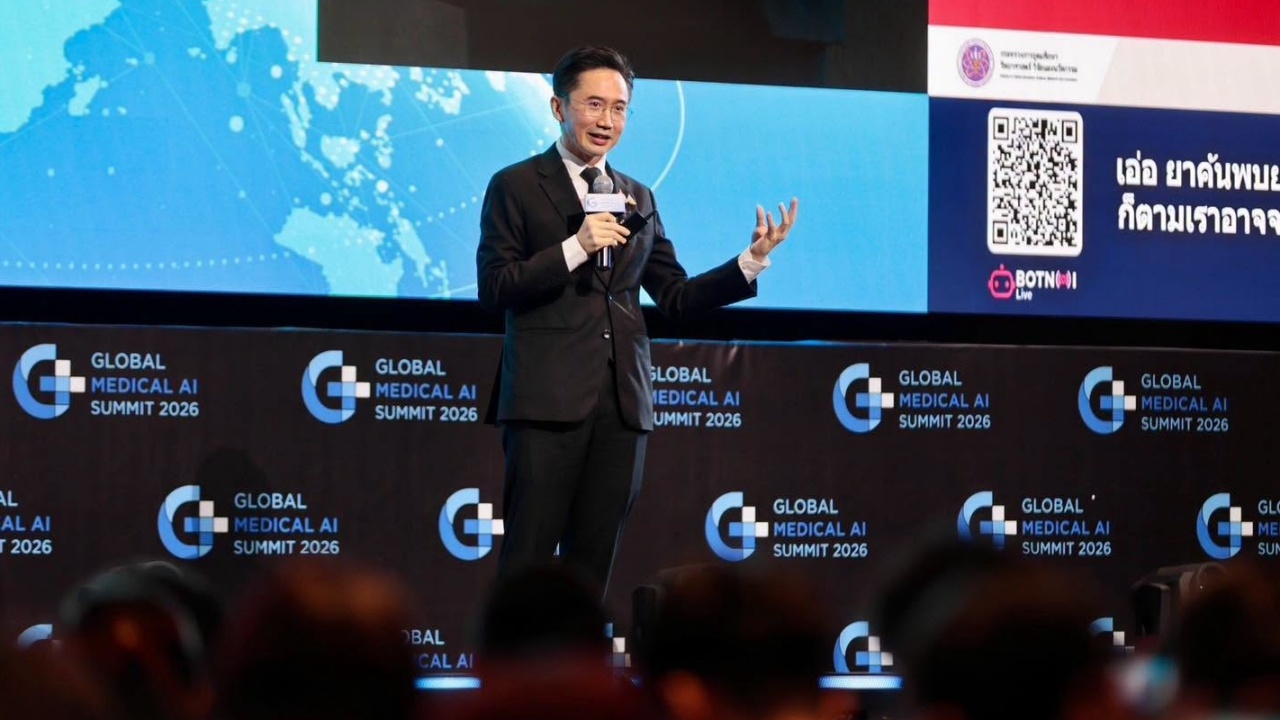
Yoschanan delivered a special keynote speech to launch the Global Medical AI Summit 2026, aiming to position Thailand as a regional center for medical AI innovation by linking research, technology, and industry to generate new knowledge for future medicine developments.
Bangkok – 30 Oct 2026 GMT+7 – The Global Medical AI Summit 2026 (GMAI 2026) gathered leading medical professionals, investors, tech innovators, and government representatives in Bangkok today. Co-organized by the Artificial Intelligence Entrepreneurs Association Thailand (AIEAT) and the Thailand Institute of Life Sciences and Innovation (Public Organization) (TILSNA), the event serves as a major international platform to accelerate the adoption, investment, and commercial scaling of medical AI technology across Thailand and Southeast Asia.
This year's summit was highly successful, attracting over 400 senior executives from 263 organizations worldwide, along with international experts from countries including the USA, Canada, UK, South Korea, Malaysia, Singapore, and the Philippines. The exhibition area buzzed with 25 booths featuring startups and tech companies showcasing cutting-edge innovations.

The conference began with a welcome address titled “The Global Gateway for Thailand's Medical AI Innovation 2026” by Dr. Chanwit Boonchuay, President of AIEAT, followed by a keynote speech presenting the vision “Thailand's Next Frontier in Medical AI” by Professor Dr. Yoschanan Wongsawat, Deputy Prime Minister and Minister of Higher Education, Science, Research and Innovation (MHESI). He positioned Thailand as a “Medical AI Hub” leveraging unique strengths such as tropical medicine data, cancer and stroke records, multidimensional data linking humans, animals, environment, and agriculture, plus a 50-year hospital tissue image archive. Medical AI encompasses not only imaging but also genomics, drug discovery, advanced therapy medicinal products (ATMP), manufacturing, energy, data centers, “Scientific Wellness,” clinical trials, and financing mechanisms. Government initiatives include establishing a national University Holding Company Consortium, engaging the Stock Exchange, opening shared university labs, utilizing Technology Licensing Offices for tech transfer, encouraging private sector challenges and hackathons, and creating private incubators and accelerators.
The goal is for Thailand to become a “Research Hub, not just a Service Hub,” promoting foundation models in medical AI, precision oncology organoids, clinical trial centers, and autonomous labs.
Thailand's location will serve as a central connection point linking BIMSTEC countries including India, Southern China, Vietnam, Laos, and Indonesia.

The official launch of the MAIN (Medical AI Network) was announced as a strategic initiative designed to unify the health technology ecosystem, connecting research through to clinical application and fostering commercial use domestically and internationally.
Key MAIN network members include the Ministry of Higher Education, Science, Research and Innovation (MHESI), TILSNA, AIEAT, AIAT, Thammasat University (TU), Sirindhorn International Institute of Technology (SIIT), Khon Kaen University (KKU), Digital Economy Promotion Agency (DCT), Thai Health Tech Association (THTA), among others.
“Funding the Future of Health” — Early-stage HealthTech and Medical AI investment in ASEAN Panelists: Dr. Joseph Mocanu (Verge HealthTech Fund), Dr. Thomas Lanyi (CDH Investments), Dr. Kid Parchariyanon (SeaX Ventures) | Moderated by Sataporn Patanakul (Guardian AI). Investors from Thailand and abroad noted AI's role in mitigating workforce shortages amid aging societies. Thailand's advantages include universal health coverage, high-quality hospitals, abundant health data, and a strong wellness industry. Future development focuses on non-invasive sensors like hyperspectral imaging and AI solutions addressing fragmented data. Investment in talent to build a regional ecosystem drew strong investor interest.

Dr. Ashraf Zarkan — CEO & Co-Founder, BioTryp Therapeutics (Cambridge, UK)
Their AI tool operates in three steps: screening over 18 million molecules, predicting toxicity and metabolism, and molecule optimization. The speaker noted AI shifts the bottleneck from molecule creation to lab testing.
Currently at lead selection (preclinical) stage, BioTryp is closing a funding round aiming for first-in-human trials before partnering or licensing to pharmaceutical companies.
The Startup Showcase featured seven companies from Thailand and abroad, including:
Attendees experienced demonstrations of advanced technologies by pioneers domestically and internationally. International exhibits included Mr. Hugo Saavedra, CEO of KYAN Therapeutics, showcasing a Functional Precision Medicine platform for cancer patients that tests drugs directly on patient cancer cells and uses small-data AI to predict and rank over 1,500 drug combinations from limited trials. Joshua Yim, Founder & CEO of Navo Health and Acryl Inc., presented AI algorithms analyzing fetal heart rate monitoring (CTG) signals for easier interpretation. Highlighting domestic potential, the Thai Medical AI Showcase presented innovations ready for market, including Shin Hyun-kyung, Vice President of Acryl Inc. (South Korea), sharing "Sovereign Medical AI: Korea's Experience, Thailand's Strategic Leap." Lessons from Korea emphasize collaboration among government, private sector, universities, and hospitals. Acryl developed "Jonathan," a platform integrating hardware and software that converts EMR/CDW data into AI-ready formats and builds proprietary foundation models without data leaving hospitals. Dr. Rapeepat Srichan, CEO of Sati, demonstrated hospital productivity platforms "Chart Sum / AI Audit" for medical record summarization, ICD coding with evidence, and policy compliance before reimbursement, plus "AI Claim Platform" for insurers to detect fraud/waste/abuse. Weha Suwatpisankit, Tech Lead at Ravis Technology, presented AI compliance tools (GMP/ISO/FDA) including the ERP system “GX Pro” with voice form entry linked to AI apps via MCP, and AI product classification for FDA submissions with references. Vipas Suttanyawalee, CTO of Athena AI, showcased a comprehensive genomics platform with Genome Archive (DNA data repository), Genome IQ (ACMG-based interpretation engine), Genome Studio (specialist tool), Wellness LifePlan (consumer reports and chatbot), Consult Guide (for doctors), and Genome Flow (case management). Finally, Sahatat Asawadilokchai, CEO & Co-Founder of Dosy Health, presented AI for CT brain scans detecting acute stroke types, hemorrhage, clots, ischemic areas, and screening for normal pressure hydrocephalus (NPH).
Medical AI Pitching Competition 2026

Simultaneously, at Hall 3's Pitching Stage, intense competition unfolded among leading Medical AI innovators. Judging and strategic benefits were derived from this international showcase, where startups fiercely vied for a 35,000 baht prize in each competition category.
Category 1: Precision & Personalized Medicine: OsseoLabs
Category 2: Smart Hospital & Healthcare Operations: BBH Hospital
Category 3: Remote Patient Monitoring & Digital Care: BINDAI
The Global Medical AI Summit 2026 set a new standard for cross-sector collaboration, reinforcing Thailand's position as a growing global center for medical artificial intelligence and HealthTech innovation.