

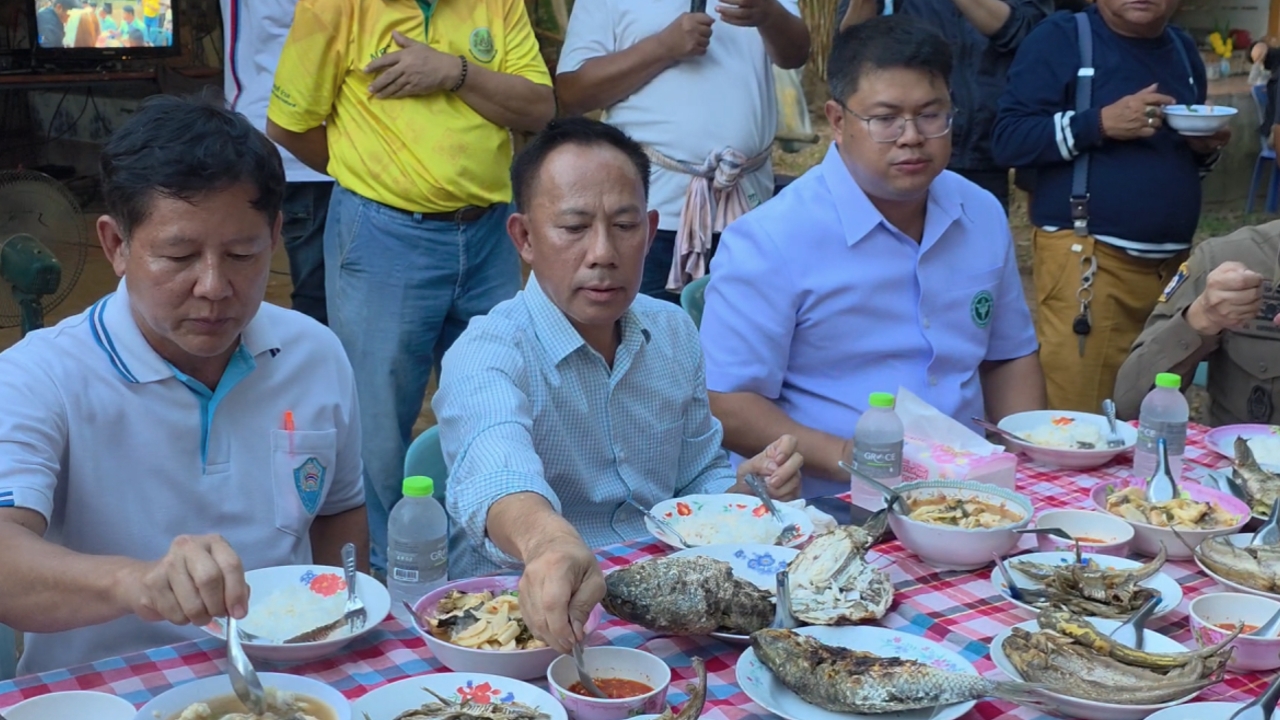
The Deputy Governor of Prachinburi visited Ban Ko Yang to taste fresh fish from the canal, urging people not to generalize the whole province amid heavy criticism, while local fishermen revealed they can catch fish but cannot sell them.
On 2 Nov 2026 GMT+7, it was reported that Mr. Chanathip Khokmanee, Deputy Governor of Prachinburi Province, acting Governor of Prachinburi Province, visited and met residents at Village 9, Ban Ko Yang, Pho Ngam Subdistrict, Prachantakham District to encourage local fishermen affected by contamination rumors about fish and aquatic animals in Prachinburi. He urged the public and social media users not to generalize that all fish in the province are contaminated and unsafe to eat.
During this visit, Mr. Chanathip joined locals in eating freshly caught fish from the canal, prepared and consumed on-site, to build confidence that fish in the area are safe to eat according to the Deputy Governor’s assurance.

While meeting locals who helped prepare and cook the fish, Mr. Chanathip also demonstrated his fishing skills by casting nets in the water. He said he grew up as a farmer's son, familiar with rural life, and has enjoyed fishing since childhood. His skilled and agile fishing showed his close connection to the fishing lifestyle.
Mr. Chanathip addressed the contamination rumors and criticism concerning fish and aquatic animals in Prachinburi, saying it is wrong to generalize that all fish in the province contain harmful chemicals or substances making them inedible.
He explained that Prachinburi is a large province with diverse environments and water sources. Generalizing fish from the entire province could harm residents, especially fish farmers and local fishermen who rely on fishing to support their families.
Mr. Chanathip said Prachinburi is an important area for freshwater aquaculture in the country, with many people engaged in fish farming and fishing. If consumers become worried and avoid eating fish, it will inevitably hurt the income and livelihoods of local people.

Regarding his visit to Village 9, Ban Ko Yang, Pho Ngam Subdistrict, Prachantakham District, Mr. Chanathip said it was in response to an invitation from Mr. Thawatchai Promchan, a representative of the Farmers Council, reflecting the frustration and discouragement of locals who catch fish but cannot sell it due to recent news. He intended to visit and encourage residents by eating fish in a simple setting to show that parts of Prachinburi can still inspire confidence.
Mr. Chanathip emphasized that this visit was not a photo opportunity but aimed to provide correct information and understanding, especially by distinguishing areas with water quality problems from those without such reports. Criticism and questions arose about using fish-eating events to build confidence.
After the fish-eating event to boost public confidence, social criticism emerged questioning the appropriateness of using such an event as reassurance amid ongoing public concerns about contamination in water and aquatic animals.

A key point raised was that eating fish once at an event cannot confirm the safety of fish across all areas, since each water source has different environments and risks, and scientific test results are necessary.
On the other hand, some viewed the Deputy Governor's visit as support for residents impacted by news, especially local fishermen who catch fish but cannot sell them normally.
However, building public confidence must be accompanied by systematic water and aquatic animal quality testing to ensure accurate communication and avoid misunderstandings that all fish in the province are equally safe or contaminated. Some areas have consumption bans awaiting Pollution Control Department results.
Mr. Chanathip said some areas currently have bans on consuming fish and aquatic animals, while the province awaits water quality test results from the Pollution Control Department, expected to be announced soon.
If tests confirm harmful contamination in any area, the province will implement appropriate control measures and consumption bans. It will also advise farmers and fishermen on standards to prevent contaminated fish and aquatic animals from affecting public health.

When asked about the possibility of contaminated fish being sold in other areas, Mr. Chanathip said that if danger is confirmed, appropriate bans and controls will be enforced. He advised farmers and fishermen to be cautious when selling aquatic animals and affirmed that only areas with confirmed data will be addressed, with plans to visit various districts.
Mr. Chanathip said, as a Prachinburi resident living near rivers, he sees people still fishing and living normally but stressed that confidence must be based on facts, not unsupported assertions. He clarified that eating fish at Ban Ko Yang was a reassurance only for that area, not an assurance that all fish from Prachinburi are safe.
For other areas like Kabin Buri District, where previous tests found certain substances in water, the province is awaiting the latest results to assess the situation and determine next steps.
Mr. Chanathip said he plans to visit other districts when possible to build public confidence and restore the province’s image, confirming only areas with verified data and test results. He will not declare areas safe without clear information.
He urged the public and news followers to consider information carefully and not to generalize that all fish or aquatic animals from Prachinburi are unsafe, as this could harm residents and fishermen not directly affected.
During an interview, when asked about rumors that some contaminated water sources might also supply tap water, Mr. Chanathip said no clear reports have been received yet and requested specific areas be identified for coordination with relevant agencies.
Currently, Prachinburi is monitoring water quality test results from relevant agencies to guide control measures and public reassurance, clearly distinguishing problematic areas from those without reported issues.
A local resident of Village 9, Ban Ko Yang, Pho Ngam Subdistrict, Prachantakham District, said that after a major flood, many fish escaped from ponds and natural water sources, resulting in a large fish supply to markets.
The villagers have long earned a living by fishing in nearby waters and selling fish at local fresh markets to support their families.

However, after contamination rumors about fish and aquatic animals in Prachinburi, they found fewer buyers for caught fish. Sometimes they had to give fish away free as people were worried and reluctant to eat them.
The resident said they feel distressed and pleaded with the public and social media users not to generalize that fish from all parts of Prachinburi are contaminated.
He requested that information be separated by district and area so fishermen in unaffected places can resume selling fish and living normally. Community leaders reflected on the impacts, noting social media caused distress to villagers.
A community leader in Prachantakham District said that after the flooding, he and some villagers were cut off from transport routes for 1–2 weeks. When waters receded, people hoped to resume fishing to earn a living.
However, many caught fish could not be sold normally due to consumer concerns over contamination, fueled by news and social media discussions about toxins in Prachinburi.
The leader said many villagers rely on local fishing, especially elderly groups aged 50–60, who have long fished canals and natural waters. In some villages, nearly half the population earns a living selling fish.
The contamination concerns have prevented villagers from selling fish normally, even though daily expenses remain, causing serious hardship.
Additionally, buyers from other provinces offer very low prices for Prachinburi fish compared to other areas—only 18 baht per kilogram versus 35–40 baht elsewhere—highlighting the economic impact on local fishermen.
The community leader also spoke about villagers’ feelings affected by social media reports that generalized Prachinburi, causing consumers to worry and avoid fish, even from areas without factories or pollution sources.
Especially in Prachantakham District, where his village has no industrial factories under types 105 and 106, he called for comprehensive data checks and urged not to generalize contamination across the province. He stressed that water in Prachantakham comes from Khao Yai and is confident the community’s water is uncontaminated.

He explained that Prachantakham’s terrain features water flowing from higher to lower areas; water from Khao Yai National Park passes through several areas before reaching Prachinburi River. He believes it is unlikely that downstream water flows back upstream. His community has no factories and he is confident local water is not affected by the current contamination concerns.
Regarding occasional black or odorous water, the leader said this may result from natural factors like decayed leaves, grass, and plant debris accumulating in water, especially in agricultural areas, which is a common annual phenomenon.
When asked about differences between water darkened by decaying grass and chemically contaminated water, he said both may appear black, but odors differ: decayed grass has one scent, chemical contamination smells sharp and pungent.
However, the community leader admitted he cannot definitively state water quality or contamination due to lack of scientific testing in the area.
He emphasized that despite local confidence in the environment, official inspections by relevant agencies are needed to provide accurate information and build trust among outsiders. He urged community leaders in 718 villages to act as watchdogs to prevent pollution.
Community leaders called on leaders from all 7 districts, 64 subdistricts, and 718 villages in Prachinburi to jointly monitor and protect their communities by reporting illegal chemical discharges, improper waste management, and urging authorities to investigate and act seriously to prevent pollution and future harm to residents.
Today, Prachinburi residents face hardships from environmental and economic problems, especially small-scale workers in communities who may not be mentioned in news but are severely affected. They urge all parties to cooperate constructively, provide comprehensive information, and help restore confidence in Prachinburi so people can resume their livelihoods normally.