

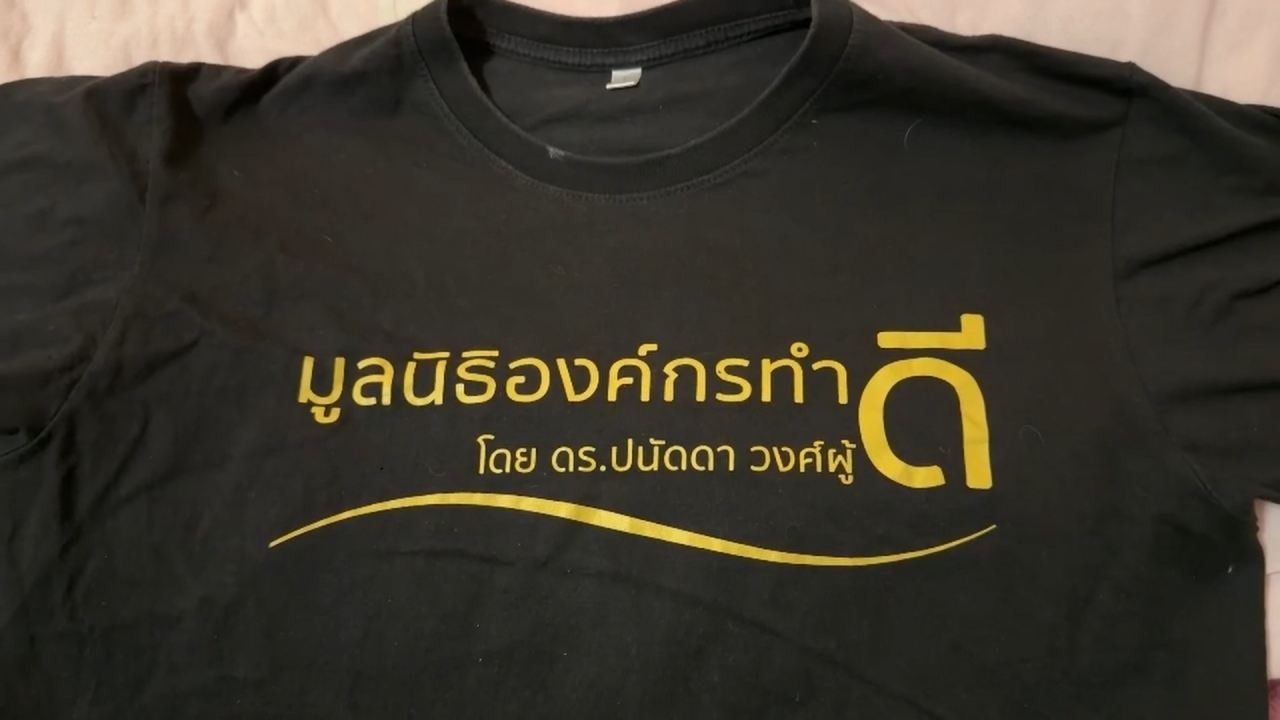
A donor to the Good Deeds Foundation said they do not hate Boon Panadda but admit feeling heartbroken, disappointed, and losing faith. They see how money can change people. They once proudly wore the foundation’s shirt but now no longer dare to wear it.
The donor opened up about their deep disappointment after following the news about the foundation, revealing they had donated money and bought shirts to support relief activities continuously. What was once a shirt worn with pride is now something they no longer dare to wear and plan to use as a mat for their cat. They admit feeling heartbroken by someone they once loved and trusted.
At 1:00 p.m. on 8 Nov 2026 GMT+7, reporters visited Khon Kaen province to gather public opinions following news about the case involving Boon Panadda Wongpudi, former beauty queen and chairperson of the Good Deeds Foundation. The aim was to reflect the feelings of people who had donated and supported the foundation's activities continuously.
Mrs. Rinpharon Intarapanich, a resident of Khon Kaen who had donated money and bought shirts supporting the Good Deeds Foundation, told reporters she felt deeply heartbroken upon first seeing news about Boon Panadda on social media. She even avoided following the news and hoped the story was untrue, initially thinking it might be a smear campaign by adversaries.
Mrs. Rinpharon said that at first, when a person named Oy Sri made a public statement, she chose to scroll past and not watch, due to negative feelings toward that individual. She shared the view held by some netizens that the statement might be an attempt to stir controversy. However, as news kept coming, especially when anchor Kanchai revealed details about the money trail, she began to feel deeply sad and disappointed because she had sincerely trusted and supported the foundation's activities.
She added that she admired strong women working for society, especially Boon Panadda, who was often among the first to help disaster victims in Thailand and worked passionately in many areas. Although she never had the chance to assist on-site, she wanted to contribute in her own small way by donating money within her means and buying shirts from the Good Deeds Foundation whenever fundraising events occurred.
Mrs. Rinpharon recalled feeling very proud the first time she received a Good Deeds Foundation shirt, seeing it as a symbol of social contribution. Previously, whenever attending events or activities, she would proudly wear that shirt. But after following the recent news, her feelings completely changed.
“I used to like wearing the Good Deeds Foundation shirt to events because it made me proud, but now I won’t dare wear it anymore. I’ll probably use it as a mat for my cat,” Mrs. Rinpharon said.
When asked if she still hated Boon Panadda, Mrs. Rinpharon said she did not hate her but admitted feeling disappointed and sad, seeing how large sums of money can sometimes change people. Someone who was once good may become different. However, she emphasized that these are just her personal feelings and opinions based on following the news.
Mrs. Rinpharon also said she usually enjoys making merit and donating to various foundations, including having donated to Wat Phrabat Namphu under Luang Por Alangkod. She felt sad when news about that surfaced but admitted she had never felt as disappointed as with Boon Panadda’s case because she felt especially connected and faithful to her.
“Regarding Boon Panadda, I have to say it’s about faith. When you’re heartbroken by someone, it’s because you loved and trusted them. But when you realize the person you loved and trusted is not who you thought, it’s true heartbreak for days,” Mrs. Rinpharon said.
Looking ahead to future charitable donations, Mrs. Rinpharon said she would be more cautious and selective, whether donating to foundations or individuals, because this incident has deeply affected the feelings of those who once trusted and had faith.
Nonetheless, she still believes in making merit and the good intentions of donors. She compared it to offering alms to a fake monk—the merit still belongs to the giver because of their good intention, while what the recipient does with the donation is their responsibility and consequences.
Mrs. Rinpharon concluded by saying the same applies to Boon Panadda’s case. She believes everyone who donated to the Good Deeds Foundation had good intentions to help others. If it turns out the money was misused, those responsible must face the consequences. But donors can still believe that the merit from their good intentions remains with them. Although she feels disappointed and has lost faith, it has not stopped her from believing in doing good and helping others.