

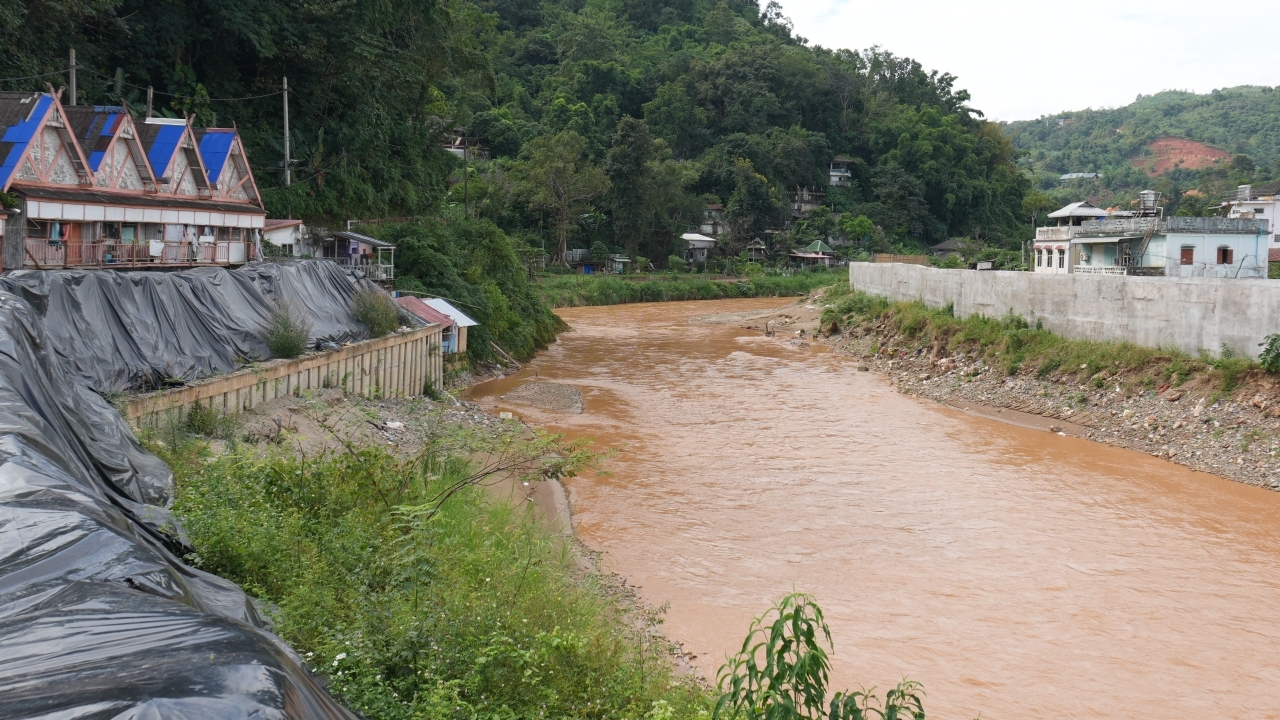
Mae Sai is heavily affected as contamination levels in the Mae Sai River have tripled. The Provincial Waterworks Authority (PWA) confirms it can still produce and supply water within safe standards. Residents in higher areas experience delays in water delivery, with some having to stay awake at night to collect water.
On 9 Nov 2026, reporters covering the Mae Sai River in Mae Sai District, Chiang Rai Province, found that water levels have risen significantly beyond the crisis period. This directly impacts the Provincial Waterworks Authority (PWA) Mae Sai branch’s water production and distribution systems due to visibly increased turbidity in raw water.
Mr. Komsan Sanma, Director of the PWA Mae Sai branch, participated in a video conference with relevant agencies to expedite solutions for the public's difficulties. He revealed that water production and supply continue as normal, even though preliminary water quality tests show contamination levels three times above normal. However, he reaffirmed that the water remains within safe standards for consumption.
Currently, turbidity (NTU) measures between 1,000 and 2,000 NTU, a level that the water treatment system can normally handle. Additionally, increased raw water levels allow continuous pumping into the production process, though some users may experience delays receiving water according to scheduled supply cycles.

Regarding water supply issues in the Ban Pha Taek community, Village No. 10, Wiang Pang Kham Subdistrict, Mae Sai District, lowland homes receive tap water first. Houses at higher elevations experience much slower water delivery because water must be pumped into storage points before being gradually pushed uphill. Moreover, some areas are government property, limiting expansion of water pipelines.
Initially, the PWA Mae Sai branch has addressed the problem by accelerating water delivery to higher areas during nighttime when lowland water consumption decreases. However, because the system has lacked water for some time, it takes time for pressure and water volume in the pipes to stabilize fully.
During a field survey of difficulties faced by highland residents of Ban Pha Taek, Mrs. Kam Jaichiang, age 65, who runs a laundry shop, and several households reported severe hardship. Those without water storage tanks must set alarms to wake at midnight to collect water for washing dishes and laundry before dawn since tap water stops flowing early in the morning.
Meanwhile, to provide initial relief, some villagers with mountain water sources have generously shared water with neighbors by allowing them to bring containers to collect water for temporary household use.
Concerning worries about contaminants in the Mae Sai River, residents stated they have closely followed the news. Although they feel fear and concern over health safety, since their homes and communities are longstanding, they can only adapt, remain vigilant, and await concrete solutions from government agencies.