

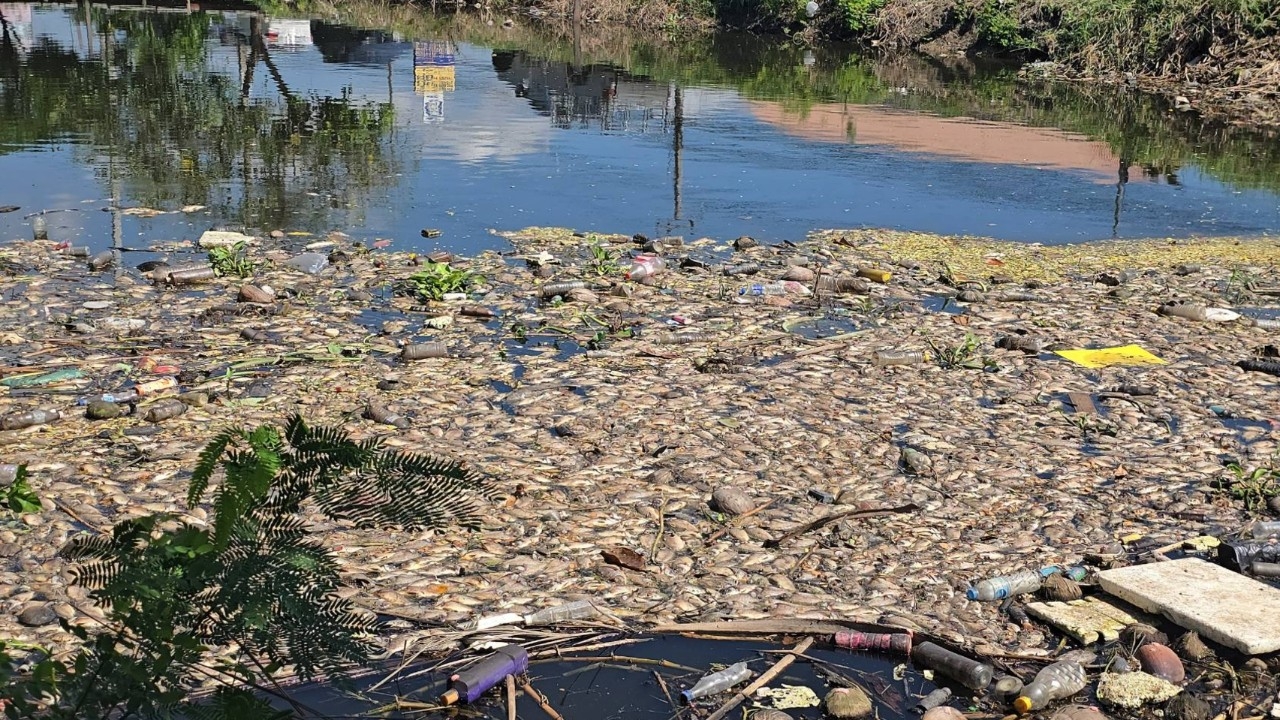
Mass fish die-offs occurred in a canal in Samut Sakhon province, with black barbels also affected. The provincial fisheries office is collaborating with the Provincial Natural Resources and Environment Office to urgently investigate the cause.
At 09:30 on 10 Nov 2026, Mr. Phedim Rod-in, Samut Sakhon Fisheries Officer, along with Mrs. Supap Srichan, Director of the Environmental Division at the Provincial Natural Resources and Environment Office, Mr. Sucheep Kongsil, Ban Ko Subdistrict Administrative Organization (SAO) Chief, health officials from Ban Ko SAO, local leaders, and other relevant personnel inspected the Heng Nermit Canal sluice gate area in Moo 8, Ban Ko subdistrict, Mueang Samut Sakhon district, following reports from residents of numerous dead fish floating along the canal and accumulating at the sluice gate. The scene showed bloated fish carcasses covering the water surface, emitting a pervasive foul odor.
Inspection revealed many dead fish of various species, including black barbels, shocker fish, snakehead fish, and Nile tilapia, floating and accumulating in large numbers. Some carcasses were bloated, estimated to have been dead for about four to five days, causing concern among nearby residents and workers affected by the stench of decaying fish.

Initially, the Samut Sakhon Provincial Fisheries Office and the Provincial Natural Resources and Environment Office jointly collected water and fish samples for laboratory analysis to determine the exact cause of death.
Meanwhile, Ban Ko SAO deployed staff to remove garbage and dead fish floating in the canal to reduce carcass accumulation, minimize foul odors, and lower potential health risks for local residents.
Mr. Phedim Rod-in, Samut Sakhon Fisheries Officer, stated that this investigation followed reports from the public about massive fish deaths in Heng Nermit Canal. Governor Amnat Charoensri assigned related agencies—including the Provincial Fisheries Office, Provincial Environment Office, local administrative organizations, and other local units—to inspect and urgently determine the cause of the fish deaths and assess any impacts on water quality and the environment.
Preliminary hypotheses suggest multiple factors may have contributed. First, recent flooding caused prolonged water stagnation in some areas, leading to decay of aquatic plants and organic debris. As water levels receded, contaminants and organic matter likely washed into the canal, triggering rapid plankton or algal blooms that could disrupt oxygen balance in the water.
Another factor is the seasonal weather transition from rainy to winter, which may bring periods of stagnant air, reducing air circulation and oxygen exchange at the water surface. Combined with oxygen consumption by decomposing organic matter, aquatic animals may face insufficient oxygen, especially during nighttime to early morning when dissolved oxygen levels typically drop.
However, these remain preliminary assumptions and have not been confirmed as the direct cause of the fish deaths. Detailed scientific analyses of water and fish samples are necessary to provide accurate and clear conclusions.
Mrs. Supap Srichan, Director of the Environmental Division at the Provincial Natural Resources and Environment Office, reported preliminary water quality tests showed dissolved oxygen (DO)—the oxygen available for aquatic life—at 2 mg/L, which meets the minimum standard for the area. The pH measured between 6 and 7, also within the standard range of 5 to 9.
Therefore, initial field measurements did not reveal clear abnormalities in tested parameters. Nonetheless, field tests provide only preliminary data and cannot fully confirm or rule out causes of fish deaths, as water quality can vary over time, especially at night and early morning when oxygen levels may fall.

The Provincial Natural Resources and Environment Office has coordinated with Regional Environment and Pollution Control Office 5 to collect water samples following scientific protocols for laboratory testing, expected to take about two weeks to yield detailed results.
Regarding whether fish found struggling but still alive can be consumed, if death is solely from oxygen depletion in water—as sometimes observed in the sea—it may not cause harmful toxins in the fish flesh, and consumption could be safe. However, since the exact cause of deaths in the canal remains unknown and contamination by hazardous substances cannot be ruled out, people should avoid catching and eating dead fish from the canal until test results confirm safety.
Mr. Pee Lon, 58, a vegetable vendor at a market near the canal, said he first noticed dead fish floating along the canal last Sunday, which then accumulated in large numbers near the sluice gate—an unusually high amount compared to previous years. Although fish die-offs had occurred in the canal before, the scale this time is unprecedented. The large number of bloated fish carcasses emits a strong stench throughout the area, so he urges authorities to promptly remove the dead fish from the water source.