

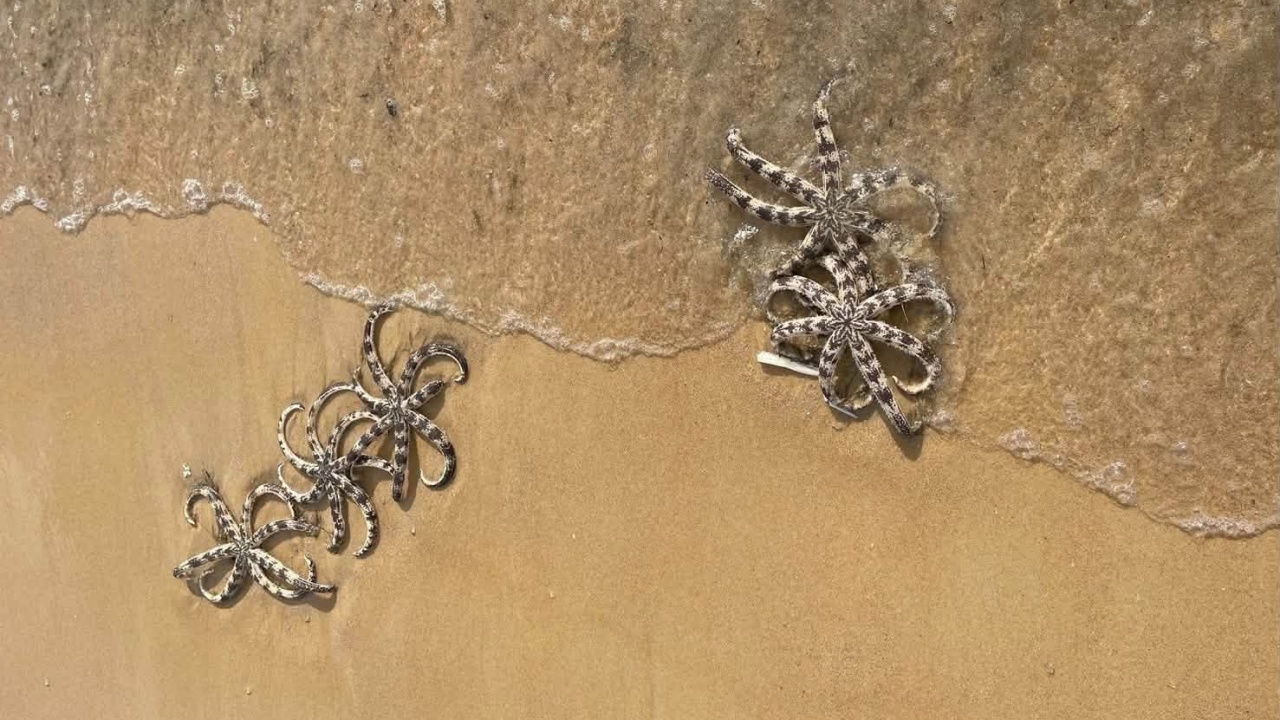
The exact cause has not been determined for the mass stranding of "starfish" on Karon Beach, Phuket Province. Officials identified the creatures as "sunstar starfish" and numerous floating salps. These are not highly toxic, but direct contact should be avoided to prevent irritation.
There have been widely shared photos showing many starfish stranded and dead along Karon Beach, Karon Subdistrict, Mueang Phuket District, Phuket. Some were washed back into the sea by waves, raising public and tourist curiosity about the cause of this phenomenon.
On 11 November 2026, Mr. Trin Thipmongkol, Deputy Mayor of Karon Subdistrict, coordinated with experts to inspect the area after more starfish and marine life were found stranded on the beach again. Reports state this phenomenon has been occurring since 5 November.

Officials from the Upper Andaman Marine and Coastal Resources Research Center, together with the Marine Resources Conservation Center under Marine and Coastal Resources Office 10, found starfish and floating salps (Salp) stranded scattered along the shoreline.

Examination with experts revealed the starfish to be the sunstar starfish (Luidia maculata), averaging 20–30 centimeters in size. They normally inhabit sandy areas near coral reefs and coastlines with a density around 0.5 individuals per square meter. Salps are free-floating marine animals found in water masses, with a density of about 15 individuals per square meter.

Neither species is considered highly toxic to humans, but officials advise avoiding direct contact with salps as they may cause irritation or allergic reactions in sensitive individuals.
Preliminary seawater quality tests showed all parameters within normal limits: salinity at 32 ppt, temperature at 29.6 degrees Celsius, pH at 7.95, and dissolved oxygen (DO) at 6.6 milligrams per liter. The inspection was conducted under clear skies but with relatively strong winds and waves.

After the inspection, officials disseminated information about the marine life found and issued precautions to local residents and beach operators to promote accurate understanding and reduce public concern about the event.
This investigation confirmed the species involved and the basic seawater quality but has not yet identified the definitive cause of the large starfish stranding.
Information sourced from the Facebook page of the Upper Andaman Marine and Coastal Resources Research Center.