

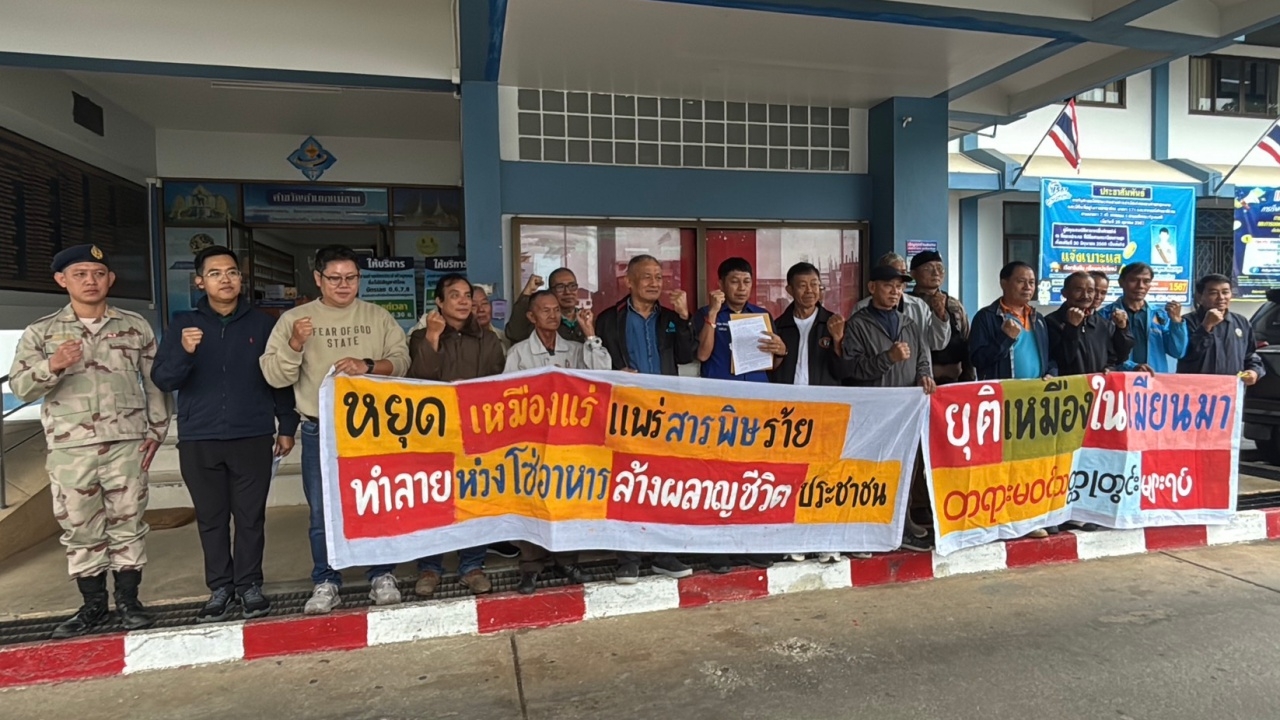
Representatives of riverside communities and farmer groups in Mae Sai District, Chiang Rai Province, submitted a letter to the Prime Minister through the Mae Sai District Chief, proposing nine urgent and long-term measures to resolve the contamination crisis in the Sai and Kok Rivers, water security for domestic and agricultural use, and recurring flooding issues. The district chief revealed the government is preparing to send senior central officials to the area on 16 Nov 2026, along with an emergency plan to handle water system disruptions.
12 Nov 2026 GMT+7 A reporter reported that the contamination of toxic substances in the Sai River in Mae Sai District, Chiang Rai Province, remains an ongoing problem affecting residents and the environment.
At 13:00 yesterday (11 Nov 2026 GMT+7) at the Mae Sai District Office, representatives from the Sailomjoy and Tham Phachom communities, led by Mr. Prajak Khruasri, along with farmer groups using RMC water 1–3 led by Mr. Thongkham Inprom, submitted a letter to Deputy Prime Minister Anutin Charnvirakul via Mae Sai District Chief Mr. Warayut Khombun, demanding the government urgently address contamination impacts in the border river linked to mining activities in Myanmar.
Summary of nine demands from the public: 1. Request the Prime Minister and his team to visit Mae Sai District to hear residents’ problems directly. 2. Stop importing tin, zinc, lead, and manganese minerals from Myanmar to push for resolving transboundary pollution. 3. Dispatch mobile clean water production vehicles from the Department of Disaster Prevention and Mitigation to assist affected residents. 4. Accelerate the Mae Kham Reservoir project in Mae Chan District as an alternative raw water source instead of contaminated rivers. 5. Expedite sourcing groundwater to support 60,500 rai of agricultural land in time for the dry-season rice planting in December. 6. Establish a heavy metal testing center for soil, aquatic animals, and crops in Chiang Rai for faster monitoring. 7. Promote joint Thailand–Myanmar working group meetings to inspect water quality with public participation. 8. Form a coalition of government, academics, and citizens to solve transboundary pollution in the Sai, Kok, Ruak, Mekong, Salawin, and Kraburi river basins. 9. Rapidly build permanent flood barriers along the Sai River to prevent flooding without relocating communities from their original areas.
Mr. Prajak Khruasri, a community representative, said villagers are concerned about the safety of domestic and agricultural water. He urged the government to establish a joint working group that allows public participation rather than imposing measures from central authorities alone. For the long term, he proposed suspending mineral imports to pressure Myanmar to resolve upstream issues and urged building permanent flood barriers to replace the deteriorating big sandbags.
Mr. Warayut Khombun, Mae Sai District Chief, said he will expedite forwarding the matter to the Chiang Rai governor, the Ministry of Interior, and the government, emphasizing that the Sai River problem is complex because it is an international river.

Following the Sai River’s heavy turbidity and arsenic levels exceeding standards detected on 5 Nov, which forced a temporary water production halt, the district has prepared eight water trucks and coordinated backup water sources (Ko Chang Station, Huai Khrai, Mae Chan, and groundwater). If insufficient, assistance will be requested from the 37th Military Circle, Department of Disaster Prevention and Mitigation, and local foundations immediately. Currently, the project is in the design and public participation review phase, with an initial budget of about 39 million baht not yet allocated.
The Mae Sai District Chief added that on 16 Nov 2026, senior executives from the Ministry of Interior, Department of Disaster Prevention and Mitigation, Provincial Waterworks Authority, and related agencies will inspect the Ko Chang water production station and hold a public hearing at the Mae Sai District Hall to receive direct proposals from residents.
Additionally, on 12 Nov 2026, a Thai–Myanmar government-level discussion will take place, expected to include the issue of transboundary pollution.