

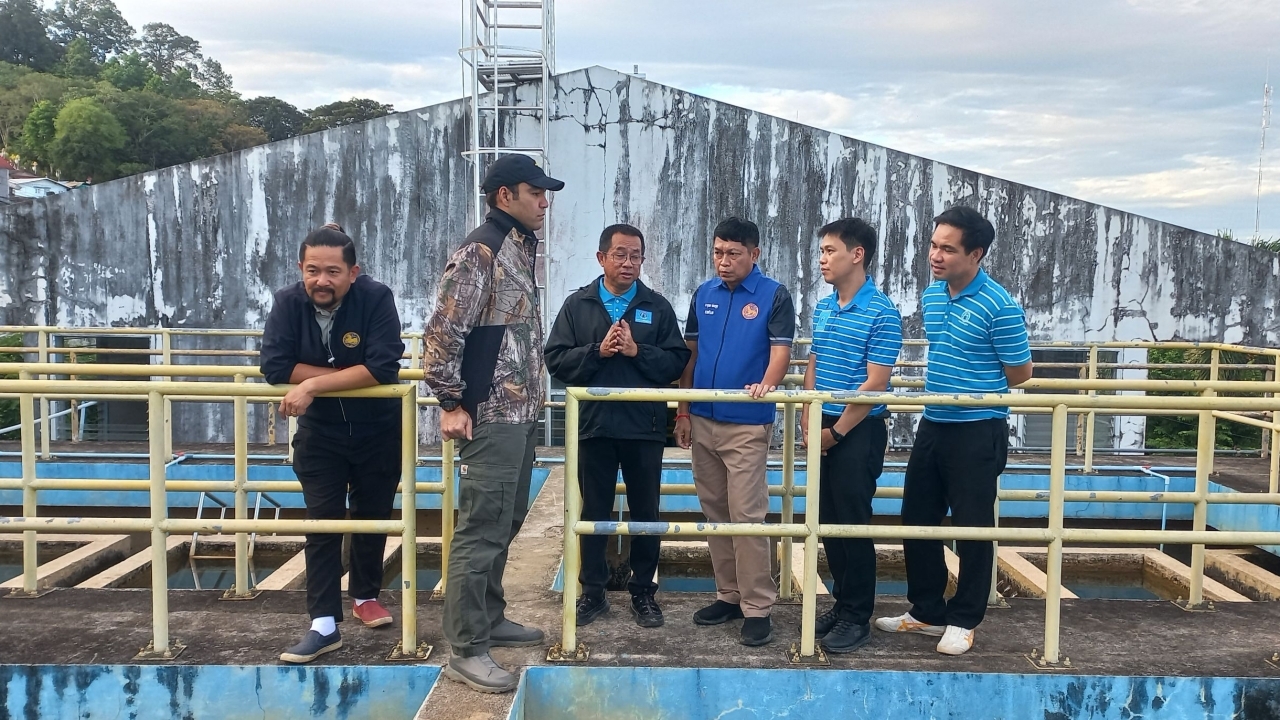
Deputy Interior Minister Jae Setth visited Mae Sai to monitor tap water production at the Provincial Waterworks Authority Mae Sai branch, building public confidence and affirming that "Mae Sai tap water is safe to drink." The system monitors water quality and immediately halts production if arsenic levels or turbidity exceed standards.
On 15 November 2026, reporters reported that toxic contamination in the Sai River in Mae Sai District, Chiang Rai Province, remains a continuing problem affecting residents and the environment.
At 4:00 p.m. on 14 November 2026, Deputy Interior Minister Jae Setth returned from inspecting key mining areas at Doi Ko Wan, Mueang Kan, and Mae Jok in Mae Fah Luang District, located in mountain valleys and headwater areas. Infrastructure development, machinery, and personnel preparations are underway, with close attention to environmental impacts and water quality linked to Thailand.
He then inspected the Mae Sai Provincial Waterworks Authority treatment plant to follow up and check tap water production processes, receive updates on operations of the Mae Sai Provincial Waterworks Authority (PWA) branch, and review work at Koh Chang station, which uses water from the Ruak River to produce some reserve tap water. This ensures water quality management meets standards. He encouraged PWA staff in Mae Sai and instructed relevant agencies to continuously monitor water quality and service the public, including informing residents about free clean drinking water points to build trust in tap water use.

Mae Sai District Chief Warayut Khomboon and the Mae Sai PWA branch manager welcomed him, facilitated the visit, provided briefings, and guided inspections of the operational system. The Mae Sai PWA branch faced a crisis due to exceptionally high turbidity in the Sai River raw water, reaching 14,000 NTU—exceeding the 6,000 NTU filter capacity—and arsenic contamination above standards. This caused Mae Sai waterworks to halt tap water production from 5 to 8 November 2026. The contamination was reported to result from mining runoff into the Sai River.
The contamination affected 14 villages across two subdistricts: villages 1, 2, 3, 4, 5, 7, 8, 9, and 10 in Wiang Pang Kham Subdistrict, and villages 2, 3, 7, 8, and 10 in Mae Sai Subdistrict, as well as nearby areas. Officials have closely monitored raw water quality and expedited resumption of tap water production once turbidity levels returned to normal.
Deputy Minister Jae Setth stated that his visit aimed to reassure residents that the Provincial Waterworks Authority adheres strictly to standards. If turbidity is too high, raw water pumping stops immediately to prevent it from entering production, and stored water is distributed to the public.

He said, “We prioritize water quality. We will not tolerate toxins or contaminants in the production system. Our short-term plan includes emergency measures to stop pumping and production, using stored water divided into zones and reserved for hospitals, supplemented by water from Koh Chang station. The long-term plan involves Chiang Saen station fully supporting Mae Sai.”
Deputy Minister Jae Setth reiterated that residents can confidently drink tap water because there is a system monitoring turbidity and arsenic to assure public safety.
Komsan Samma, manager of the Mae Sai Provincial Waterworks Authority branch, revealed that water quality is now checked every 30 minutes for turbidity and arsenic in raw water, pre-filtered, and post-filtered water. Turbidity must not exceed 3,000 to 6,000 NTU; currently, it has decreased to below 500 NTU.