

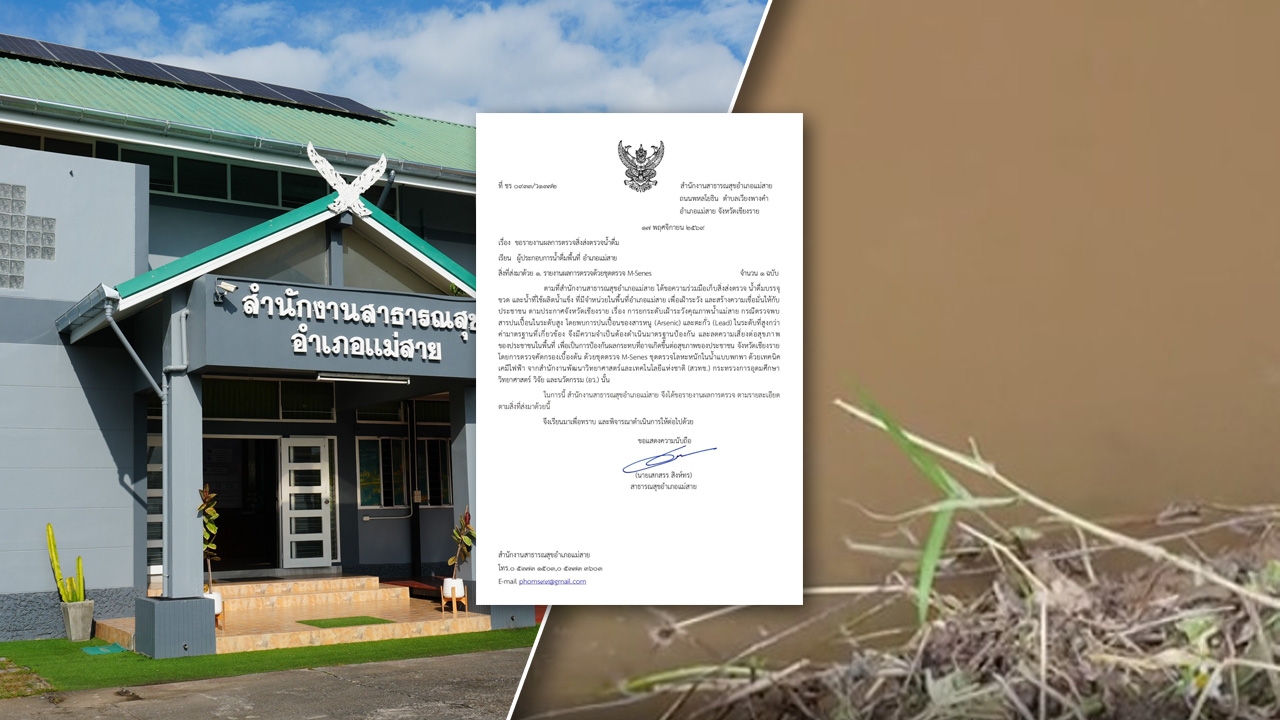
Chiang Rai's Mae Sai public health officials conducted random inspections of over 30 water production facilities using the “M-Sense” detection kit, raising confidence among residents in the high-risk area. Test results were normal with no arsenic contamination found.
On 18 Nov 2026 GMT+7, reporters covered the toxic contamination situation in the Sai River, Mae Sai district, Chiang Rai. Elevated arsenic and lead levels above related standards remain an ongoing problem impacting residents and the environment.
Regarding this, on 17 Nov 2026 GMT+7, the Mae Sai District Public Health Office, Chiang Rai Province, dispatched staff to randomly test water quality from consumption sources, drinking water factories, and ice production sites in Mae Sai district—over 30 locations. They used the innovative “M-Sense” heavy metal detection kit to monitor arsenic and heavy metal contamination, reducing health risks and building community trust. All random tests showed no arsenic contamination.
This field activity followed a visit on 15 Nov 2026 GMT+7 by Dr. Yotsanan Wongsawat, Deputy Prime Minister and Minister of Higher Education, Science, Research and Innovation (MHESI), and his team. They inspected water quality near the First Thai-Myanmar Friendship Bridge in Mae Sai district and handed over 100 “M-Sense” heavy metal test kits, an innovation from the National Science and Technology Development Agency (NSTDA) that can rapidly screen for arsenic and heavy metals in water within 3–5 minutes. Fifty kits went to Chiang Rai Provincial Public Health Office and fifty to Mae Sai District Public Health Office.
Mae Sai public health officials disclosed that after receiving the “M-Sense” kits, their office promptly conducted random surveillance tests at 30 locations. These included bottled drinking water, school drinking water, ice, groundwater, and natural water sources from which samples were collected.
Test results were normal with no arsenic detected. The public and local businesses showed strong interest in the “M-Sense” kits and inquired about purchasing them for personal testing. However, these kits are not commercially available and the limited supply received cannot meet public demand. Each kit allows only a single test. Consequently, residents and key institutions like schools and workplaces with many employees continuously bring bottled water samples for testing. Officials must prioritize testing in high-risk spots near the Sai and Ruak rivers.
However, Mr. Charoen Sawkamkhet, 67, from Ban Mae Kham Talat, Moo 2, Mae Kham subdistrict, Mae Chan district, Chiang Rai, a rice farmer, is severely affected during the harvest season. Although about 20,000 rai of farmland, adjoining Mae Sai and Chiang Saen districts, mostly use clean domestic headwater sources without mining activities,
and are far from arsenic contamination points, several rice mills have refused to buy their crops due to concerns and generalized fears that rice from the area might be contaminated by toxins through irrigation water.
This situation causes great worry and hardship among farmers in these clean water areas. They demand government agencies to promptly manage and systematically inspect and certify product quality to restore confidence among rice mills and consumers, since farmers alone cannot resolve the trust issue.