

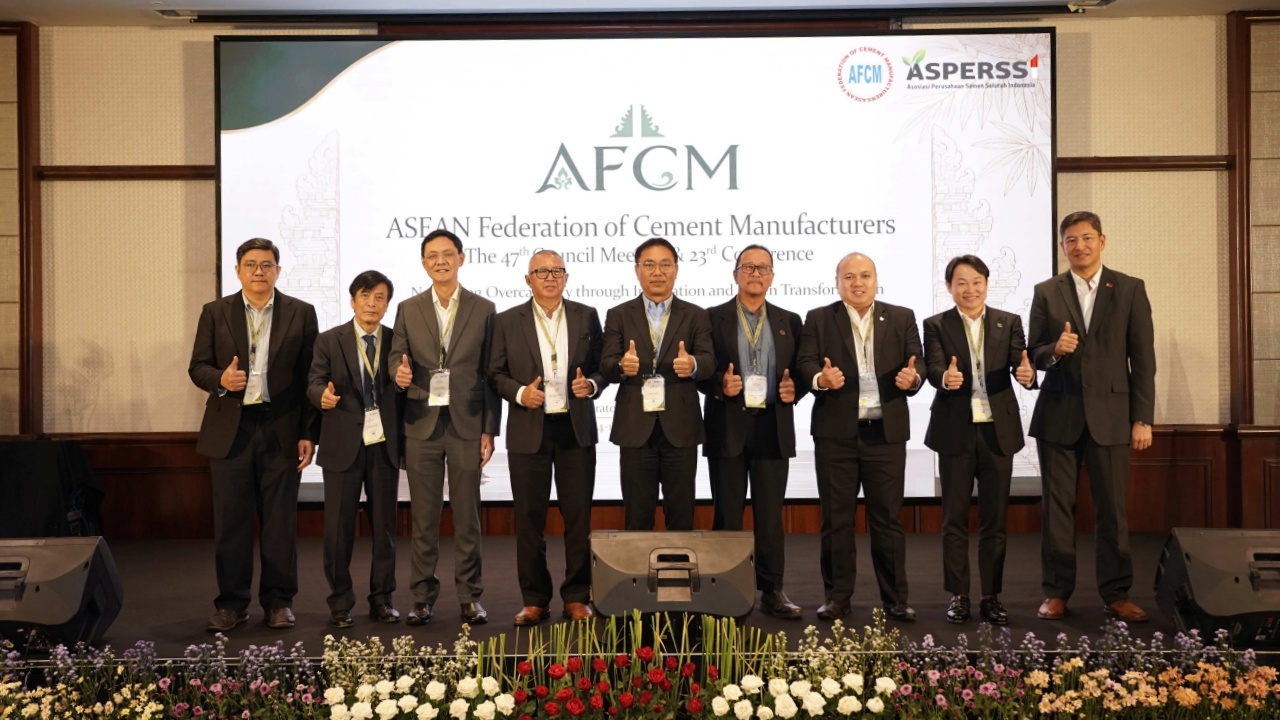
TCMA has united with the ASEAN cement industry under the decarbonization roadmap, achieving a reduction of 14.4 million tons of CO2, passing on AFCM leadership to the Philippines while advancing technology platforms and global alliances to continue progress.
The Thai Cement Manufacturers Association (TCMA) has driven cooperation within the ASEAN cement industry under the 2035 AFCM Decarbonization Roadmap framework. This effort yielded results in 2025, reducing CO2 emissions by over 14 million tons, demonstrating the power of collaborative direction turning into concrete action. Following the handover of AFCM chairmanship to the Philippines, TCMA continues to connect global technology networks and partners, preparing to host the 27th AFCM Technical Symposium & Exhibition in 2027 in Bangkok.
Dr. Chana Phumee, Honorary President of TCMA and Chair of the ASEAN Federation of Cement Manufacturers (AFCM), shared progress following the AFCM Meetings. Since all eight AFCM member countries jointly announced the 2035 AFCM Decarbonization Roadmap in October 2025, implementation has steadily advanced, including carbon reduction measures, knowledge exchange, and member performance monitoring, providing clearer insight into the regional cement industry's overall development.
"Having a regional roadmap gives all eight member countries clear direction and goals while allowing each to proceed according to their own context and readiness. The CO2 emission reductions achieved show that when the industry shares a common target and takes action together, measurable results follow. Transitioning to low-carbon cement is not only an environmental issue but also an opportunity to upgrade technology, add value, and enhance the long-term competitiveness of ASEAN's industry," Dr. Chana said.
Regarding progress under the 2035 AFCM Decarbonization Roadmap, data from all eight member countries shows that in 2025, the ASEAN cement industry reduced CO2 emissions by over 14 million tons, a 6.0% decrease compared to the 2020 baseline. Advances were driven by low-carbon cement use, increased alternative fuel proportions, and renewable electricity use, reflecting a transformation in raw material and energy consumption. The goals include cumulative CO2 reductions of about 35.2 million tons by 2030 and 42.9 million tons by 2035 compared to 2020.

Mr. Montri Nithikul, TCMA Vice President and AFCM Secretary-General, noted another key development: members have adapted the regional roadmap into national implementation plans, demonstrating commitment to systematic carbon reduction. The Philippines developed the Philippine Cement and Concrete Decarbonization Roadmap, Indonesia created the Decarbonization Roadmap of Indonesia Cement Industry, and Thailand has the Thailand 2050 Net Zero Cement and Concrete Roadmap as its main guiding framework.
"Members turning shared goals into national roadmaps shows the strengthening of cooperation. Each country can learn from and exchange experiences on technology, innovation, standards, and operational approaches, enabling an effective industrial transition and supporting the region’s long-term carbon reduction targets," Mr. Montri said.
Mr. Surachai Nimlaor, TCMA President and head of the Thai delegation, stated that TCMA aims to create value through regional cooperation by connecting Thai cement producers with AFCM members, government, academia, and international partners to exchange knowledge and leverage promising technologies. This especially aligns with the Thailand 2050 Net Zero Cement and Concrete Roadmap and the advancement of the Saraburi Sandbox, a key area for integrating collaboration and promoting low-carbon industry development.
"TCMA prioritizes making cooperation tangible and beneficial for members and the Thai industry by applying knowledge, technology, and experience from regional and global networks to suit Thailand’s context. The Saraburi Sandbox is also an important opportunity to build partnerships and foster innovation locally, creating models and approaches that can be scaled across the industry nationally and regionally," Mr. Surachai said.

This meeting also marked the important occasion of handing over the AFCM chairmanship from Dr. Chana Phumee, who completed his term, to the Philippines. This ensures continuity of the mission and cooperation driving the ASEAN cement industry forward, reflecting ongoing collaboration among member countries under the One Team, One Community concept.
TCMA continues to strengthen alliances with AFCM members and partners regionally and internationally to advance knowledge, connect technology and innovation, and create economic opportunities while enhancing the competitiveness of the Thai and ASEAN cement industries. The goal is a strong and sustainable industry under the Made in ASEAN, for ASEAN concept, linked to the global stage.
This important ongoing cooperation will be further advanced at the regional level in 2027 when Thailand, through TCMA, hosts the 27th AFCM Technical Symposium & Exhibition from 3–5 November 2027 in Bangkok. Under the theme CEMENT NEXUS – Bridging Innovation & Partnership for Cement Decarbonization, this event will be a key platform connecting cement producers, experts, technology providers, and partners worldwide to exchange technical knowledge, showcase technology and innovation, and build collaboration and industrial opportunities to accelerate the transition and enhance ASEAN cement industry competitiveness.
