

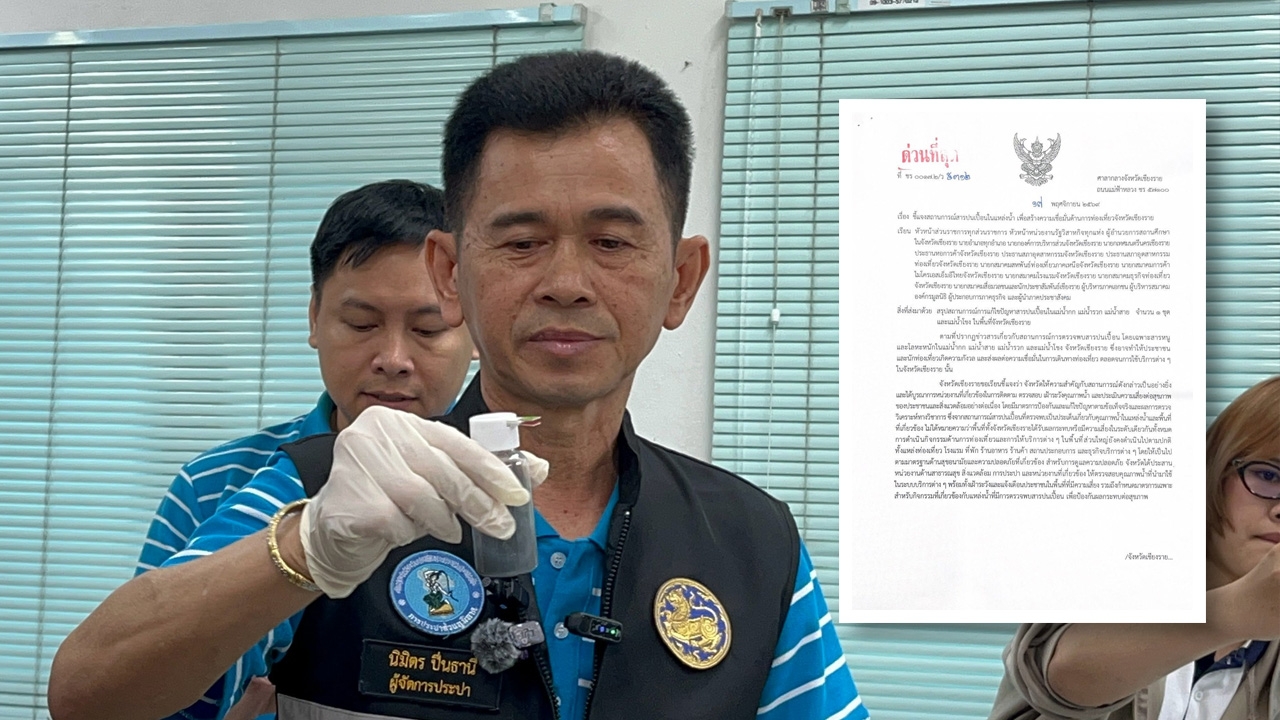
Chiang Rai Provincial Waterworks Authority opened its laboratory to present test results, confirming tap water cleanliness and absence of arsenic exceeding standards. The local hotel association revealed a 1% room cancellation rate and appealed to the government to expedite problem resolution, fearing economic impact. Meanwhile, the governor issued an urgent letter clarifying that water contamination is a localized issue and requested all sectors to avoid generalizing it across the entire province to prevent unnecessary concern.
On 19 Nov 2026 GMT+7, reporters covered the news that heavy metal and arsenic contaminants were detected in natural water sources in Chiang Rai Province, including the Kok, Sai, Ruak, and Mekong rivers, causing public and tourist concern. Recently, Mr. Chucheep Pongchai, Governor of Chiang Rai, signed an urgent official letter No. Chor 0017.2/W 5312 dated 17 Nov 2026 GMT+7 addressed to heads of government agencies, state enterprises, private sector, tourism business associations, and media, clarifying the water contamination situation to restore confidence in Chiang Rai tourism.
The statement emphasized the province’s commitment to integrating relevant agencies to continuously monitor water quality and assess health risks. It clarified that contamination detected is limited to specific points and related areas, not implying that the entire Chiang Rai province is equally affected or at the same risk level. Most tourism activities, hotels, accommodations, restaurants, and service businesses remain open under health and safety standards. The statement also urged all sectors to disseminate accurate information to avoid generalized assumptions that could unnecessarily harm the province’s tourism economy.

Meanwhile, at 1:00 p.m. on 18 Nov 2026 GMT+7, the Chiang Rai branch of the Provincial Waterworks Authority invited media to a press briefing at the Chiang Rai cluster laboratory (Wang Kham Water Treatment Plant) to present tap water quality test results and build confidence among residents and tourists.
Mr. Nimit Pinthani, Manager of Chiang Rai PWA branch, explained the water treatment process at Wang Kham plant, which draws raw water from the Kok River and subjects it to six stringent treatment steps: pre-chlorination to disinfect and help precipitate arsenic, sodium hydroxide addition to separate arsenic compounds, coagulant addition, intermediate chlorination, filtration, and final post-chlorination in clear water tanks. Daily water quality tests using test kits are conducted before distribution.
Mr. Nimit confirmed that Chiang Rai PWA branch, serving 10 districts through six branches (covering approximately 82,000 of 500,000 households), controls water quality according to World Health Organization (WHO) standards. In 2025, water quality was tested 48 times, and in 2026, tests occur four times monthly (twice by central labs and twice by PWA labs). Results have consistently shown no arsenic, lead, mercury, or cadmium exceeding standard limits. Therefore, residents and tourists can safely use the water. For community-managed water supply systems, PWA offers full technical consultation.

Ms. Suwanna Pinsuwan, Secretary of the Chiang Rai Hotel Association, described the impact on lodging businesses, stating the association has continuously monitored the situation and coordinated with the water authority. Although the news caused a slight cancellation rate of about 1% (averaging 1–2 rooms per hotel) and some clients of large hotels postponed trips, totaling around 100 rooms, this remained limited, partly because the period coincided with the low tourist season.
“The hotel association maintains confidence in the water authority’s testing and treatment processes but urges the government to urgently and seriously address the water contamination issue. We are concerned that misinformation could harm the province’s reputation and cause long-term economic decline,” Ms. Suwanna stated.