

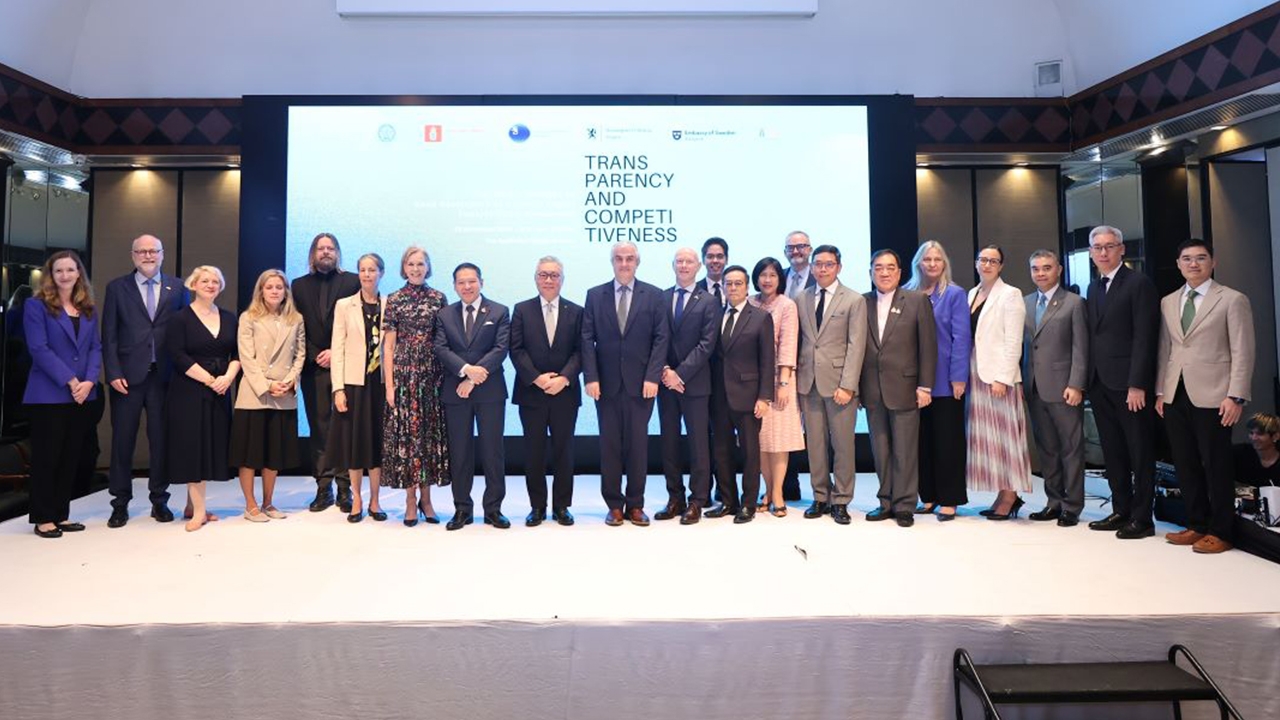
Experts from the Scandinavian-OECD group point out that Thailand's government agencies must be strong, enforce laws effectively, and open channels for transparent oversight by all sectors.
“For Nordic countries, having laws is only the starting point. Consistent enforcement and genuinely accountable institutions are the mechanisms driving national growth. However, every country must find its own growth path, considering its institutions, history, and priorities in addressing shared challenges,” said His Excellency Danny Annan, Denmark’s Ambassador to Thailand, during the Transparency and Competitiveness: Thai–Nordic Dialogue on Good Governance as a Growth Engine Towards OECD-membership forum.

This important forum took place on 25 Nov 2026 at the Sukhothai Hotel in Bangkok, gathering perspectives and experiences from policymakers, international organizations, business sectors, and civil society, especially from Nordic countries (Denmark, Finland, Norway, and Sweden) and the OECD standards. The aim was to draw lessons and highlight key challenges for Thailand’s path to OECD membership by 2028 and achieving high-income status by 2037.

The meeting emphasized that escaping Thailand’s middle-income trap is not just about having laws on paper that are enforceable but also about strengthening public institutions, enforcing laws fairly, reducing hidden costs, and ensuring transparency and accountability accessible to all sectors. Particularly, law enforcement remains a recurring challenge for Thailand discussed throughout this forum.

“The main challenge for many countries, including Thailand, is not passing laws but actual implementation.” Mr. Mathias Cormann, Secretary-General of the OECD, stated this during a video message, emphasizing that “Trust” from businesses and citizens arises from honest, complete enforcement of laws without relying on excessively strict legal measures.
OECD representatives also addressed Thailand’s membership agenda, noting that although Thailand’s anti-corruption strategy outperforms the OECD average in both policy and practice and could bolster economic growth if expanded, challenges remain. For example, Thailand’s conflict of interest prevention laws meet 78% of OECD criteria legally but only 11% in practical enforcement.
They clearly stated that Thailand must ratify the OECD Anti-Bribery Convention, requiring reforms in three key legal areas: strengthening offenses for bribing foreign officials, corporate liability, and legal clarity. Progress depends on genuine practical reforms. Thailand has reviewed these laws three times, and the next step is effective enforcement to unlock OECD membership potential as planned.

On this occasion, senior leaders and representatives from key organizations delivered speeches and shared strategic views, including His Excellency Danny Annan, Denmark’s Ambassador to Thailand, who opened the forum by stressing that good governance is not solely the government’s responsibility but requires cooperation across society, academia, civil society, and international organizations. Good governance is not just about laws or regulations but about creating an environment conducive to economic success—allowing businesses to grow, create jobs, and invest in a fair, predictable atmosphere.
The success of the Nordic countries—characterized by high trust and low corruption—stems from independent institutions, professional management, competitive private sectors committed to transparency and accountability, free media, and strong civil society. He concluded that laws are only the starting point; serious enforcement and neutral, accountable institutions are the true mechanisms for national growth. Thailand can seek development paths that promote participation considering its background and context.

, Mr. Saran Charoensuwan, Assistant Minister at the Ministry of Foreign Affairs, noted that Thailand and the Nordic countries have close relations in trade, investment, and promoting the rule of law. Currently, over 350 Nordic companies operate in Thailand, with trade valued at approximately 9 billion USD last year. Thailand is advancing negotiations on a Thailand-EU Free Trade Agreement. This meeting was a good opportunity following Thailand's recent consultations with the OECD on business and labor to finalize a cooperation plan aiming for OECD membership by 2028, aligning with Thailand’s ASEAN chairmanship that year.
Mr. Saran also emphasized that legal reforms and strengthening public integrity—a commitment for OECD accession—offer opportunities to reduce business costs and create certainty for investors. The government must lead with transparency and accountability. He also mentioned the significant opportunity for the Thailand Institute of Justice (TIJ) to host the OECD Global Roundtable on Equal Access to Justice next year (2027) to promote justice and attract investment.

Regarding Prof. Dr. Kittipong Kittayarak, Chairman of the Thailand Institute of Justice (TIJ), he reflected that the rule of law is an “invisible infrastructure” and likened it to a country’s operating system. No matter how strong the physical infrastructure, without fair, responsible, and citizen-responsive rule of law, the economy cannot function at full capacity.
The TIJ chairman emphasized that according to the World Justice Project Rule of Law Index, the four Nordic countries consistently rank among the top globally. Thailand has made legal reform progress but must accelerate closing practical enforcement gaps. Joining the OECD, now a national agenda, acts as a catalyst for opening space for the private sector and independent watchdogs to become “co-owners of reform.” He gave examples such as linking government data through the Open Government Partnership (OGP), which TIJ supports continuously, and organizing cross-institutional projects engaging all social sectors to make rule of law tangible for citizens.

At this forum, experts from Nordic countries and the business sector analyzed the connection between institutional quality and economic competitiveness, proposing ways to enhance trust.

Professor Mogens Kamp Justesen, Copenhagen Business School, stated that strong institutions are the foundation for investment and economic growth. When institutions are weak, businesses rely on political connections and favoritism for licenses, distorting competition. High-capacity states require professional, neutral bureaucracies with adequate budgets and personnel, fair law enforcement for businesses of all sizes, and independent oversight.

Ms. Linda Piirto, Head of Supply Chain and Governance at UN Global Compact Finland, pointed out that investors choose markets based on transparency guarantees and knowing their partners (KYC). She noted that the EU and UN are strengthening anti-corruption regulations and sanctions, expanding definitions to cover improper influence, impacting entire supply chains including partners in Thailand. Therefore, Thailand must integrate efforts across government, civil society, academia, and media to independently monitor sector operations, create transparency, and build trust to attract investors.

Ms. Vibeke Lyssand Leirvåg, Chair of the Joint Foreign Chambers of Commerce in Thailand (JFCCT), which represents over 8,000 companies from 30 chambers, emphasized that the government must not only attract new investment but also maintain current investor confidence by enforcing laws fairly. Facing the middle-income trap and fierce competition from neighbors like Vietnam, OECD accession signals are closely watched by foreign investors. Business and government must focus on communicating and understanding governance, ESG regulations, and international standards from executives down to operational staff to align efforts clearly.

Ms. Victoria von Uexküll, Secretary-General of The Swedish Anti-Corruption Institute (IMM), said that trust is an “economic asset” confirming that government operations are fair and worth investing in. Lessons from Sweden show that clear anti-corruption codes of conduct combined with genuine public access to official documents form the foundation of transparency and empower civil society and private sectors like Thailand’s CAC network to effectively collaborate on oversight.
At this high-level forum, heads of public audit agencies, private sector representatives, and OECD and Nordic experts revealed concrete progress in restructuring Thailand’s institutions as follows:

Mr. Nitipan Prachuapmo, Secretary-General of the National Anti-Corruption Commission (NACC), disclosed that Thailand has been a party to the OECD Anti-Bribery Convention for over a decade and ratified the UNCAC. Recently, NACC expedited improvements to three key laws proposed for Cabinet consideration: (1) extending bribery offenses to foreign companies bribing Thai officials, (2) corporate liability laws domestically and abroad, and (3) non-trial dispute resolution mechanisms allowing rapid compensation by offending companies. Additionally, NACC closely cooperates with Nordic police on transnational bribery cases and runs initiatives like “One Department, One Transparency” alongside partnerships with Thailand’s private sector anti-corruption coalition (CAC).

Mr. Phumvisan Kasemsuk, Secretary-General of the Public Sector Anti-Corruption Commission (PACC), explained that “tea money” and hidden costs arise mainly from excessive discretion, delays, and opacity, consistent with Thailand’s CPI score of 33/100 (ranked 116 out of 186 countries). 2026 data also show gaps between laws and enforcement. PACC drives five structural measures under the concept “Make the honest path the easiest path,” making honest conduct the simplest route:
(1) Promote whistleblower protection laws in collaboration with the Ministry of Justice, NACC, and the Office of the Council of State.
(2) Integrate complaint systems into a single platform (ACOC) covering 40 agencies across criminal, administrative, and civil sectors.
(3) Use AI (CRAMP) to audit budgets of large projects from the allocation stage.
(4) Expand digital services allowing citizens to file complaints via the “Government Way” app and extend online license application models from Sriracha Land Office to 15 offices in the Eastern Economic Corridor (EEC).
(5) Upgrade integrity and transparency assessments (ITA) to behavior-based evaluations (Behavior-Based ITA).

Dr. Phot Aramwattananon, Chairman of the Board of the Thai Chamber of Commerce and the Joint Foreign Chambers of Commerce in Thailand (JFCCT), stated that although Thailand benefits from location and infrastructure, businesses still bear hidden costs from redundancy, delays, and uncertain legal interpretations, especially SMEs, which are more affected than large companies. JFCCT and 45 partner organizations have formed a private-sector task force against corruption, working with government to review laws, ministerial regulations, and announcements that are obstacles, support the “One Department, One Transparency” project, and enhance SMEs to operate ethically and free from money laundering.

Ms. Nejla Saula, Head of Anti-Corruption and Integrity in the Public Sector at OECD, revealed that Thailand currently attracts about 18 billion USD in foreign direct investment (FDI), which is still below potential compared to other countries’ FDI-to-GDP ratios. The 2026 OECD report also points to a 44% gap in implementing integrity measures. She recommended Thailand urgently establish unified legal standards across agencies, expand conflict of interest and lobbying rules to cover the executive, judiciary, law enforcement, and local government, use AI to disclose government data, assess new risks including scams, and develop measurement systems based on citizen experiences (like South Korea’s ITA). She also exchanged lessons from new member countries like Costa Rica and Romania.

, Professor Mogens Kamp Justesen, Copenhagen Business School, reiterated that strong institutions are key to building trust and attracting quality investment rather than relying on political patronage. He proposed three institutional pillars for Thailand: (1) enhance capacity and independence of the bureaucracy grounded in integrity, continuity, and protection for officials enforcing laws impartially; (2) create rule-based, transparent, and accountable management systems that reduce redundancy without sacrificing transparency, allowing for dispute and appeal mechanisms such as in procurement; and (3) regulate business-politics relations and oversee political financing through open, transparent forums supervising lobbying, political donations, and conflicts of interest from the “Revolving Door” phenomenon.

The forum also featured the honor of H.E. Anna Hammargren, Swedish Ambassador to Thailand; H.E. Kristiina Kivaya-Santopoulos, Finnish Ambassador to Thailand; and H.E. Frode Solberg, Norwegian Ambassador to Thailand, alongside OECD and Thai agency representatives.

In the afternoon, intense exchanges focused on building confidence among foreign investors and designing trust using Nordic approaches to foster public-private relations. Dr. Sa-ard Yen, TIJ Director, participated as a speaker. The session also analyzed scenarios related to bribery and corruption to depict situations and propose solutions.
Overall, the forums reflected a shared commitment among all sectors to transform Thailand’s OECD accession goal into sustainable structural reform, where rule of law and good governance stabilize and build trust in government, reduce burdens on business and civil society, promote fair competition, and ultimately enhance the quality of life for Thai people.