

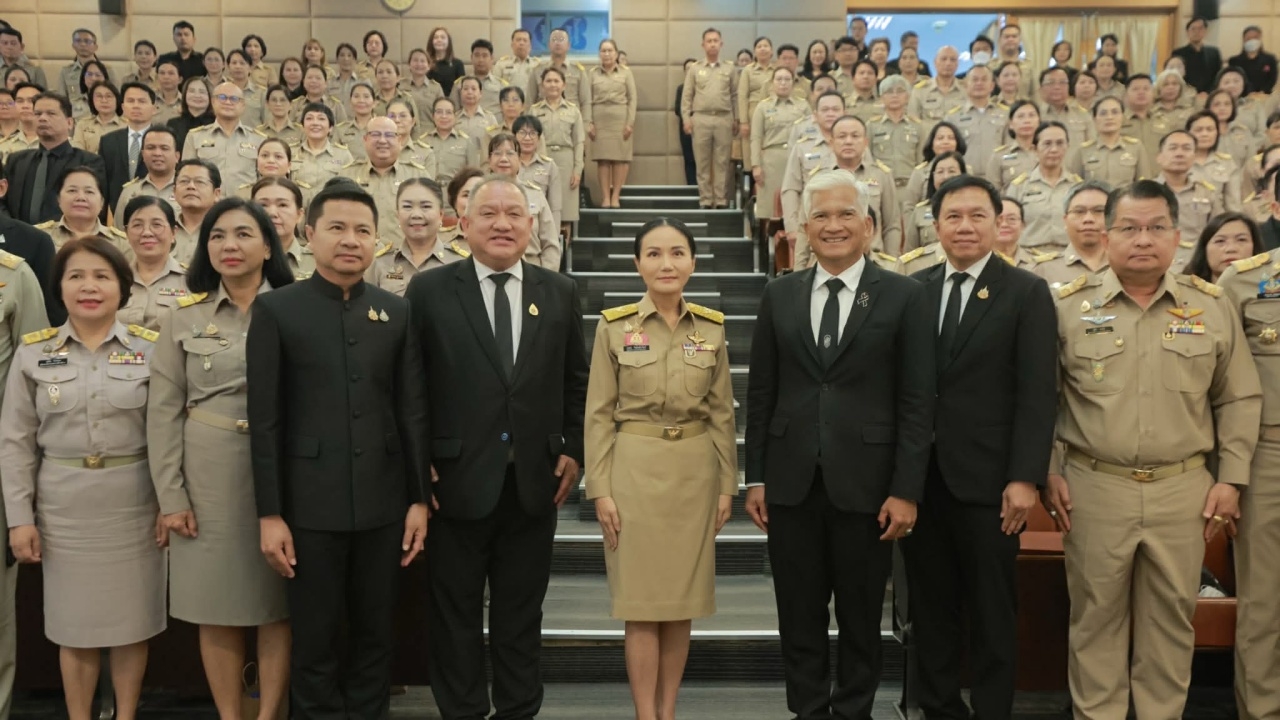
Minister Narumon emphasized that the modern Ministry of Education must integrate the entire system, highlighting teachers as the heart of child development. She called for cutting the top-down command cycle and promoting provincial education officers as key links connecting local areas to the central government.
On 2 Feb, reporters reported that Mrs. Narumon Pinyosinwat, Minister of Education, presided over the opening of the first regional education management meeting for 2026. Attendees included Mr. Suthep Kaengsantia, Permanent Secretary of the Ministry of Education; Mr. Yossapon Venukoset, Secretary-General of the Vocational Education Commission; Mr. Pichet Wanthong, Deputy Secretary-General of the Basic Education Commission; Mr. Monthon Paksuwan, Secretary-General of the Private Education Promotion Commission; along with senior ministry executives, regional education officers, provincial education officers, and department heads. The event was held at Professor Mom Luang Pin Malakul Meeting Room, 3rd Floor, Ratchamangkhala Building, Ministry of Education.
Mr. Suthep reported that the meeting's purpose was to serve as a main mechanism to enhance learner quality under the concept of studying well with morality. The focus was on translating policy into practice aligned with each area's context, national strategy, and national reform plan. Scheduled for 2-3 Feb 2026, the meeting included 240 participants: senior executives, all 18 regional education officers, provincial education officers nationwide, and related staff. The format featured lectures and knowledge exchanges on key topics such as policy direction and budgeting aligned with national strategy, raising private education quality, international education management, teacher professional development and welfare, and ethical standards enforcement. It also covered quick-win policy projects and the Credit Bank initiative. This effort follows the authority under the National Council for Peace and Order's Order No. 19/2017 to reform regional education, promoting cooperative and integrated education management.
Mrs. Narumon stated that over the past seven months, the key to work in this era is integration without division. She likened the four main offices—the Ministry's Permanent Secretary Office, the Office of the Education Council Secretary, the Basic Education Commission, and the Vocational Education Commission—to four princes who must face each other and work as one. This reduces gaps between central policy and local implementation. Recent inspection visits demonstrated that senior executives hearing problems firsthand on site gain clearer facts than receiving reports from a 'tower,' leading to quicker, more flexible, and context-appropriate regulation adjustments.
She emphasized that a critical policy shift, following the guidance of Lt. Col. Thammanat Prompao, Deputy Prime Minister and Minister of Agriculture and Cooperatives overseeing the Ministry of Education, is that Thai education has traditionally focused on children as valuable products but often neglected the 'factory' and workers—teachers and education personnel, the most important mechanism in producing outcomes. It is time to seriously care for these workers. She urged provincial education officers and all administrators to support the welfare and living conditions of their subordinates to boost morale in delivering quality education. Regarding the policy to establish a central savings cooperative to address teacher debt and welfare teacher housing projects, the Ministry has completed details and submitted them to the Secretariat of the Cabinet to ensure teachers nationwide have life stability.
Mrs. Narumon added that the role of modern provincial and regional education officers should not be merely messengers but serve as vital links coordinating seamless cooperation among all local agencies. If policy-level issues arise, they should report directly to the central ministry to enable joint improvements and truly responsive education management tailored to local needs.