

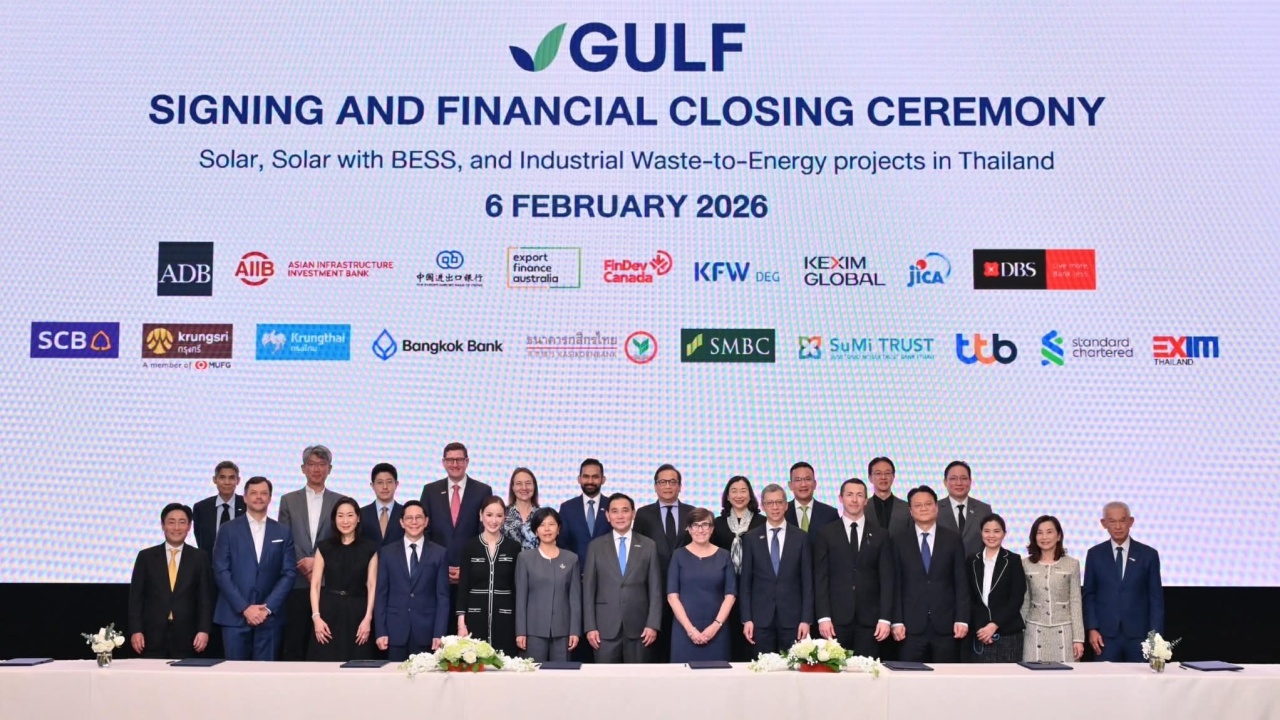
GULF has successfully secured a loan of 60 billion baht, approximately 1.9 billion US dollars, to invest in renewable power plant projects with a total contracted electricity capacity of 939 megawatts.
On 6 Feb, reporters reported that Gulf Development Public Company Limited (GULF) successfully secured a 60 billion baht loan to develop 27 renewable power plant projects with a total contracted capacity of 939 megawatts. These include 15 solar power plants and solar power plants combined with energy storage systems, totaling 843 megawatts, and 12 industrial waste power plants totaling 96 megawatts. These projects are through subsidiaries Gulf Renewable Energy Company Limited and Gulf West To Energy Holdings Company Limited. This marks a significant step in driving GULF’s strategy to reduce greenhouse gas emissions and its goal to achieve Net Zero Emissions by 2050, while promoting clean energy use to support the country’s sustainable energy transition.
The 15 solar power plants and solar power plants combined with energy storage systems have a total contracted capacity of 843 megawatts, scheduled for commercial operation between 2024 and 2026. Their total investment exceeds 43 billion baht, or about 1.3 billion US dollars, supported by leading financial institutions both domestic and international. The Asian Development Bank (ADB) serves as the mandated lead arranger and bookrunner, with co-financing from the Asian Infrastructure Investment Bank (AIIB), Deutsche Investitions- und Entwicklungsgesellschaft (DEG), Development Finance Institute Canada (FinDev Canada), Export Finance Australia (EFA), Export-Import Bank of China (CEXIM), Japan International Cooperation Agency (JICA), KEXIM Global (Singapore) (KGS), Bangkok Bank, Krungsri Bank, Export-Import Bank of Thailand, Kasikornbank, Krungthai Bank, Siam Commercial Bank, Sumitomo Mitsui Banking Corporation, Bangkok Branch, Sumitomo Mitsui Trust Bank (Thai), and DBS Bank. Of these, 12 projects with a total contracted capacity of 649 megawatts are already commercially operating. The remaining 3 projects, totaling 194 megawatts, are under construction and expected to begin commercial operation in 2026.
Additionally, GULF is promoting a circular economy through developing 12 industrial waste power plant projects with a total contracted capacity of 96 megawatts, scheduled for commercial operation in 2027. These projects focus on sustainably converting industrial waste into energy, reducing reliance on landfilling, and improving waste management efficiency. They have secured long-term loans totaling about 17 billion baht (approximately 550 million US dollars) from development finance institutions including ADB and AIIB, as well as leading commercial banks such as Siam Commercial Bank, Krungsri Bank, TMBThanachart Bank, Sumitomo Mitsui Banking Corporation, Bangkok Branch, and Standard Chartered Bank.
Mr. Sarath Ratanavadi, Chief Executive Officer of GULF, expressed gratitude to Multilateral Development Banks (MDBs), Development Finance Institutions (DFIs) such as ADB, and leading domestic and international commercial banks for their loan support. He said this reflects the confidence financial institutions have in GULF. Currently, GULF is developing projects covering solar power plants, solar power plants combined with energy storage, wind power plants, hydropower plants, and waste-to-energy power plants. This financial support confirms the shared commitment to advancing clean energy aligned with Thailand’s decarbonization policy to achieve Net Zero Emissions by 2050.
Mr. Aaron Batten, Director of the Asian Development Bank (ADB) Thailand Office, stated that as the Sole Mandated Lead Arranger and Bookrunner for the renewable energy project group and as Environmental and Social Coordinator for the industrial waste power plant projects, ADB is proud to play a key role in supporting this financial transaction. The support from ADB reflects the important role of private sector investment in helping Thailand achieve its renewable energy targets. This collaboration also marks an important step toward driving a sustainable long-term energy system for the region.
Mr. Krit Chantharotok, Chief Executive Officer of Siam Commercial Bank, said the bank is very pleased to support the GULF Group in implementing comprehensive sustainability projects, from large-scale renewable energy projects such as solar power plants and solar power plants combined with energy storage systems, to industrial waste power plants that play a significant role in driving sustainable development. This support reflects the bank’s commitment to promoting a circular economy and innovative infrastructure that addresses both waste management challenges and the growing demand for low-carbon energy. The project’s financial structure serves as a model for future environmental projects and underscores that industrial sustainability and financial returns are closely linked and can be effectively pursued together within the rapidly changing Thai energy market context.