

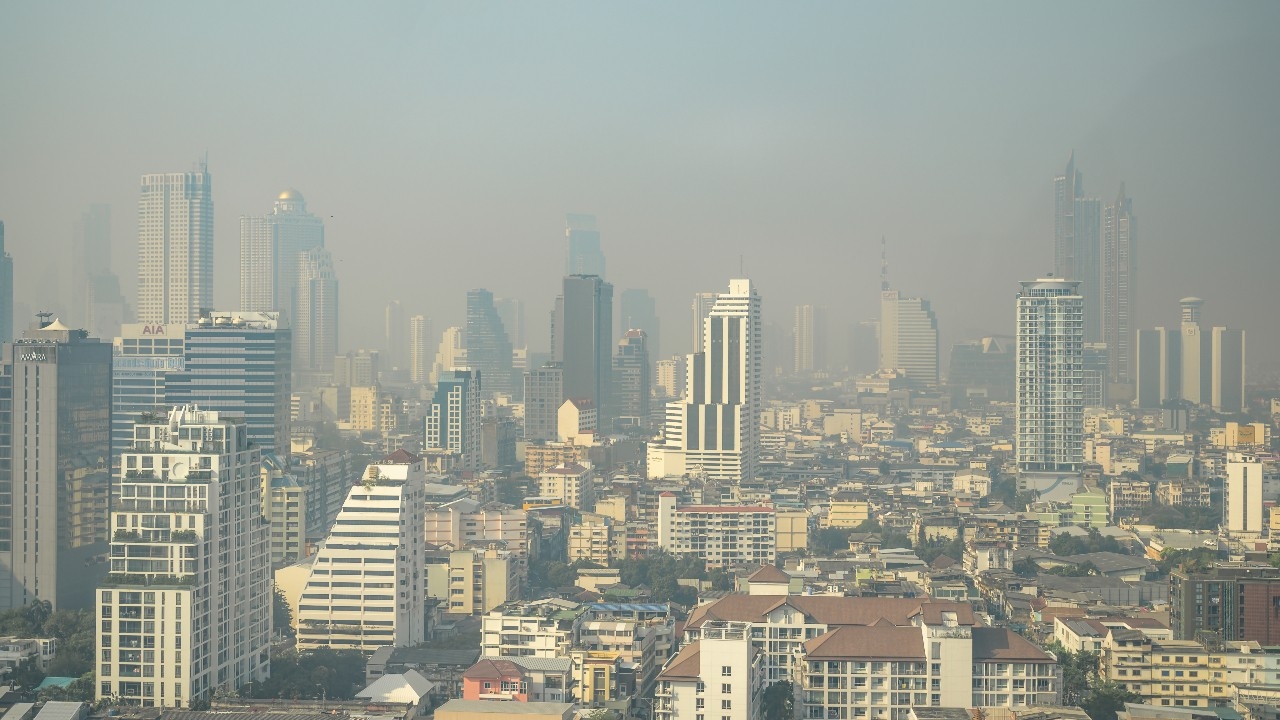
Check today's air pollution on 14 Feb 2026: Bangkok must remain cautious as PM2.5 levels exceed the standard at the orange level, starting to affect health in four areas.
On 14 Feb 2026, the Bangkok Air Quality Information Center reported the PM2.5 dust particle situation from Bangkok's air quality monitoring stations at 07:00. The 24-hour average PM2.5 level was recorded.
Measurements ranged from 16 to 39.1 micrograms per cubic meter (µg/m³), exceeding the standard at the orange level, which begins to affect health (standard limit is 37.5 µg/m³) in four areas, which are:
1. Lat Krabang District, in front of Nakharaphiban Hospital: measured at 39.1 µg/m³.
2. Prawet District, in front of Seacon Square Department Store: measured at 38.5 µg/m³.
3. Laksi District, inside the Laksi District Office: measured at 38.2 µg/m³.
4. Nong Chok District, in front of the Nong Chok District Office: measured at 37.7 µg/m³.
The air quality index from Bangkok monitoring stations is mostly at a moderate level.
The Meteorological Department forecasts that Bangkok will have light fog in the morning, with some light rain in certain areas.
Health advisory: Orange air quality level means health impacts are beginning to appear.
Related factors (forecast meteorological conditions affecting PM2.5) from 14 to 22 Feb: Air ventilation is rated "weak/good" with near-surface atmospheric layers alternating between open and closed, influenced by southern winds, reducing dust accumulation. Today's forecast includes partly cloudy skies with morning fog and some light rain in places.
Satellite hotspot data from NASA shows no abnormal heat spots detected on the Earth's surface in Bangkok.
The Environment Office has coordinated with all relevant agencies to intensify enforcement of the dust pollution control plan to mitigate the severity of PM2.5 pollution and its health effects. It also encourages public and sector participation by changing behaviors and reducing dust-generating activities through “5 ways to reduce dust you can do”: 1. Regularly clean the house by dusting; 2. Avoid burning trash or incense; 3. Plant trees to absorb pollutants and trap dust; 4. Use public transport; and 5. Turn off engines when parked and maintain vehicles to prevent excessive black smoke.
Public warnings and information dissemination encourage people to check air quality before leaving home via:
If people spot pollution sources, they can report tips via Traffy Fondue.


