

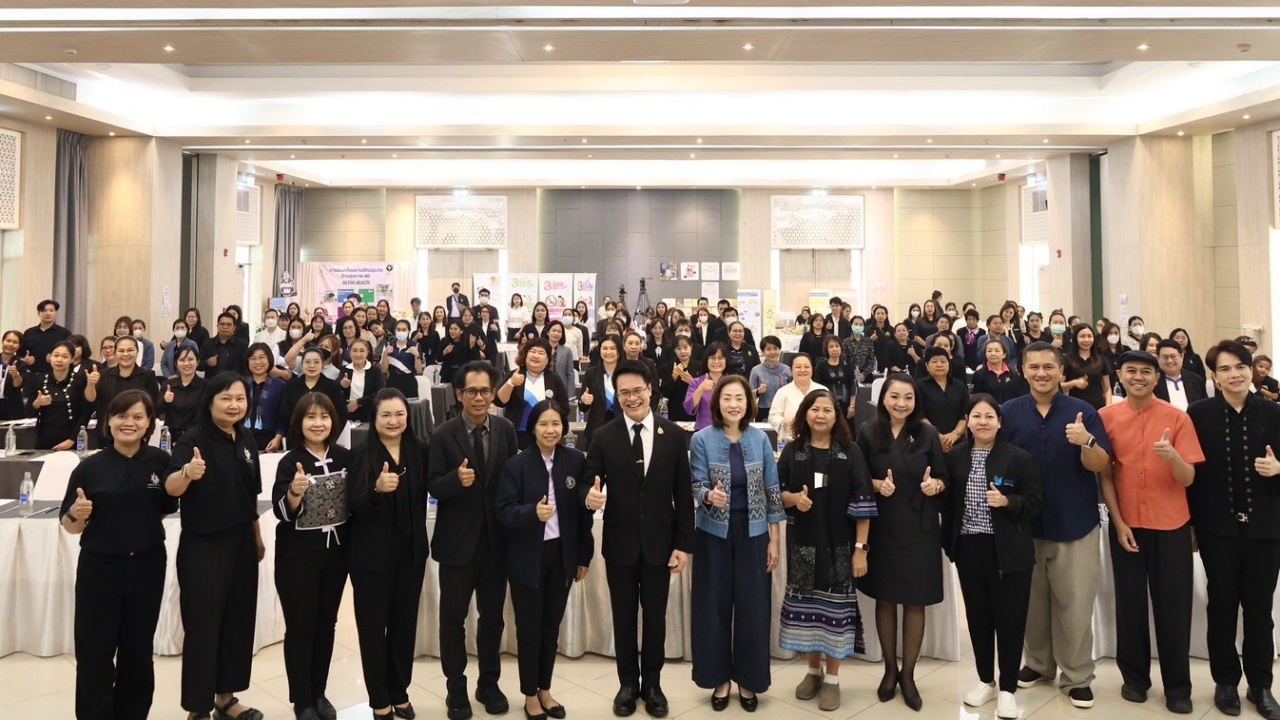
The Office of the Education Council teams up with northern networks to advance the “3 Accelerate 3 Reduce 3 Increase” policy to combat the development crisis, promoting the 4H concept: Head – Hand – Heart – Health to revitalize early childhood development in the digital age.
On 2 April 2026, Dr. Supachai Janpum, Deputy Secretary-General of the Education Council, chaired the opening of a workshop meeting focused on driving policy implementation. “3 Accelerate 3 Reduce 3 Increase” to promote early childhood development at the regional level. The event included Dr. Suangmon Sittisaman, an expert on the Early Childhood Development Policy Committee specializing in mass communication, along with specialists from early childhood development agencies joining forces with networks from government, private sector, independent organizations, and civil society. Also attending was Ms. Patcharaporn Kritjadjindarung, Director of the Early Childhood Development Policy Office. The meeting took place at Green Lake Resort Hotel, Chiang Mai Province, and was simultaneously broadcast live via Facebook and YouTube channels. “Education Council” and “Early Childhood Thailand”
Dr. Supachai stated that the Office of the Education Council (OEC) collaborates with central and regional early childhood development agencies to hold this meeting to enhance knowledge and skills among teachers, caregivers, and related partners to restore development in young children affected by economic and social crises, especially digital technology. He emphasized that the 0–6 years age range is the golden period for building brain foundations, particularly the frontal lobe. Investing in young children during this time yields the highest long-term social returns through the concept 4H: Head – Hand – Heart – Health. Enhancing young children's brain power is not the responsibility of any single agency but requires cooperation from all sectors to nurture Thai children who can think critically, learn effectively, and adapt amid the challenges of the crisis era.
An academic forum to drive the policy “3 Accelerate 3 Reduce 3 Increase” toward regional implementation was conducted by Dr. Suangmon Sittisaman, an expert on the Early Childhood Development Policy Committee; Ms. Wanichata Chotiwisithkul from Chiang Mai Education Office; Associate Professor Dr. Juthamas Chotibang; and Mr. Tham Chueasthapanasiri from Mahidol University. They jointly presented guidelines for adapting the policy to local contexts, creating learning environments conducive to development, and reducing risk factors that hinder growth. Their aim was to establish a strong foundation for early childhood quality growth and sustainable adaptation to change, while extracting lessons from policy implementation efforts.
The “3 Accelerate” focus on accelerating development recovery. Accelerate screening and monitoring of child development by integrating cooperation between early childhood development centers and public health services to identify at-risk children and provide timely assistance. Accelerate promotion of quality active learning and play skills. Accelerate systematic support for nutrition and mental health for children and families.
The “3 Reduce” focus on reducing risk factors affecting development. Reduce family stress through counseling and building parent networks. Reduce screen time by promoting creative activities to replace excessive digital media use. Reduce educational inequality by allocating resources equitably, especially in vulnerable areas.
The “3 Increase” aim to build life resilience. Promote learning through play to develop brain and emotional skills. Increase the role of family as the first learning environment. Support parents in gaining knowledge and skills to care for their children. Encourage community collaboration so all sectors participate comprehensively in child care. Addressing the early childhood crisis requires integrated public policies, family support, and genuine community involvement.
Additionally, the Chiang Mai model was presented, which adopts a proactive approach through the Lanna Child 4D Model covering dental health, development & play, diet, and disease prevention. This integrates well-being and family systems (SEL & Well-being) to foster social and emotional skills, alongside a parental skills development project. The policy has been adapted to balance the learning ecosystem for teachers and learners by accelerating life skills, enhancing teachers, and creating opportunities; reducing teacher workload, rote memorization, and inequality; and increasing learner quality, happiness, and participation. The goal is for Chiang Mai children to grow appropriately, happily, and equitably.
In the afternoon, activities unlocked “4 Powers to Build Early Learning Brains” through Mini Workshops and Mini Lectures promoting the concept 4H: Head – Hand – Heart – Health, covering reading, play, emotional learning, and brain, body, and mind well-being of young children to enhance learning potential in the digital world as follows:
Head: The wonder of reading — boosting brain power and learning potential, demonstrated by Ms. Sudjai Promkerdchaiyarit Srirotthirit. She presented activities promoting reading picture books, stories, and storytelling to stimulate brain function, language skills, concentration, and imagination. Regular reading aloud is a tool to stimulate brain structures and imagination, including setting up book corners in early childhood centers and kindergartens. Techniques for lively storytelling form the foundation for developing language, memory, concentration, and imagination skills essential for future educational success. Reading is not just teaching children to recognize letters but building conversation, bonding, and inspiration. Children growing up with books tend to have analytical thinking skills and a rich vocabulary for communication.
Hand: Play changes the world — brain development through free play, demonstrated by Ms. Tattiya Likhitwong and Ms. Sunee Saramit. They showed activities using diverse loose parts, which are open-ended play materials allowing children to imagine and connect ideas without limits, discovering new things and unique experiences freely. Examples of loose parts include twigs, leaves, flowers, fruits, stones, tissue cores, and recycled materials. Free play is not just a pastime but a vital tool for brain skill development. Creating with natural materials helps children learn through direct experience, fostering creativity and self-confidence. Therefore, children should be given safe, age-appropriate opportunities for free play, as play is the best form of learning for children.
Heart: From Head to Heart — children's media and learning emotions and feelings, presented by Mr. Narongphat Tosayanon and Mr. Rat Champamoon. They explained that emotions affect early childhood learning and relate to the development of the frontal brain that governs emotions and behavior. Caregivers should select appropriate media, music, sounds, and communication to provide safe experiences that support brain development. Children's media play a key role in shaping thoughts and feelings. Discussing emotions, teaching empathy, and adults modeling good behavior help children grow emotionally stable and adapt well to various situations.
Health: Digital health — brain, body, and mind health of young children in the digital era, explained by Mr. Tham Chueasthapanasiri. He delved into Digital Health and Digital Literacy for young children, noting that as technology becomes part of daily life, screen-based child-rearing reduces interaction with the real world, potentially leading to pseudo-attention deficit and hindering frontal brain function.
Therefore, children's health includes digital well-being affecting brain and emotional development. Building digital intelligence is not about banning technology but creating resilience by reducing screen time and increasing creative activities. When parents watch media together and discuss content with children, it helps them distinguish reality from media representations, ensuring quality and safe growth for young children in the digital world.
At the end, the meeting summarized the approach to driving the “3 Accelerate 3 Reduce 3 Increase” policy to promote early childhood development toward regional implementation. The Office of the Education Council and partner networks emphasized that the key to policy success is integrating cooperation among home, school, and community. They stressed the need to rapidly build correct understanding among parents and teachers about the critical golden learning period, while increasing opportunities and creative spaces aligned with young children's nature to jointly build a strong foundation for the country's future. Interested parties can watch the discussion replay via the Education Council and Early Childhood Thailand Facebook and YouTube channels.