

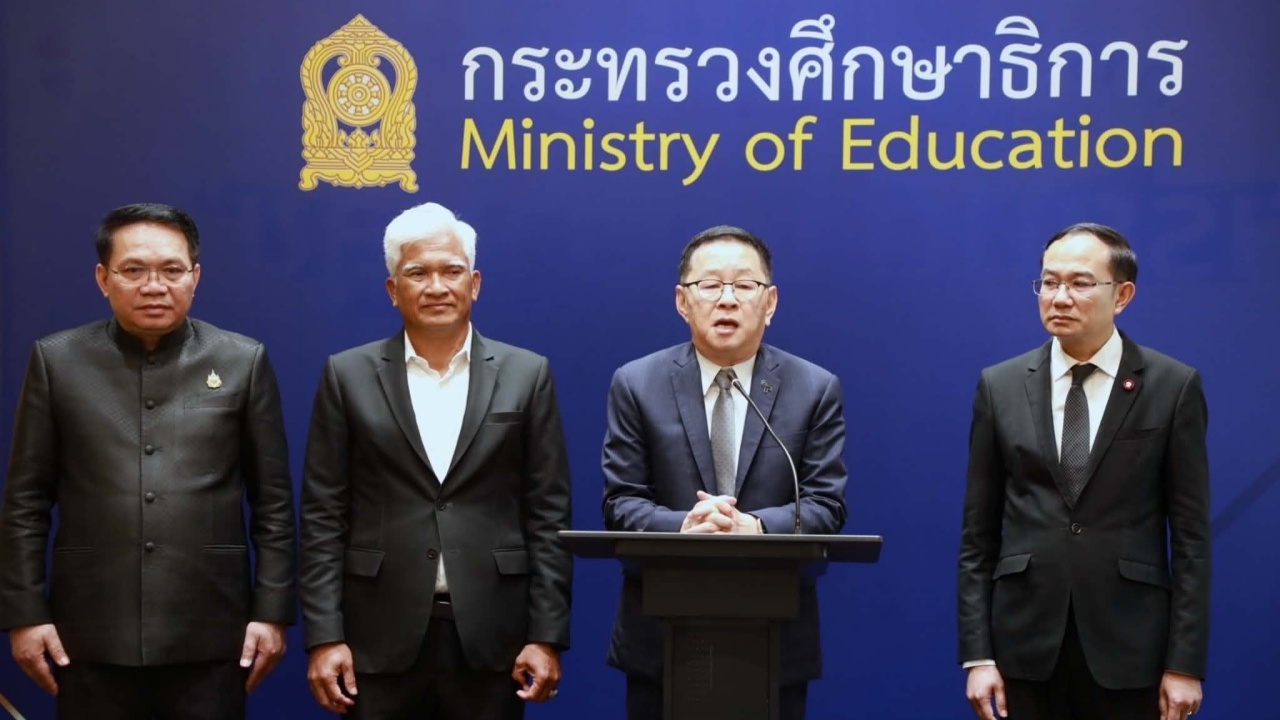
The Minister of Education led a meeting to gather opinions to advance the new draft of the National Education Act, initially establishing three frameworks for feedback.
On 8 May, reporters reported that Minister of Education Prasert Chanruangthong chaired a consultation meeting to advance the draft National Education Act B.E. ... Associate Professor Dr. Prawit Erawan, Secretary-General of the Office of the Education Council (OEC), facilitated the meeting. The session included experts, Ministry of Education executives, and representatives from various sectors—political parties, government, private sector, civil society, and stakeholders—held at the Rajavallop meeting room, Ministry of Education, Bangkok, alongside an electronic media broadcast.
Associate Professor Dr. Prawit stated that, following the joint parliamentary session (regular session 1), five key missions for a new phase of Thai education were identified: teacher workload, budget inequality, curriculum and teaching management, school safety, and the National Education Act B.E. ... The Office of the Education Council, responsible for proposing policies, plans, and national education standards, developed three frameworks for proposing the draft National Education Act to find a consensus for moving forward:
Approach 1 confirms submitting the draft No. 660/2564 with additional remarks, avoiding the need to restart the legislative process and enabling faster progress, since it has already been reviewed by the Legislative Drafting Committee. However, the draft law containsseveral problematic provisions.
Approach 2 involves amending the 1999 Act by reinforcing its weaknesses and strengthening it to be an effective educational constitution, followed by a renewed legislative process that may take less time than starting anew.
Approach 3 is to draft a completely new law, starting from scratch with drafting, consultation, proposal, and review, resulting in a concise, flexible law aligned with modern educational management contexts.
Reporters added that the meeting included wide-ranging exchanges aiming to finalize the new law as quickly as possible, highlighting challenges for each approach, suggesting additional ways to creatively integrate efforts, establish special committees, promote broad participation, allow flexibility in legal adjustments to keep pace with social and technological changes, and link subsidiary laws and policies related to knowledge in teaching and curriculum updates consistent with current global realities in collaboration with relevant agencies.
Finally, Minister Prasert said in a closing press statement that advancing the draft National Education Act B.E. ... involves three frameworks: first, confirming the original draft previously submitted to the Cabinet but halted due to the House dissolution; second, amending the 1999 Act; and third, drafting a new law. Each has distinct pros and cons. Additionally, public feedback and alternative suggestions were invited, including establishing a special committee to expedite the new law’s progress to meet all parties’ needs and the current government’s timeline. The working group will clarify all feedback by the end of May to create a quality law with clear principles, reduce complexity for easier implementation, and aim to push the Act’s completion as soon as possible.