

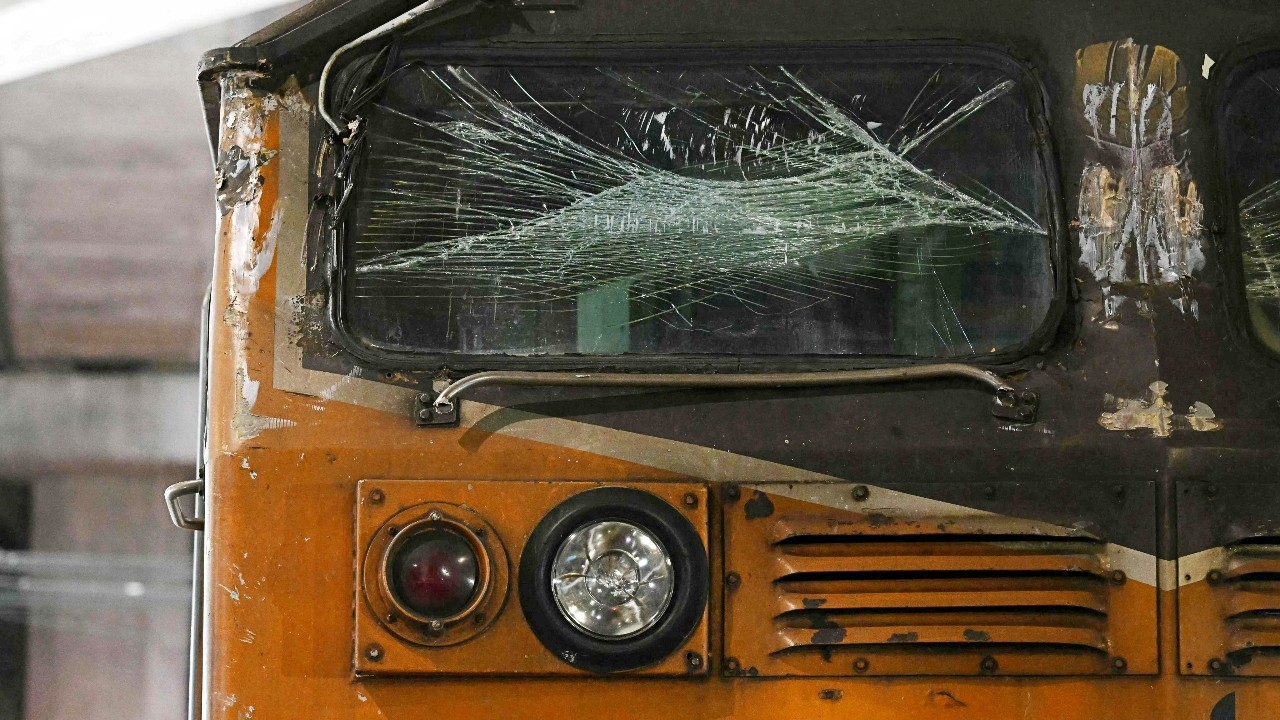
The State Railway of Thailand is preparing to order the suspension of the train driver and plans to further investigate the “engine technician.” Black box data revealed the driver applied emergency brakes only 100 meters before the collision point, whereas normally the braking distance should be around 500-600 meters.
The tragedy involved freight train number 2126 crashing into an orange air-conditioned bus (Por. 206), vehicle number 3-44197, running between Mega Bangna and Kasetsart University. The collision caused a fire, resulting in eight passenger deaths and 30 injuries, as well as damage to several vehicles. The incident occurred near Makkasan Airport Rail Link Station, on Asoke-Din Daeng Road, Makkasan sub-district, Ratchathewi district at 15:42 on 16 May, as previously reported.
On 18 May 2026, Mr. Anan Phonimdang, Acting Governor of the State Railway of Thailand, revealed that the train driver involved in the collision had tested positive for drugs in an initial screening. He said the railway authority was informed about this last night. Normally, the State Railway conducts alcohol and basic health checks before duty and records the results, but routine drug testing has not been regularly conducted.
However, following the accident, the Department of Rail Transport ordered the State Railway to promptly implement drug testing measures for all train drivers.
Mr. Anan said that until now, the State Railway has only conducted random drug tests during annual health checks and for new employees. The driver involved began working in 2023, about three years ago, and passed alcohol screening on 15 May before the incident, with no alcohol detected.
Regarding the train driver's license, Mr. Anan explained that previously the State Railway issued licenses to its drivers. But since the Rail Transport Act came into effect on 27 March 2026, drivers must apply for licenses from the Department of Rail Transport. The State Railway has submitted all employee names for licensing, which is currently being processed digitally by the department.
Concerning the black box data, Mr. Anan said this system records only speed information. The train departed from Khlong Tan Station and traveled about 2,800 meters before the crash site, maintaining an average speed of approximately 34 kilometers per hour before applying emergency brakes roughly 100 meters from the collision point.

Mr. Anan further explained that the normal braking distance for a train, including decision and standard braking distances, is about 1,000 meters at maximum speed of 120 kilometers per hour. At lower speeds, braking distance shortens proportionally to speed and train weight.
There is concern whether the driver could stop in time if he saw hand signals from crossing guards at close range. Mr. Anan clarified that drivers typically see signals from 300 to 500 meters away, while emergency braking distance is about 500-600 meters at maximum speed. Since this train was moving at about 34 kilometers per hour, factors like traffic conditions and train weight must be considered.
Mr. Anan noted that although the train was not traveling fast, standard procedure requires drivers to slow down in advance if barriers are not fully lowered or signals are not showing permission. Drivers must prepare to stop and watch for hand signals from crossing guards to ensure safe stopping in abnormal situations.
He added that according to operating regulations, drivers must obey trackside signals. When crossing barriers function properly, a signal light permits train passage. If barriers are not fully closed on both sides, the signal light will not activate, and drivers must rely on hand signals from crossing guards, similar to how traffic police use hand signals when traffic lights fail.
Initial findings showed that at the time of the accident, the crossing barriers were not lowered due to traffic congestion on the road. Consequently, the signal light did not activate, and the driver had to rely on hand signals from the crossing guard.
Regarding CCTV footage showing an official using a red flag to signal, Mr. Anan explained that officials use hand signals, flags, and lights. The image showing an outstretched arm holding a flag represents a “stop” or “do not proceed” signal.
Mr. Anan admitted that the driver not wearing a uniform while on duty was “irregular” and is under investigation, as regulations require drivers to wear uniforms during work.
On the locomotive crew structure, there is one driver and one “engine technician” who acts as the driver’s assistant, handling technical tasks and observing signals. The engine technician was on board during the accident and was injured but has since been discharged from the hospital. The engine technician may also be subject to investigation, depending on findings by the railway committee and police.
Mr. Anan said the State Railway is initially preparing disciplinary action against the driver after preliminary drug tests detected substances including cannabis and methamphetamine. Official confirmation from the hospital is awaited before further updates. Investigations of other staff involved are ongoing.