

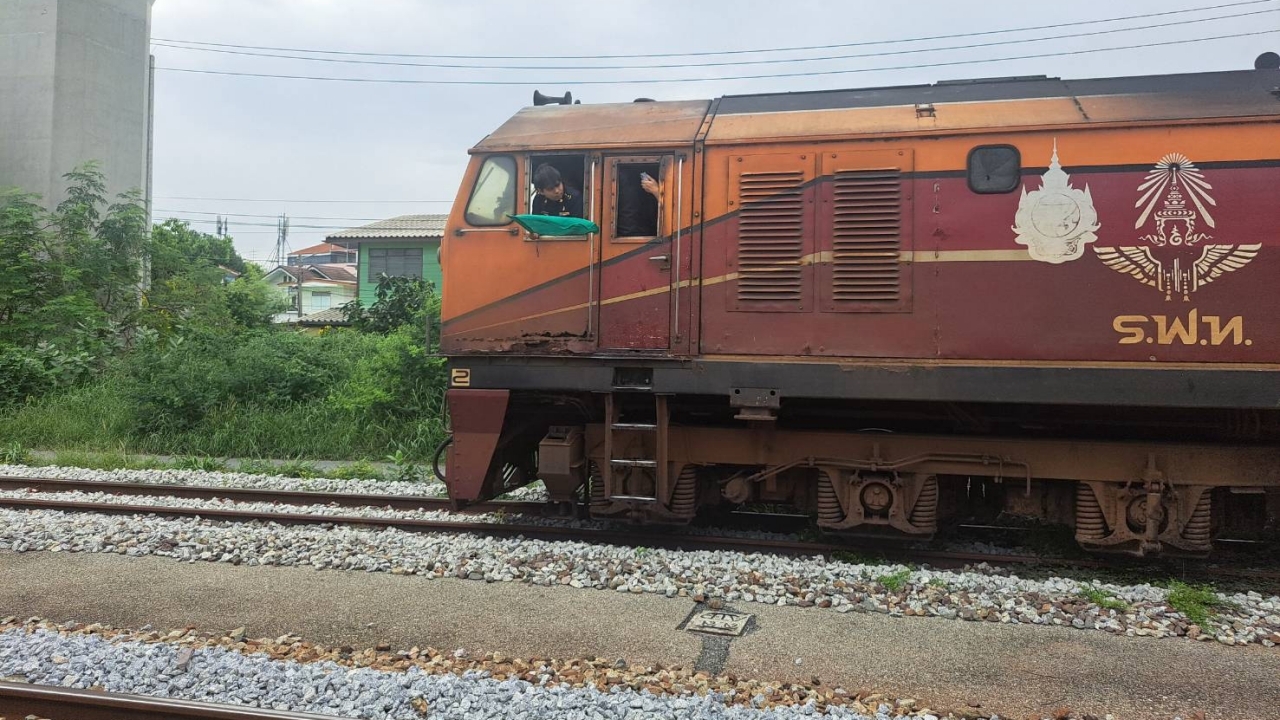
A police investigation team boarded a train to reenact the "train collides with bus" incident that caused 8 deaths, aiming to verify the facts about the visibility distance of signal flags and the speed used during train operation.
The tragic case involved freight train No. 2126 colliding with an orange air-conditioned bus (route Por.206), bus number 3-44197, running between Mega Bangna and Kasetsart University (KU), license plate 12-5641 Bangkok. The collision caused a fire, resulting in 8 passenger deaths and 30 injuries, as well as damage to several vehicles. The incident occurred near the Airport Rail Link Makkasan Station on Asoke-Din Daeng Road, Makkasan subdistrict, Ratchathewi district at 15:42 on 16 May, amid widespread sorrow.
Subsequently, Sayomporn Suangkul, 46, the train driver; Uthen Chomkiri, 57, a train operations staff member responsible for operating the crossing gates and signaling; and Lapis Thongboon, 56, the bus driver, were formally charged, as previously reported.

Update: At 13:57 on 20 May 2026, Pol. Col. Sakya Saengwan, Deputy Commander of Metropolitan Police Division 1, along with an investigative team from the same division, boarded a train to reenact the incident. They boarded at Hua Mak Station, where only railway and police personnel were allowed in the locomotive, which was coupled with one passenger carriage. The train traveled 9.2 kilometers to Asoke Station, near the accident site on Asoke-Din Daeng Road close to the Airport Rail Link Makkasan Station, taking over an hour.
During the reenactment, investigators focused on checking the visibility distances of the signal system to determine how far ahead the train driver could see various signals, including flags, signal lights, or vehicles parked on the tracks. They also examined the train's braking distance to assess how much distance the driver needed to slow and stop before reaching the station or the crossing gate booth, as well as when the crossing gate staff started signaling the driver.
Additionally, they observed the train's speed from the start of the journey through to the deceleration and braking phases before the train stopped.
The investigation team collected this data to verify consistency with the testimonies of the crossing gate controller, train driver, mechanic, and railway security staff involved with the train in question. They also compared these findings with the operating procedures of the State Railway of Thailand, focusing on the roles of the train driver and crossing gate controller. Observations included train speed management, radio communications, the distance between the train and gate before lowering the barrier, and the signaling methods used by the crossing controller with lights and flags.
For this reenactment, the investigation team divided personnel into two groups: one group observed from onboard the train, and the other observed from the railway crossing booths. The train used for the reenactment was a regular passenger train.
According to data from the State Railway of Thailand, both passenger and freight trains follow the same operational regulations.
