

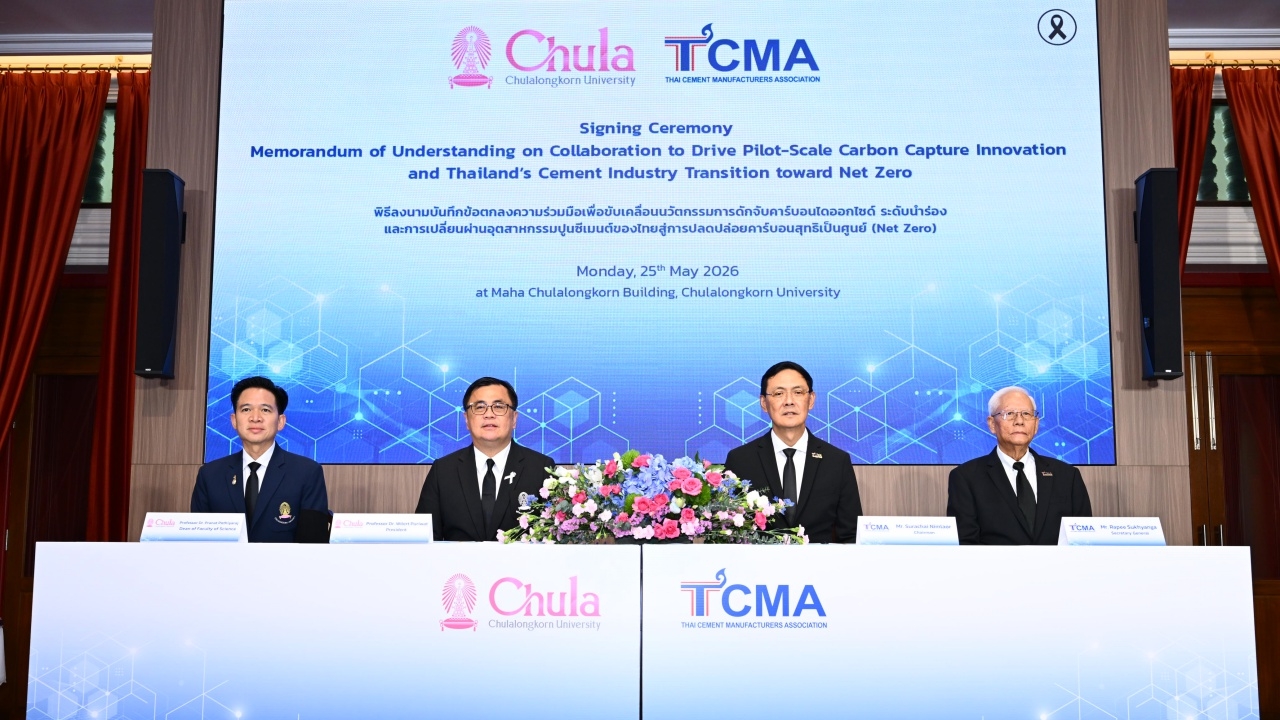
TCMA teams up with Chulalongkorn University and Thai-Canadian partners to launch a strategic collaboration establishing the foundation for a low-carbon industry toward Net Zero 2050, aiming to reduce greenhouse gas emissions and promote sustainability.
The Thai Cement Manufacturers Association (TCMA) signed a memorandum of understanding with Chulalongkorn University to advance strategic cooperation in knowledge, technology, and workforce development. Supported by international partners, this collaboration will develop and pilot carbon capture technology at the Saraburi Sandbox, before expanding to industrial-scale application and policy development. This marks a significant step toward building a national low-carbon industrial ecosystem and supporting the Net Zero 2050 goal.
Mr. Surachai Nimlaor, President of TCMA, said this cooperation reflects the proactive role of the industrial sector in driving the Climate Commitment through a Public–Private Partnership (PPP) mechanism. This links the industrial sector, academia, government, and international partners including ECCC, UNIDO, and GCCA to promote the transition to a low-carbon industry following the Thailand 2050 Net Zero Cement and Concrete Roadmap.
"The collaboration with Chulalongkorn University elevates this into a long-term platform, covering knowledge development, workforce preparation, and pilot technology trials. It is further enhanced by Canadian experts and real-world testing at the Saraburi Sandbox, which will serve as a learning area to develop scalable industry-wide approaches," Mr. Surachai said.
Professor Dr. Wiles Phurivatchara, President of Chulalongkorn University, said the collaboration highlights the university’s role as a Strategic Knowledge Partner, bridging knowledge into practical use while developing "Green Talent" to support the industrial transition.
"Chulalongkorn aims for this cooperation to serve as a strategic mechanism to strengthen knowledge bases in low-carbon technology alongside workforce development, enhancing capabilities aligned with the transition direction and supporting a long-term green economy," the university president said.

Ms. Ping Kidnigor, Canadian Ambassador to Thailand, said Canada is pleased to support this collaboration, reflecting international climate cooperation and the longstanding relationship of over 65 years between the two countries.
"This partnership encompasses the transfer of knowledge, technology, and experience in greenhouse gas reduction, especially supporting experts and workforce development, linking to real industrial trials and applications. Carbon capture technology will bridge innovation and practical use to drive a low-carbon economy," Ambassador Ping said.
From the government sector, Dr. Pirun Saiyasitpanich, Director-General of the Department of Climate Change and Environment, said the cement industry is a key sector for greenhouse gas reduction to achieve Net Zero 2050 while enhancing Climate Resilience.
"This cooperation serves as a policy mechanism connecting projects at the national level, using the Saraburi Sandbox as a testing and development base to ensure outcomes can effectively inform policy and be scaled up," Dr. Pirun said.
Mr. Teerathat Isarangkul Na Ayutthaya, Deputy Director-General of the Department of Industrial Works, said this collaboration aligns with the "One MIND" policy that integrates regulatory oversight with promoting green industry. The department is ready to support this partnership to develop a scalable model at the industrial level to enhance the country's competitive capabilities.
Dr. Chana Phumee, Honorary President of TCMA and Chairman of the ASEAN Federation of Cement Manufacturers (AFCM), said this cooperation is an important step elevating Thailand as a regional model for carbon reduction in the industrial sector.
"Integrating collaboration through PPP that connects all sectors with technology development, knowledge, and workforce from policy to pilot testing will form the foundation of a Low-Carbon Industrial Ecosystem and establish a scalable systemic model," Dr. Chana said.
This cooperation marks the beginning of developing Thailand’s low-carbon industrial ecosystem by linking knowledge, technology, innovation, workforce, and policy into practical use and commercial scaling. It aims to accelerate the transition to a low-carbon economy, enhance Climate Resilience, and boost the country’s competitiveness amid a global economy increasingly focused on sustainability.