

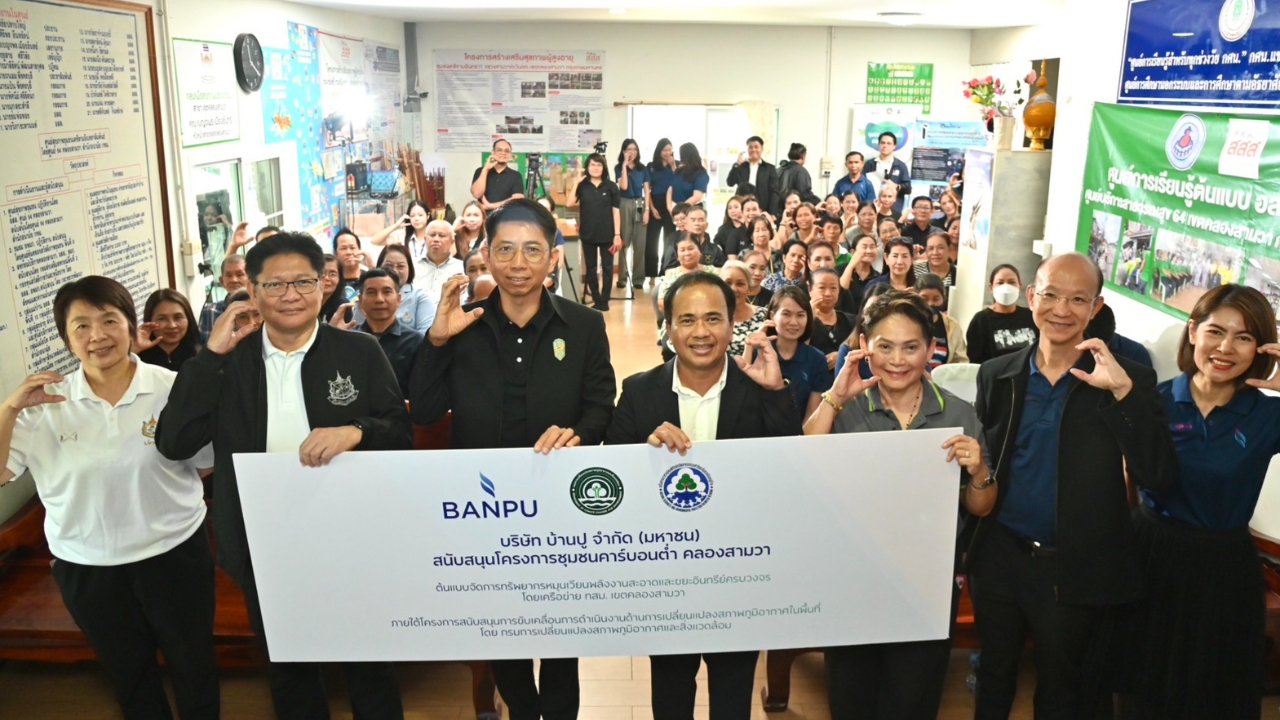
The Department of Climate Change and Banpu promote low-carbon communities by installing solar panels and setting up organic waste management points in Khlong Sam Wa, addressing household-level global warming issues with plans to expand to other areas.
On 25 June 2026, the Department of Climate Change and Environment, Ministry of Natural Resources and Environment, together with Banpu Public Company Limited, a leader in diversified energy, delivered the “Low-Carbon Community Project in Khlong Sam Wa” to members of the Khlong Sam Wa Volunteer Network at the KC1 Village Community Learning Center, Khlong Sam Wa District, Bangkok. This pilot project arose from a collaborative mechanism between government, private sector, and civil society to support climate change action at the local level (Thailand Climate Action Conference: TCAC). The Village Volunteer Network (ทสม.) of Khlong Sam Wa is the main body driving and managing the area to create a tangible low-carbon urban community model.
Mr. Komet Phutsason, Deputy Director-General of the Department of Climate Change and Environment, said, “The KC1 Community Learning Center project is a prototype of a ‘self-managed community’ actively addressing global warming at the household level. The department plans to expand this project to encourage similar collaborations in other areas to build the country’s resilience to climate change through public participation. As a policy regulator and promoter, we thank Banpu Public Company Limited and the KC1 Village community for supporting Thailand’s climate change efforts.”
Over an eight-month period from November 2025 to June 2026, Banpu provided funding and expertise to reduce greenhouse gas emissions by installing a 5-kilowatt solar rooftop system, cutting emissions by approximately 2,400 kilograms of CO2 equivalent per year. Simultaneously, the project established demonstration points for household organic waste management using innovative compost bins and black soldier fly larvae (BSF) setups. This reduces organic waste volume, ultimately lowering landfill methane emissions, while promoting technical and academic mentorship to advance activities locally.

Mr. Jirameth Atcha, Assistant Chief Executive Officer for Corporate Management and Development at Banpu Public Company Limited, stated, “Banpu is pleased to help drive the Department of Climate Change and Environment’s project to promote renewable energy. This aligns with Banpu’s carbon reduction goals and commitment to building a better society. KC1 is a strong and united community, and we hope everyone will fully benefit from the solar system and organic waste management points.” The Low-Carbon Community Project in Khlong Sam Wa reduces the learning center’s common electricity expenses by over 24,000 baht annually, freeing funds for elderly care and vocational training for local housewives, health volunteers, and residents. Ms. Benjaporn Muang-in, Chairwoman of the Khlong Sam Wa Volunteer Network, shared, “Beyond clean energy powering activities at the center, household food waste is diverted from landfills to become high-quality biofertilizer, reducing urban agriculture costs. The community is cleaner, healthier, more united, and everyone feels proud to contribute to combating global warming.”
The collaboration of these three sectors in developing the “Low-Carbon Community in Khlong Sam Wa” not only strengthens public efforts against global warming but also elevates the KC1 Village Community Learning Center as a model for clean energy management and organic waste handling at the source. This supports Thailand’s master plan for carbon neutrality and sustainable urban development.

