

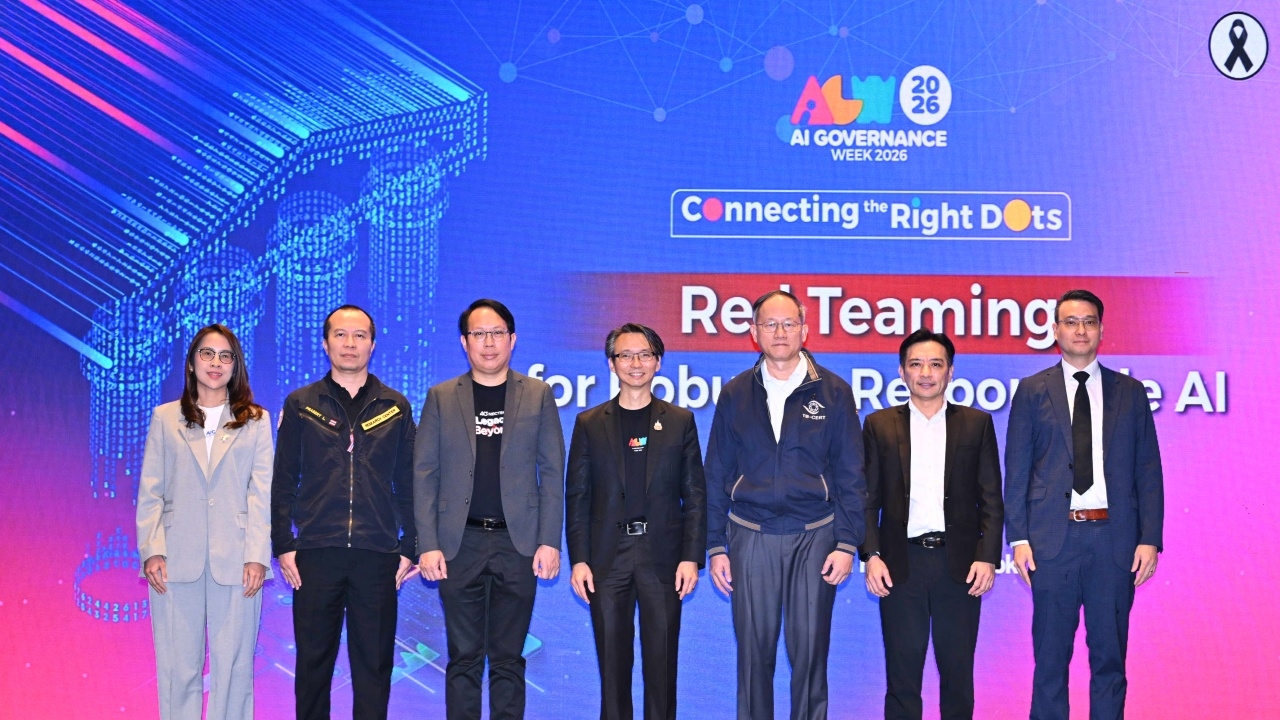
ETDA marked the close of AI Governance Week 2026 by hosting Thailand’s first-ever "AI Red Teaming" platform, engaging the banking, technology, and cybersecurity sectors to identify AI vulnerabilities and strengthen trust in the financial industry.
On 3 July 2026 GMT+7, the Electronic Transactions Development Agency (ETDA) under the Ministry of Digital Economy and Society, through its AI Governance Center (AIGC), partnered with the National Electronics and Computer Technology Center (NECTEC), the Banking Sector Computer Emergency Response Team (TB-CERT), and the National Cybersecurity Agency (NCSA) to present the "Red Teaming for Robust and Responsible AI" event, a key activity on the final day of AI Governance Week 2026 held at the Mandarin Hotel, Bangkok.
The event provided a platform for policymakers, regulators, banking and technology sectors, and AI security experts to exchange approaches on testing and enhancing AI system safety—especially within the financial sector, a critical system affecting the public and national economy—through knowledge sharing on identifying AI blind spots, particularly in large language models (LLMs) increasingly used in financial services.
Additionally, the Thailand Banking AI Red Team Challenge 2026 simulated AI system tests to uncover risks, weaknesses, and vulnerabilities, aiming to elevate AI safety in finance and establish practical AI governance frameworks at the national level.

Dr. Chaiyachana Mitraphan, Director of ETDA, stated that AI today is not just a tool for improving efficiency but is integrated into vital processes across sectors, including public services, data analysis, decision support, and financial services, all involving critical data, citizens' rights, and societal trust.
Therefore, governing AI with good governance principles cannot stop at policies or guidelines alone; there must be mechanisms to effectively test whether developed AI systems are safe, trustworthy, fair, and capable of managing potential risks.
Throughout the past week, AI Governance Week 2026 connected key AI governance elements, from international regulatory dialogues and ethical impact assessments (EIA) to organizational readiness for responsible AI use, legal discussions, education, and AI applications in key national sectors, demonstrating that AI governance requires integrated policies, standards, tools, capacity building, and cross-sector collaboration.
Today, we are linking another crucial component: proactive AI system testing to simulate risk scenarios, identify blind spots, risks, and vulnerabilities before real-world deployment—known as "AI Red Teaming."
One major AI challenge is "Blind Spots," unseen system weaknesses during design, development, or initial testing phases, which can cause broad impacts on users, organizations, and society when AI is operational—covering system security, cybersecurity, personal data protection, fairness of outcomes, and accuracy and reliability of AI responses.
AI Red Teaming is therefore a vital mechanism enabling organizations to assess AI risks through usage scenario simulations, system behavior testing, and vulnerability identification across various dimensions before deployment, allowing early risk detection, timely system improvements, and ongoing enhancement of AI safety, reliability, and accountability.

The "Red Teaming for Robust and Responsible AI" event, the final day highlight of AI Governance Week 2026, was a significant initiative organized by ETDA in collaboration with TB-CERT, NECTEC, NCSA, and public-private partners to concretely advance AI safety testing through the Thailand Banking AI Red Team Challenge 2026—the country’s first simulation of AI system testing in the banking context, where AI and LLM adoption is rapidly growing.
This includes AI use in customer service chatbots, financial product and service analysis, and internal organizational support. The competition sought AI risks across key areas: safety, security, privacy, fairness, and reliability, assessing potential unsafe behaviors, unauthorized data disclosures, unfair results, or inaccurate, inconsistent information that could undermine user or financial system trust.
The competition was divided into two tracks, each designed to test AI risks from different perspectives: Track A—Banking AI Risk Intelligence—focused on user interaction by having contestants engage with a simulated bank AI chatbot to identify unethical AI behaviors; Track B—Capture the Flag (CTF)—emphasized technical vulnerability analysis to induce AI to reveal confidential data, termed "Flags," which the system aims to protect.
Choosing the banking sector as the starting point for AI Red Team testing is crucial because it handles citizens’ sensitive data, impacts the broader economy, and requires high trust. This testing is not merely a contest to find winners but a knowledge-gathering effort to develop best practices, build AI Red Team expertise, and foster collaboration among government, private sector, and academia toward suitable AI testing guidelines, tools, and standards.
Beyond the competition, the event featured panel discussions with experts from leading Thai and international agencies, including sessions such as "Shaping the Future of Safe and Responsible AI Development," involving representatives from ETDA, TB-CERT, NCSA, NECTEC, and AIAT, and "AI Safety in Practice: Lessons from the Frontlines," with participants from Microsoft, Google, Huawei, and IMDA Singapore sharing perspectives on managing AI risks—from implementing guardrails and system testing to establishing accountability mechanisms for safe, widespread AI use.
A key topic was building Trustworthy AI, highlighted in keynote speeches: "Building Trustworthy AI: Advancing Responsibility and Safety at Scale" by IMDA Singapore, and "Building AI Safety into Products: Guardrails and Red Teaming in Practice" by Google. These emphasized that AI safety should be embedded in product development from the start. Further, the "Ensuring AI Safety in Products: LLM Benchmarking in Practice" session, with representatives from Thai Life Insurance, TRUE, and NECTEC, underscored the importance of testing and benchmarking large language models (LLMs) for accuracy, safety, and fairness before real-world deployment.
The day concluded with the AI Red Teaming Awards Ceremony, honoring the top teams from the Thailand Banking AI Red Team Challenge 2026 who most effectively identified AI risks, weaknesses, and vulnerabilities. The competition’s results will be essential for developing benchmarks, risk assessment guidelines, and AI testing standards applicable to the financial sector and extendable to other industries.
The collaborative efforts during the five-day AI Governance Week 2026 demonstrated Thailand’s AI ecosystem’s strength, highlighting the importance of applying AI technology responsibly with trustworthiness, safety, and accountability as foundational principles for all organizations. It also showcased the country’s progress in establishing the AI Governance Center (AIGPC) as a national AI governance hub working with domestic and international partners to sustainably drive the digital economy and society.