

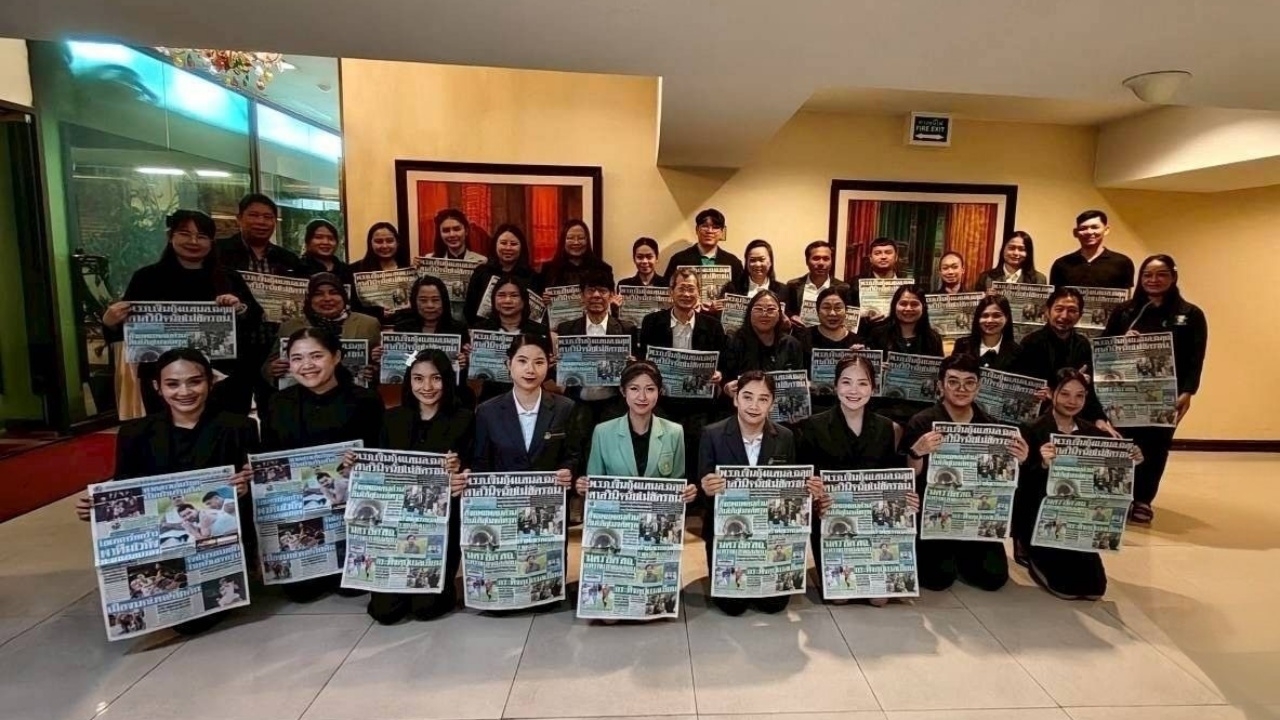
The Media Council Foundation joins forces with the Media Development Fund to continue the "Media Literacy Skills Enhancement Project for Children Using Newspapers and Online Newspapers for 2026." They held the 9th and final seminar workshop.
On 10 July 2026, at the Mit Maitri Room, Princeton Park Hotel, Din Daeng District, the Media Council Foundation, under the National Media Council, supported by the Safe and Creative Media Development Fund, organized the 9th and final seminar workshop of the Media Literacy Skills Enhancement Project for Children Using Newspapers and Online Newspapers in 2026. Mr. Damrit Wiriyakul, Regional News Editor of Thairath Newspaper, and Mr. Nattapon Thongbaeyai, Deputy Executive Editor of Thairath Online, participated as speakers.

This seminar used Thairath Newspaper as a teaching tool, involving 24 Thairath Wittaya schools, including Thairath Wittaya 82 (Khok Tong Charoen) in Nakhon Ratchasima, Thairath Wittaya 95 (Wat Pho Thong Bon) in Nonthaburi, Thairath Wittaya 11 (Ban Khae) in Mukdahan, Thairath Wittaya 49 (Ban Wong Wiang) in Loei, Thairath Wittaya 92 (Community Na Kha) in Udon Thani, Thairath Wittaya 111 (Ban Thung Nang Kaeo) in Satun, Thairath Wittaya 105 (Chueak Muay Wittaya) in Nong Khai, Thairath Wittaya 72 (Municipality 8) in Udon Thani, Thairath Wittaya 83 (Ban Huai Chot) in Sa Kaeo, Thairath Wittaya 99 (Ban Mae Suya) in Mae Hong Son, Thairath Wittaya 104 (Ban Thung Kratin) in Ratchaburi, and Thairath Wittaya 79 (Ban Nong Ab Chang) in Chiang Mai.
Also included were Thairath Wittaya 54 (Wat Sai Siat) in Phang Nga, Thairath Wittaya 31 (Thung Nao Phutthima School) in Phrae, Thairath Wittaya 55 (Wat Bot Don Phrom) in Nonthaburi, Thairath Wittaya 84 (Ban Samran Pia Fan) in Khon Kaen, Thairath Wittaya 40 (Ban Khuan Pho) in Satun, Thairath Wittaya 76 (Ban Phala) in Chumphon, Thairath Wittaya 46 (Dok Kham Tai) in Phayao, Thairath Wittaya 70 (Ban Bang Kaeo) in Samut Songkhram, Thairath Wittaya 2 (Wat Chang Yai) in Phra Nakhon Si Ayutthaya, Thairath Wittaya 80 (Wang Pring Phetphaisan) in Songkhla, Thairath Wittaya 42 (Ban Noen Rae Paiboon Rat Songkhro) in Chonburi, and Thairath Wittaya 12 (Ban Ek) in Chiang Mai.
The project held nine nationwide seminar workshops for upper primary teachers: the first on 16 June in Hua Hin District, Prachuap Khiri Khan Province; 18 June in Ubon Ratchathani; 22 June in Trat; 24 June in Songkhla; 26 June in Phitsanulok; 6-7 July in Bangkok; and the eighth on 9 July in Bangkok.
Ms. Nipawan Kaorakmuk, Vice Chairperson of the National Media Council, said the project benefits all parties: newspapers involved gain greater reader access through schools, teachers, and students; schools foster student learning activities, enhancing educational quality; teachers learn methods to integrate newspapers and online media into teaching; and students build immunity to critically understand media content.
This year’s project emphasizes summarizing learning outcomes through pre- and post-training tests, as well as joint lessons learned from teachers and student representatives, alongside the project team and editors from newspapers and online media, strengthening network collaboration.
Associate Professor Surasit Wityarat, project leader, said this is the second consecutive year of the project, which has structured activities and content into 20% promoting reading, 50% media literacy skills, and 30% applying media literacy skills in daily life.
They will also conduct lessons learned with teachers, students, and network partners, especially fifth-grade students—the main target group—to assess whether media literacy skills have improved after participating, aiming to develop and expand the project further.
Importantly, the project focuses on building capacity among educational personnel by scheduling nine teacher training sessions nationwide for upper primary educators, with at least 150 teachers participating. The goal is for teachers to integrate acquired knowledge into classroom instruction, ultimately ensuring at least 3,000 participating students genuinely develop daily media literacy skills.